Table of contents:
- Letter from the editor
- Therapy Garden: A Grassroots Mental Health Movement Takes Root in Ann Arbor
- The Benefits of Yoga: A Chat with a Local Instructor
- Ann Arbor Yoga Studio Round-Up
- Art Therapy: What It Is and Where to Find It in Ann Arbor
Letter from the editor
Community building is a crucial tool in supporting and improving mental health. In this issue, we highlight Therapy Garden, a local resource that fosters connection and conversation among mental health professionals in Ann Arbor.
We also explore how physical wellness can impact mental health, with a focus on yoga. Through a conversation with a local instructor and a roundup of area studios, we look at how movement and mindful practice can support both the body and the mind.
Thank you for reading,
Mary Genson
Assignment editor
Therapy Garden: A Grassroots Mental Health Movement Takes Root in Ann Arbor

By Donna Iadipaolo
At first glance, the work of a therapist is deeply relational. Conversation, emotional attunement and human connection define each day.
Yet for many therapists, especially those in private practice, the profession can be paradoxically isolating. Private offices, independent caseloads and packed schedules often mean limited interaction with colleagues who truly understand the emotional weight of the work.
In Ann Arbor, that quiet isolation is beginning to give way to something new: a growing, grassroots professional community called Therapy Garden. Founded by licensed professional counselor Joanne Jonna, this organic movement is bringing together therapists, psychiatrists and allied mental health professionals for connection, collaboration, conversation—and something increasingly rare: belonging.
A quiet return to the field
Jonna’s career path reflects both commitment and evolution. After earning her master’s degree in counseling in 2008, she began her work in educational settings, serving as both a teacher and a school counselor. Like many professionals, she chose to step away to raise her children, which shifted her path. That time allowed space for growth, clarity and an eventual return to the field with renewed intention.
“I earned my master’s degree in counseling in 2008 and spent the early part of my career as both a schoolteacher and school counselor,” Jonna said. “After taking time away from professional work to raise my children, I returned to the mental health field with a renewed focus on clinical practice. Most recently, I founded Wildflower Mental Health Therapy, my own private practice, where I work with children, teens and adults navigating anxiety, grief, trauma, identity and life transitions.”
It was in this return—paired with her expanding work in private practice—that Jonna began to notice a missing link, not in the clinical process itself, but in the professional environment surrounding it.
Therapists, she realized, were often going it alone.
The seed of an idea
The concept of Therapy Garden grew naturally from a simple idea: creating space for connection among local mental health professionals. Jonna recognized that even small gatherings could make a meaningful impact.
“I founded Therapy Garden to support and connect local mental health professionals in an organic, community-driven space,” Jonna said. “I offered to host a gathering at the Ann Arbor Club, where I’m a member. That event drew over 25 therapists, psychiatrists and affiliates from across the region.”
By offering a consistent, central and welcoming location in downtown Ann Arbor, Jonna created a physical place for something that had been missing for so long: shared space.
Coffee, conversation and community
As the gatherings continued, they naturally evolved into a regular, structured experience. The group became known as Coffee & Connect, a monthly or bi-monthly event held at the Ann Arbor Club. Jonna co-hosts the sessions with Dr. Harry Rai, MD (psychiatrist, psychotherapist, and owner of Dharma Psychiatry PLLC), and the sessions grew into an intentional blend of warmth and professional depth.
“My husband, Vincent Jonna, helps facilitate the event and bakes healthy, homemade snacks for our guests, which has become a favorite part of the experience for many attendees,” Jonna said. “Together, we’ve created a space for therapists to build relationships, share ideas, spotlight clinical expertise and support one another professionally and personally.”
These gatherings aren’t built around formal presentations or rigid agendas. Instead, they are intentionally welcoming—rooted in authenticity rather than expertise alone. The consistent presence of homemade snacks, hot coffee and familiar faces helps shift the tone away from competition and toward care.
Why connection matters
In a field built on holding space for others, therapists rarely have an opportunity to be held themselves. Jonna understood that the emotional labor of the profession required an outlet—not just for learning, but for genuine human connection.
“The movement was inspired by a simple but powerful need: connection,” Jonna said. “Many therapists, especially those in private practice, work in isolation without built-in peer support. Therapists keep coming back because it offers something we rarely get in clinical settings: genuine community. It’s a place where we can celebrate each other’s strengths, process challenges, and stay inspired in a field that requires so much giving.”
Therapy Garden is not built on hierarchy or professional ranking. Instead, it is grounded in mutual respect, vulnerability and shared purpose. Clinicians in different disciplines and specialties come together, not as competitors, but as collaborators within the same ecosystem.
What happens at Coffee & Connect
Each session maintains a loose structure to ensure engagement while leaving plenty of room for organic conversation and spontaneous discussion.
“Each meeting begins with a warm welcome, followed by round-the-room introductions where attendees share who they are, what they do and any current needs, referrals, or resources,” Jonna said. “We regularly feature spotlights on individual clinicians and their specialties. At a recent event, over 20 clinicians gathered for a dialogue on how psychiatric medications can impact therapy, featuring insights from Dr. Rai and Dr. Tova Berg.”
The format intentionally changes month to month to create variety and deeper levels of interaction.
“One month, we hosted a ‘therapist speed dating’ session to spark meaningful one-on-one conversations,” Jonna said. “Another month, we led a group book discussion on No Bad Parts by Richard Schwartz. At our third gathering, we invited Reid Depowski-Knowles to lead a short presentation on Mindful ISTDP, followed by rotating mini-conversations that helped participants connect more personally.”
This variation allows attendees to engage in multiple ways: academically, personally, creatively, and emotionally. Each meeting becomes not just a networking event — but an experience.
Building toward something bigger
While Therapy Garden is still young, its long-term potential is undeniable. What is currently a gathering space may one day become a broader platform for consultation, education and advocacy.
Yet Jonna is thoughtful about preserving its original heart. “In the short term, our goal is to reduce isolation and foster authentic community among local mental health professionals. Longer term, I’d love to see the group grow into something more structured—peer consultation groups, skill-sharing workshops, continuing education, or even advocacy initiatives. But everything starts with relationships.”
Those relationships are already making a difference — not only for therapists, but for their clients as well.
“Therapists who feel supported are more grounded, creative, and well-resourced — and that directly benefits their clients. Being in a community allows us to make stronger referrals, share tools and think more systemically. A more connected and collaborative professional network strengthens the entire mental health ecosystem.”
An open invitation
One of the most unique aspects of Therapy Garden is its accessibility. There are no gatekeepers or formal barriers to participation. The initiative grows as human connection grows—through invitations, introductions and word of mouth.
“The group is open and welcoming. There’s no formal application—most people hear about it through word of mouth. I currently maintain a roster of over 100 therapists, psychiatrists and affiliated professionals, and I coordinate communication between meetings to help connect the right providers with the right needs.”
At its core, Therapy Garden is about something deceptively simple: showing up. It is built on quiet courage — the courage to invite, to gather, to stay and to connect.
“This group has reminded me that a meaningful professional community doesn’t have to be formal or institutional. Sometimes it starts with four people in a quiet room and one genuine invitation to connect. Therapy Garden is about showing up, not performing. The conversations are real, the connections are lasting and the growth happens together.”
In a world that often asks people to be more efficient, more productive and more independent, Therapy Garden gently offers a different message: You don’t have to do this alone. And in Ann Arbor, one gathering, one cup of coffee and one circle of chairs at a time, that message is taking root.
The Benefits of Yoga: A Chat with a Local Instructor
By Chelsea Devona
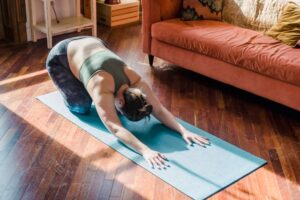
Spring is the perfect time to pick up yoga–it’s a good season for movement and flow. Yoga has lots of health benefits, both physical and mental, for adults and kids alike.
“We were all born flexible–we’re born wanting to move,” says Pavel Bednarski, yoga instructor and owner of Red Yoga studio in Ann Arbor. “But we’ve become sedentary. We just sit. When we sit in chairs all the time, we’re doing a disfavor to our skeletal formation.”
For people who are intimidated about picking up yoga, Bednarski says it doesn’t have to be complicated–you don’t have to tie yourself into a pretzel to get the health benefits. “Some people think they can’t go to yoga because they’re not flexible,” said Pavel. “But you go to yoga to become more flexible.”
Bednarski’s yoga instructor experience spans age groups, from youth to senior. When he first started teaching, he taught at five different studios, and got a position teaching at a psychiatric hospital, where he could see firsthand how yoga affected the lives of the kids, many of whom were on a variety of prescription medications already to try to help keep them under control. “But the yoga and the Tibetan bowls really calmed them down,” he said. “They loved the practice and were always excited for me to come back. When it was their last week at the hospital, they’d ask me, where can I go do more yoga?”
He’s taught chair yoga to seniors with more limited mobility and saw what a difference it made to them—cultivating the feeling that they could accomplish movement even within their limits.
University of Michigan students came into Red Yoga to do a study of how yoga affected young adults. They found that students who were practicing yoga had better mental concentration, slept better and suffered less from anxiety about exams or papers. “All this has been said before,” said Bednarski, “but it was nice to see a local study done on how it affected young adults. Better sleep and appetite? That’s awesome! When you’re doing yoga, you tend to want to eat better. When you start to take care of your body and your mind, that affects you positively.”
Bednarski said the number one question he’ll get is: will yoga help me lose weight? His answer is: not directly. He cautions people against taking up a yoga class just assuming it’ll help them lose weight. “But it will help you be more active in other areas of your life,” Bednarski said. “In other words, you’re going to take a bicycle ride, go kayaking on the Huron river, make a habit of doing something outdoors. You’ll take up a sport, go for a walk after dinner, look for healthier alternatives in food. That’s a run-off of what happens when you start practicing yoga.”
For people who are concerned about going to hot yoga because they don’t like the heat, Pavel encourages them to try it. “The heat is good because it makes it easier to move,” he said. Muscles are more pliable in the heat. Pavel didn’t care for the dry 105 temperatures at some hot yoga studios, so when he purchased Red Yoga, he set the heat at 95 and added a steam humidifier that makes it easier to breathe and draws out the sweat. Dry heat means the body doesn’t sweat as much, but humid heat draws sweat out, so it’s good for pores, skin, and lungs. “Lungs love moist wet air,” Bednarski said. And it makes practicing deep breathing in yoga much easier.
When Pavel first started experiencing yoga himself, he noted that he was calmer, more relaxed, and always looked forward to going to yoga. “It’s easy to say, I’m tired, it’s late, I’d rather have a snack—but when you go, you always feel good that you went,” Bednarski said. “There’s never a time when you go to yoga and wish you hadn’t.”
For more information about Red Yoga’s offerings, you can check out their website.
If you are interested in holistic yoga and meditation classes and weekend retreats, Ann Arbor Yoga and Meditation offers a variety of options in that realm. The owner and teacher, Ema Stefanova, has seen firsthand the many benefits from both physical yoga and meditation. “It is important to find a safe and knowledgeable instructor,” she said, especially for people who may be dealing with illness.
Ann Arbor Yoga Studio Round-Up

By Ella Yip
Yoga offers a range of benefits for both the mind and body, with one of its most significant impacts being on mental health. Here is a list of local yoga studios.
This studio offers a committed place to practice for everyone, accepting beginners and advanced students. Additionally, the studio offers instruction in English and Spanish. Modifications for all age groups are made for each class to make accommodations for seniors and youth.
Ann Arbor School of Yoga, 420 West Huron, Ann Arbor.
This Focus collective provides a supportive environment, it helps with transformative discipline poses, aid and plenty of supplies for other people.
Eastover Professional Center, 1527 Eastover Place, Suite, Ann Arbor.
An accessible and positive community, the Tiny Buddha Yoga studio accommodates with plenty of modifications, offering a fun, non-serious practice for those looking to pick up their practice or even begin!
1717 Pauline Blvd, Ann Arbor.
A studio that offers a myriad of retreats. Designed for serious students looking to take their practice to new destinations and apply their time and dedication. Offering adventure and serious practice, making both possible for longtime students.
1220 S University, Ste 210, Ann Arbor.
This studio centers mindfulness and meditation as a key element in their practice, offering instruction from incredibly qualified individuals. This studio is central for practice rather than a workout, allowing students to connect with wellbeing elements to this larger practice.
1904 Federal Blvd, Ann Arbor.
Specializing in heat flow classes, focusing on intense and dedicated practice. This studio also has videos as well as in-person classes for both at-home and in-person students. Classes and types vary; some can be gifted to others, and they offer specialized classes for athletes.
2745 Plymouth Rd, Ann Arbor.
Offering classes alongside travel, the studio offers sound healing and training to become a yoga teacher. This is a community-facilitating space, welcoming new, dedicated members. Offering newsletters and updates, as well as a new member promotion, accepting new community members.
3384 Washtenaw Ave, Ann Arbor
Art Therapy: What It Is and Where to Find It in Ann Arbor

By Elizabeth Morabito
Sometimes art isn’t meant to be beautiful. Or even seen by anyone else. For some people, it’s meant to take what’s in your head and put it somewhere you can see it. It’s a way to process emotions, reduce stress and make sense of experiences that are hard to put into words.
Unlike a traditional art class, the focus isn’t on technique or talent. It’s on the process. You don’t need to be “good” at art to benefit. In fact, that’s kind of the point.
How art therapy works
Art therapy is facilitated by a credentialed professional—often a licensed counselor with additional certification in art therapy. Sessions might involve creating images, working with color and texture or responding visually to prompts.
The artwork becomes a starting point for conversation. It can help people express thoughts they can’t quite say out loud, uncover patterns or safely explore difficult memories.
Art therapy is used with children, teens, and adults and can support a wide range of needs, including:
- Anxiety and depression
- Trauma and PTSD
- Grief and loss
- Chronic illness or pain
- Developmental or behavioral challenges
- Life transitions and stress
It’s also increasingly used in schools, hospitals and community programs as a way to support emotional well-being in a more accessible, less intimidating format than traditional talk therapy alone.
Why art therapy works
There’s a reason art therapy has been gaining traction. Creative expression engages different parts of the brain than verbal processing. For some people, especially those who feel stuck or overwhelmed, that shift can open up new ways of understanding what they’re going through.
It can also feel safer. Putting something on paper creates a bit of distance, making it easier to explore tough emotions without being consumed by them. And sometimes, it’s simply grounding. The act of making something—focusing on color, shape, movement — can calm the nervous system in ways that are hard to replicate otherwise.
Where to Find Art Therapy in Ann Arbor
Nonprofits and Community-Based Programs
Ann Arbor Art Center
While best known for classes and exhibitions, they also offer therapeutic art programs and workshops designed to support well-being through creative expression in a community setting.
117 W Liberty St, Ann Arbor
Neutral Zone
This nonprofit teen center offers visual arts programs in a supportive, youth-driven environment. While not formal art therapy, these programs often serve a therapeutic role for teens exploring identity, stress and mental health.
310 E Washington St, Ann Arbor
Ozone House
Provides crisis support and ongoing services for young people, often incorporating creative expression into programming to help youth process experiences and build coping skills.
1705 Washtenaw Ave, Ann Arbor
Private Practitioners and Counseling Centers
Ann Arbor Counseling Associates
Offers art therapy as part of individualized treatment plans, helping clients navigate stress, trauma, and major life transitions.
2950 S State St, Ann Arbor
Integrative Empowerment Group
Incorporates art therapy into its holistic approach to address anxiety, trauma and emotional regulation through both creative and traditional methods.
2000 S Industrial Hwy, Ann Arbor
Still Waters Counseling
Offers a range of therapeutic services, including expressive and creative therapies, with a focus on whole-person care and emotional well-being.
4343 Concourse Dr, Ann Arbor