
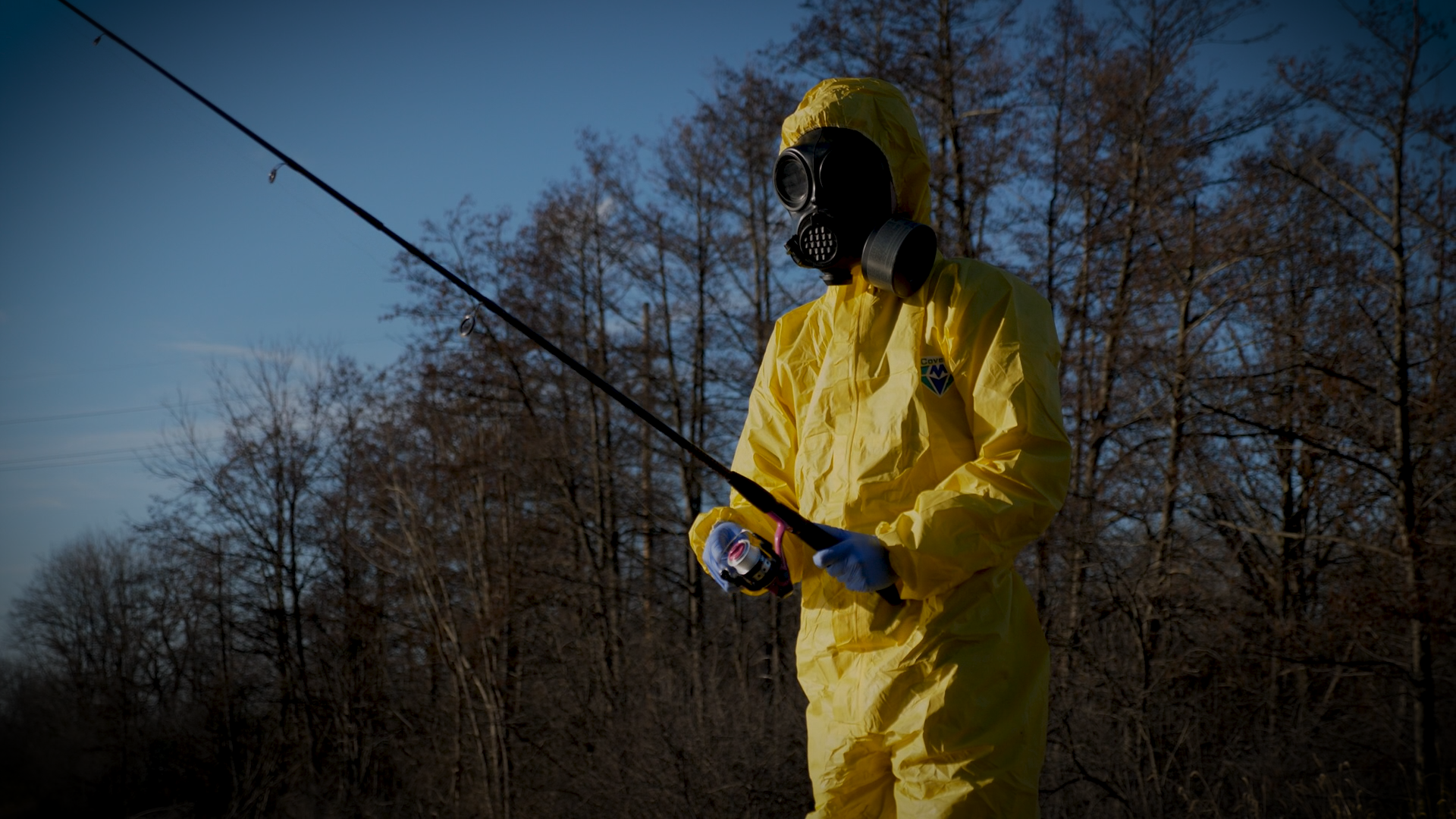
For filmmaker Frank Parkinson, making documentaries has always been about people.

Growing up in Saline and spending countless hours exploring the Huron River and the woods surrounding Ann Arbor, he developed an appreciation for southeast Michigan’s natural beauty at an early age. Those experiences eventually led him to create Seven Years, a documentary examining the human cost of PFAS contamination in Michigan—an issue that has affected communities throughout the state and transformed public conversations about environmental justice.
The film’s screening at Ann Arbor’s historic Michigan Theater is especially meaningful for Parkinson, who spent much of his childhood watching movies there. Now, instead of sitting in the audience, he will see his own work projected on the same screen that helped inspire his filmmaking career. The Michigan Theater has served as one of the region’s cultural landmarks since opening in 1928 and continues to be one of the Midwest’s premier destinations for independent cinema, documentaries, and film festivals.
A story that began close to home
For Parkinson, the documentary is rooted as much in place as it is in pollution.
“Everybody who grew up in or near Ann Arbor knows the supposed origin of its name,” he said. “Folklore says the name comes from the two founders’ wives (both serendipitously named Ann) who often sat together under the groves of trees in the area. The city and its nature have always been inseparable.”
That lifelong connection to the outdoors shaped both his interests and his career.
“As such, I, too, am obsessed with the outdoors, and that love has guided much of the subject matter that I have covered,” he said. “I care deeply about the environment and hope that my documentaries influence others to take what actions they can to protect our public lands.”
Parkinson’s interest in PFAS began years before production started.
“I first heard about PFAS contamination when I was studying environmental science in high school and went to a community meeting with the Huron River Watershed Council back in 2018,” he explained. “It wasn’t until my junior year of undergrad that I realized how big this issue has become and that this was a problem that people needed to be informed about.”
PFAS, or per- and polyfluoroalkyl substances, are often called “forever chemicals” because they persist in the environment for decades and can accumulate in the human body. The chemicals have been used since the 1940s in products ranging from nonstick cookware to stain-resistant fabrics and firefighting foam. Michigan has become one of the nation’s leaders in monitoring and responding to PFAS contamination, with contamination identified in water, soil, wildlife, and drinking water across the state.
Why film matters
While scientific reports and newspaper articles explain the chemistry behind PFAS contamination, Parkinson believes documentary film reaches audiences differently.
“This issue needs to be told through film because of the people who are impacted by it,” he said. “Articles are great at getting information across, but films are about emotion. Not only do victims’ stories deserve to be heard, but I also believe film allows audiences to better understand people’s struggles.”
That philosophy became the foundation of Seven Years.
Rather than focusing exclusively on data and policy, Parkinson centers the documentary on individuals whose lives have been altered by contaminated water and industrial pollution.
“I think film is especially powerful when covering environmental justice and public health, because while official reports use cold statistics to explain these crises, films put a human face to the numbers,” he said. “By showing us the real humans and places paying the price, film makes the abstract data deeply personal and impossible to ignore.”
Meeting the people behind the statistics
One of those people is Sandy Wynn-Stelt, whose family’s property became contaminated by PFAS associated with Wolverine Worldwide.
Parkinson said meeting Wynn-Stelt fundamentally changed his understanding of the crisis.

“I would say the moment that impacted me the most and changed my perspective on the issue was when my primary subject and friend, Sandy Wynn-Stelt, revealed the extent of the pollution from Wolverine Worldwide on her property,” he said. “I was blown away by the levels recorded on her land, and it proved to me just how negligently these companies operate.”
That experience reinforced his belief that environmental stories are ultimately stories about people.
“It’s important to me to put people first in my documentaries because facts and statistics can easily get lost in the viewers’ minds,” Parkinson said. “They are important but rarely tell the full story.”
He credits one lesson from his University of Michigan education for helping shape his storytelling approach.
“I learned when I was in marketing at U of M about a psychological phenomenon called the identifiable victim effect, which simply states that an image or video of a specific individual is much more impactful than a large number,” he explained. “I believe the same applies to documentary filmmaking.”
Becoming part of the story
Unlike many documentarians who remain behind the camera, Parkinson made the unusual decision to appear in Seven Years himself.
“Growing up on the river and doing all sorts of activities around it significantly influenced how I approached the documentary because I chose to include myself as a ‘character,'” he said.
That choice became even more personal because of his own health journey. “Since PFAS causes an umbrella of cancers, and having survived cancer myself in my early 20s, I felt like it was important to include my connection to the story and personalize the issue.”
Parkinson’s battle with leukemia while attending the University of Michigan profoundly shaped both his life and his filmmaking. After intensive treatment and recovery, he returned to complete his degree in Film, Television and Media, while continuing to create award-winning documentaries exploring health, resilience and environmental justice.
An Ann Arbor education
Parkinson credits the University of Michigan and the local arts community with helping him grow into the filmmaker he is today.
“The arts community at the University of Michigan and in Ann Arbor was as incredibly influential to my development as a filmmaker and creative,” he said.
He specifically credits the university’s Film, Television, and Media Department and faculty mentor John J. Valadez.
“I was incredibly lucky to be in such a supportive community and learn from some incredible filmmakers in the Film, Television, and Media department, such as Peabody Award-winning director John J. Valadez.”
Beyond the classroom, he says the collaborative atmosphere challenged him to continually improve.
“Being surrounded by so many other talented and passionate people challenged me to improve and experiment with my storytelling.”
RELATED: Michigan’s Water: What is Safe and What Fish Can I Eat?
Coming full circle
Perhaps no screening could be more meaningful than one at the Michigan Theater.
“I’ve been going to films at the Michigan Theater since I was a young boy, and so the opportunity to see my film screened in the main theater was a dream come true,” Parkinson said.
“I hope to have my film screened in many places, but I don’t think any of them will be as special as the Michigan Theater.”
For many local filmmakers, appearing at the Michigan Theater represents a milestone. For Parkinson, it also represents returning home.
Hoping to inspire action
Parkinson knows audiences may leave the theater with difficult emotions.
“I wouldn’t be shocked if audiences left feeling saddened and angry,” he said. “I felt angry constantly from pre-production to the final wrap.”
As he researched the issue, he discovered repeated examples of environmental negligence. “As I dug deeper into this issue, I found more and more layers of deceit, carelessness, and disregard for citizens who were and are affected by polluting factories and their products.”
He also recognizes how overwhelming the issue can feel. “PFAS contamination is an overwhelming issue when you consider the extent to which the pollution has spread and ingrained itself in our country’s DNA.”
Still, he hopes viewers leave motivated rather than discouraged. “However, I hope they leave feeling impassioned,” he said. “Anger rarely solves any issue, but passion does. I hope folks are inspired to do their own research to see how PFAS has impacted them and how they can help fight its spread.”
Looking ahead
Today, Parkinson continues expanding his filmmaking career beyond Michigan.
He is currently pursuing a Master of Fine Arts in Film and Media Production at the University of Texas at Austin, where he was one of only nine students admitted into the program.
His newest documentary follows a one-man feral hog trapping operation in Central Texas, continuing his interest in stories where people, communities and the environment intersect.
Yet despite beginning the next chapter of his career hundreds of miles away, his advice to aspiring filmmakers in Washtenaw County reflects the lessons he learned growing up in southeast Michigan.
“I would tell young filmmakers in Washtenaw County to be observant and fearless,” he said. “We are so blessed to live in an age where independent filmmaking has never been cheaper.”
His advice begins with paying attention.
“Be present in the spaces you find yourself in. What do you notice? Be present in the conversations you’re involved in and pay attention to novel events, communities and people in the area.”
And above all, he encourages curiosity.
“Plenty of people have fascinating lives and interests, but you’ll never know unless you ask.”
For Parkinson, that simple philosophy—asking questions, listening carefully, and telling human stories—continues to guide his work. Whether documenting the consequences of PFAS contamination in Michigan, or exploring environmental issues elsewhere, his films remind audiences that behind every statistic is a person, behind every crisis is a community, and sometimes the most powerful stories begin close to home.

Donna Marie Iadipaolo is a writer, journalist, and State of Michigan certified teacher, since 1990. She has written for national publications like The Village Voice, Ear Magazine of New Music, Insurance & Technology, and TheStreet.
She is now writing locally for many publications, including Current Magazine, Ann Arbor Family, and the Ann Arbor Independent. Her undergraduate degree is from the University of Michigan, Ann Arbor, where she graduated with an honors bachelor’s degree and three teacher certificate majors: mathematics, social sciences, English. She also earned three graduate degrees in Master of Science, Master of Arts, and Education Specialist Degree.

