
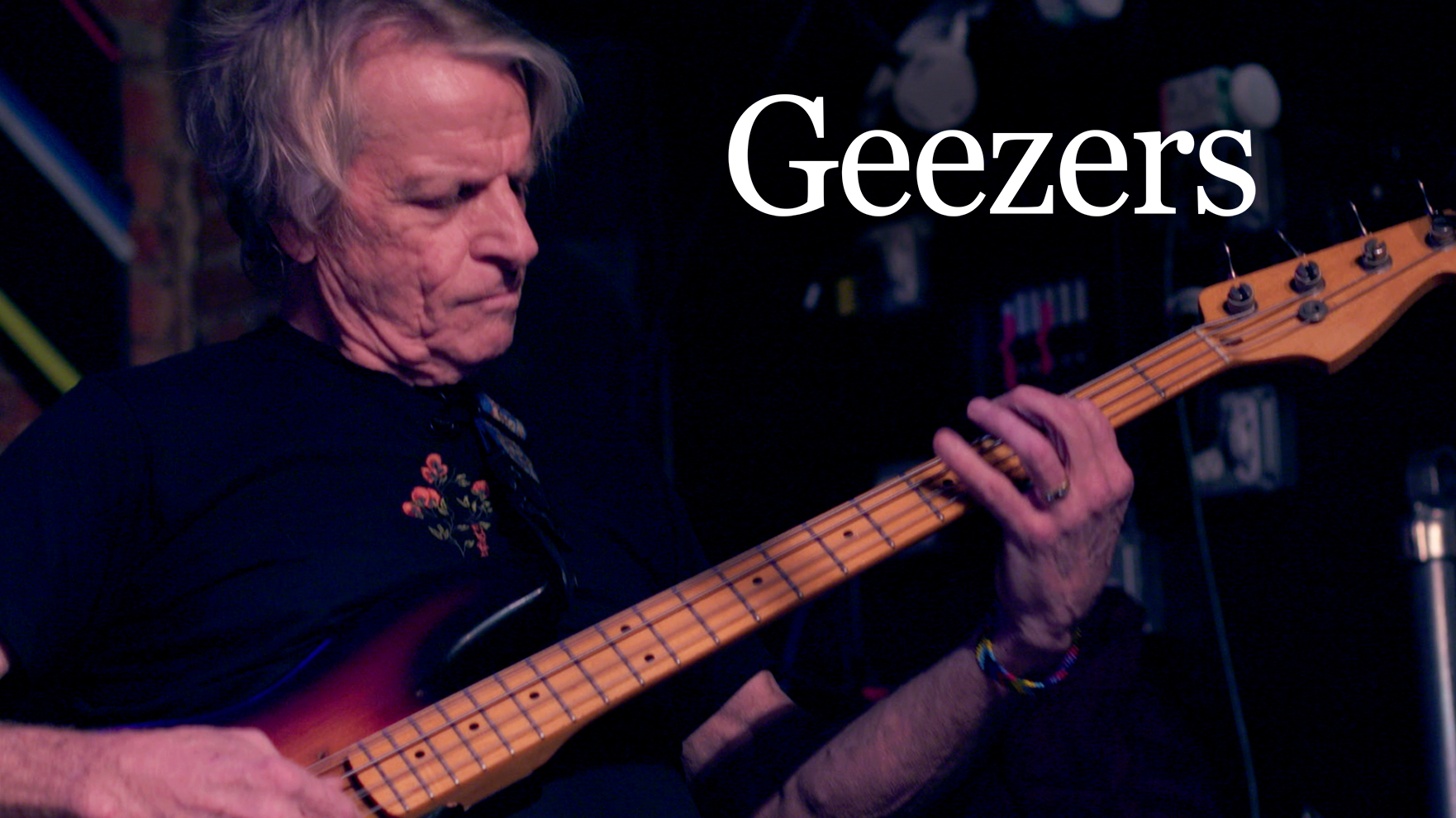
When filmmaker Jason Cooper first walked into Geezer Happy Hour in Ann Arbor, he wasn’t entirely sure what he was looking for. What he found instead was something far deeper than a quirky weekly music event—it was a story about loss, purpose and the enduring human need to create.
“I read an article about Geezer Happy Hour not long after I moved to Ann Arbor from Los Angeles,” said Cooper, director and producer of “Geezers.” “I went one Friday night on a whim, thinking it would just be a fun thing to check out, and brought my camera just in case. I knew there could be a story there, but I wasn’t sure what it was yet.”
That uncertainty quickly gave way to clarity when he met the film’s central figure, Randy Tessier.
“I met Randy that night and started to see the real potential his life and his loss stuck with me. I’m a dad and a creative, so there were some overlapping themes in his journey that really hit home,” said Cooper.
From local phenomenon to award-winning film
Cooper, who has been working as a documentary filmmaker since 2011, spent years shaping what would become “Geezers.” The film made the festival rounds throughout 2024 and 2025, earning recognition at multiple events, including a Best Michigan Short win at the Hell’s Half Mile Film & Music Festival.
Now, the film is widely accessible. It can be streamed here: https://www.youtube.com/watch?v=r22G4FIRVC4.
Building trust, capturing truth
One of the film’s greatest strengths is its intimacy—something Cooper credits to a stripped-down, human approach to filmmaking.
“It helps that Randy is very open, or at least he was with me,” Cooper explained. “I was upfront that I wanted our conversation to be about more than just ‘old people rocking.’”
Rather than relying on rigid interview structures, Cooper leaned into authenticity. “From a production standpoint, I kept things simple and tried not to over-prepare. I knew the general areas I wanted to explore, but I didn’t bring notes or a list of questions. We just set aside time for Randy to talk, and for me to listen.”
Shaping an emotional arc
Though the film begins with the lively energy of Geezer Happy Hour, its emotional center lies in Randy’s personal journey.
RELATED: Randy Tessier: Music, Teaching and the Fickle Finger of Unexpected Fame
“Editing is always an iterative process, and I’m not sure I can fully explain how we got to where we ended up,” Cooper said. “We went through a lot of cuts.”
Working with editor Jay Armitage, Cooper gradually discovered the film’s structure. “We knew we wanted to hook people with the ‘Geezers,’ but ultimately, it’s Randy’s personal journey that makes the film feel special. The structure came from following that emotional arc.”
Balancing those elements proved challenging. “The hard part was figuring out how to balance the Happy Hour with his story and then weave them together in a way that felt natural. It took more than a few tries to get it to a place where it really worked.”
Avoiding cliché, finding meaning
Telling a story about aging musicians comes with its own pitfalls—chief among them sentimentality. Cooper was determined to avoid that.
“The challenge is finding the emotional core,” he said. “I didn’t want it to just be ‘older people still want to create things.’ I wanted to understand Randy’s why…that’s what people connect to.”
Interestingly, sidestepping nostalgia came more naturally. “To paraphrase Randy: when you don’t know how much time you have left, there’s not much point living in the past.”
Capturing the Ann Arbor “Vibe”
Though the themes are universal, “Geezers” is unmistakably rooted in Ann Arbor. Cooper made it a priority to preserve that sense of place.
“It was very important for the Geezer Happy Hour ‘vibe’ to come through,” he said. “Even though it’s an event anyone can go to—and everyone should, it’s a blast—I felt like I was being invited into a private community.”
That awareness shaped how he filmed the space and its people. “I was very conscious of staying true to the spirit of the event and the people who show up week in and week out.”
Two worlds, one life
Visually, the film contrasts two distinct worlds: the vibrant performances and the quieter moments of reflection.
“At the Happy Hour, everything is about motion, energy, color and joy,” Cooper said. “Randy’s personal world is much quieter, warmer, but also a bit lonely.”
That duality reveals the complexity of its subject. “He’s alone in all the moments I filmed with him outside of the event. That contrast helped show both sides of him. He’s this on-stage persona, but also a complex person dealing with grief, ambition and the passage of time.”
A story about continuing
At its core, “Geezers” is about resilience—not as an abstract concept, but as a lived, daily practice.
“That was a key theme from the beginning, and a big part of what drew me to the story,” Cooper said. “Jay and I actually started looking at this as the first in a potential series called ‘Geezers,’ with each film focusing on someone who’s still out there pursuing things…creatively, personally, however they want…later in life.”
For Cooper, these stories expand our understanding of possibility. “There are so many stories like Randy’s that just expand what feels possible. People still chasing ideas, building things, finding new purpose, or just doing it because they love it. That’s the part that really excites me.”
The power of showing up
Though Cooper didn’t initially set out to make a statement about cultural preservation, the film naturally touches on it.
“Something like Geezer Happy Hour exists because people keep showing up, week after week, and building something together,” he said. “As places change, those kinds of communities can be easy to overlook or lose.”
His hope is simple but meaningful. “If the film does anything, I hope it helps people recognize the value in that and not take it for granted.”
Living in the moment
Ultimately, “Geezers” leaves audiences with a quiet but powerful message.
“I hope that people watch this film and feel inspired to live more in the moment,” Cooper said. “There are a lot of things Randy embodies…never giving up on your dreams, finding solace in creating, building community. But honestly, what I love most is his ability to appreciate each moment. That’s what stayed with me.”
In a world often focused on what’s next, “Geezers” reminds us of something far more important: what’s now.

Donna Marie Iadipaolo is a writer, journalist, and State of Michigan certified teacher, since 1990. She has written for national publications like The Village Voice, Ear Magazine of New Music, Insurance & Technology, and TheStreet.
She is now writing locally for many publications, including Current Magazine, Ann Arbor Family, and the Ann Arbor Independent. Her undergraduate degree is from the University of Michigan, Ann Arbor, where she graduated with an honors bachelor’s degree and three teacher certificate majors: mathematics, social sciences, English. She also earned three graduate degrees in Master of Science, Master of Arts, and Education Specialist Degree.

