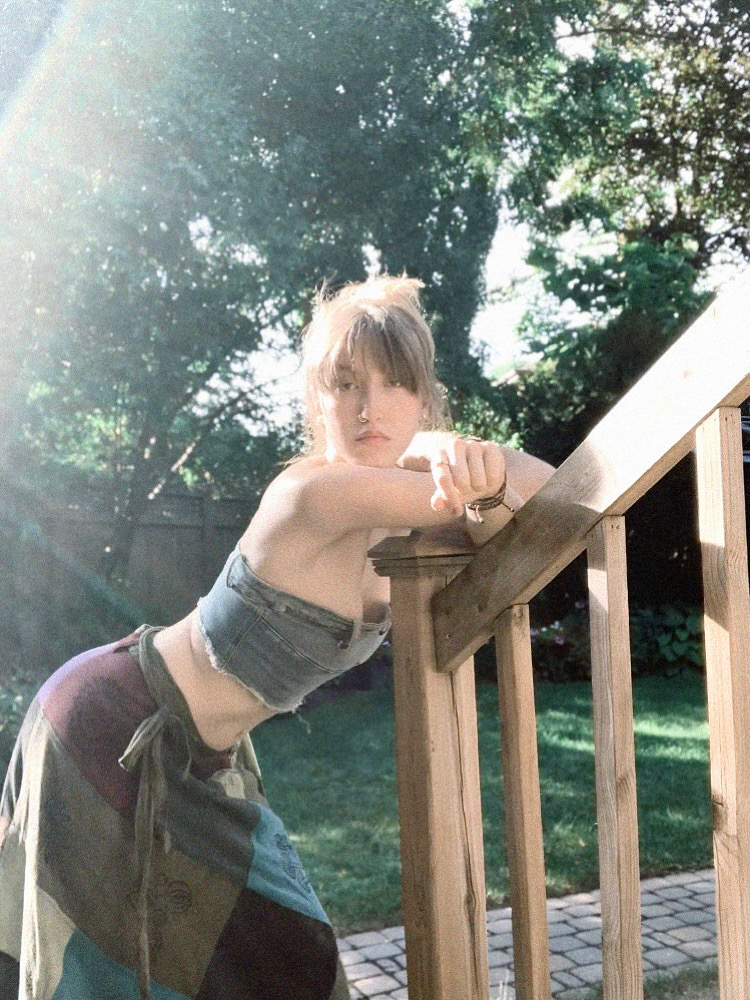
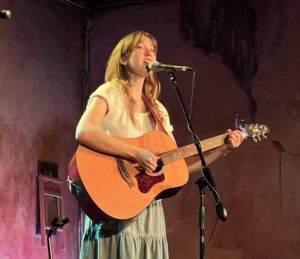
Maddy Ringo is a singer-songwriter that is graduating from the University of Michigan.
In Ann Arbor, music isn’t just something you hear; it’s something with which you connect. It lives in coffee shops, spills out of small venues and thrives in the shared space between performer and audience. For singer-songwriter Maddy Ringo, connection has shaped not only her sound, but her identity as a deeply feeling artist.
Ringo’s music and persona are widely recognized in town as reflecting complex experiences and emotions with intensity, sensitivity and artistic depth.
Since arriving as a first-year student in 2022, Ringo has grown into a recognizable voice in the town’s vibrant music scene. As she prepares to graduate from the University of Michigan and take her next steps, she reflects on the community—and the uncertainty and excitement that come with moving forward.
A city that listens—and participates
For Ringo, Ann Arbor stands apart not because of its prestige or institutions, but because of its people—their openness, participation and live-music community.
“I think that really Ann Arbor is the best example of what Midwestern music communities are about, which really is just the love and craving for live music and dance,” Ringo said. “…Everybody wants to join in music. It’s the jam culture. It’s the sort of very laid-back DIY way that a lot of us do music…really culturally deep and impactful music.”
That sense of shared ownership over music—where the line between performer and audience blurs—has been central to her.
“It (music scene) just feels very community-based,” Ringo said. “And it feels like I’m really playing for people who want to hear music all the time and are very moved by it—and open. And more than just moved by it, open to sharing the way that it moves them.”
Inviting the listener in
Ringo’s approach to music isn’t about performance alone—it’s also about immersion. She’s less interested in presenting polished, glossy songs than in creating a space where listeners feel part of the story.
“I hope that they (the audience) feel a sense of storytelling,” Ringo said. “I hope that they feel invited in. I think that’s my biggest thing is that I don’t want to just present something. I want to tell a story. And I want to invite people into the conversation.”
That conversational quality—onstage and within her lyrics—creates an experience that feels personal, even in a crowded room.
Between tradition and the present
Ringo said that her music exists at the intersection of folk tradition and contemporary songwriting. It’s a balance she has worked to refine over time, navigating between deeply personal expression and broader cultural resonance.
“I think it’s easy to write navel-gazing folk songs,” Ringo said. “I mean, I think that what people call folk music, like modern folk, is a lot more pop, and it’s a lot more production-based.”
Maddy Ringo creates music that is a mix of folk tradition and contemporary songwriting.
She wants to write and perform something deeper. Ringo acknowledges the pull of modern influences but remains committed to something more enduring.
“The songs (Ringo’s) are often a lot more personal, and I definitely have written many of those,” Ringo said. “But I think that I’ve always tried to balance, like, a personal narrative. And I’ve always tried to balance the personal narrative with a message that is more accessible for the audience.”
For Ringo, one test of a song is simple but profound: does it live beyond her?
“I think it’s really just about, you know, I’ll write a song and then just kind of think, like, melodically, could I hear my mother singing this while she’s making dinner? Like, could I hear her humming it?”
It’s also a question rooted in tradition—and in legacy.
“Could I see it (her song) in a catalog of folk music like the ones that I grew up with, like the Rise Up Singing book,” Ringo said. “Could these lyrics translate into a broader story of America and American life and our folk tradition? Or is this story going to die with me? Because I’d rather create stories that have a little bit of a longer life, or a broader life,…”
“Rise Up Singing” is a popular, comprehensive songbook edited by Peter Blood and Annie Patterson, containing lyrics, chords, and sources for roughly 1,200 folk, folk-revival, Broadway, pop, and protest songs.
A song at the crossroads
Ringo recently performed as the headliner at the International Women’s Day Eve event at LIVE nightclub. Other artists who performed were SK Rodriguez, Juniper, Doris Williams, Me Again Medicine Show, Michele Smolarski and Kira Blue. The event was hosted by the local chapter of Women’s International League for Peace and Freedom.
If there’s one track that captures where Ringo is right now, it’s her recent release, “Maybe I’ll Go Up That Mountain.” The song reflects both a literal and emotional transition—between past and future, familiarity and risk.
“And it’s the story (‘Maybe I’ll Go Up That Mountain’) that I think it very much sums up most of my music career up to this point,” Ringo said. “Especially just being a young artist and being sort of an amateur, and being in college and in transit, and having moved from Canada and landed back in Michigan, where my whole family is from.”
Her personal history—rooted in both Toronto and generations of Michigan family—adds another layer to that sense of movement.
“So that song (‘Maybe I’ll Go Up That Mountain’), I think, really encapsulates this tension between old life and new life in the past and now, and moving towards this life of conventional music success, but knowing that that’s not what my heart desires,” Ringo said.
The song also grapples with a question many artists face: what happens when art meets industry?
“Maybe it’s more accurate to say the commercialization aspect is really something that I’m afraid of and that I’m not sure what I’m going to encounter when I get up that mountain,” Ringo said.
Still, she recognizes that this path—uncertain as it is—is one she feels compelled to take.
“But at the same time, you know, it’s what I can do,” Ringo said. “It’s the pathway that modern music takes. So, I think that song really encapsulates that, you know, bridging those two worlds.”
Influences close to home
While her sound draws from a wide range of traditions, Ringo credits much of her artistic development to the musicians and spaces she’s encountered in Ann Arbor.
“I absolutely have been very inspired by just the way of putting on a show that I think is distinctive to Ann Arbor,” Ringo said. “Like a lot of the shows that I’ve seen in the and the big lineups that I’ve been part of at the arts.”
Among those influences are local performers who blend storytelling with musical craft. “People like Jen Cass, who is a really, really fabulous storyteller,” Ringo said. “(She’s) like a mentor figure for me, as somebody who really incorporates her own personal stories, but also like broader narrative into her music.”
Live performance, too, has played a formative role. “I went to a Dick Siegel show when I was a sophomore, and that really, that made me like, ‘Okay, I understand Ann Arbor music scene now,” Ringo said. “I think he’s just so emblematic of this kind of style, this kind of folk, sort of, like folky, but also that bluesy, kind of, like funky signature.”
What stands out most, though, is the joy embedded in the scene. “And it’s like, it’s fun, you know, that’s like, the biggest, the biggest thing is that there are always just those, like, really fun songs that, yeah, everybody can sing along with.”
What comes next
Ringo’s immediate future is still rooted in Ann Arbor, with several performances scheduled in the coming months, including a senior recital.
“I have a senior recital coming up on April 25 that’s at Black Crystal Cafe. I’ll be playing around Detroit in late April as well, in Ypsi in May,” Ringo said. “I’ll definitely be in town and mostly playing around Ann Arbor and Ypsi until late June.”
But beyond that, a new chapter awaits—one defined by movement and exploration.
“And then I’ll be taking off, but I’ll be periodically back, yeah, I mean not forever, because my family is all in the area now,” Ringo said. “I’m not leaving for good, but I won’t be playing here as frequently, starting in about July.”
Her plan? Hit the road and see where it leads.
Holding on while moving forward
As she looks ahead, Ringo is clear about what she hopes will remain constant—and what she hopes will change.
“I think what I would want to stay exactly the same is how much I enjoy music,” Ringo said. “And how my friends are always right by my side with this. And, yeah, I’d like to keep the community, the feeling of doing music with my community, and also just the passion for it.”
At the same time, she’s realistic about the challenges that come with turning art into a livelihood.
“I know that’s not always realistic when something becomes a career, you know, when art meets capitalism, sometimes that creates feelings of distress,” Ringo said. “I hope that I still have a love for just the act of it, and the process and the craft.”
And like many emerging artists, she’s navigating both ambition and uncertainty. “I mean, I hope that I maybe gain a little bit of traction and can actually live off of a music income,” Ringo said. “Right now I’m just scraping something together…So I’d like to be able to pay my rent (through music) without my part-time job.”
Even with that hope, there’s an awareness that self-doubt may never fully disappear. “I’d like to just be comfortable,” Ringo said. “I’d like to be able to not feel so much like I am. I don’t know, there’s like, there’s a sense of imposter syndrome when you’re just getting started out that I hope maybe has gone away, but somehow I suspect never will.”
A voice rooted in community
As Ringo prepares to leave Ann Arbor—at least for now—her music carries with it the imprint of the city: its openness, its collaborative spirit, and its belief in the power of shared experience.
In a place where audiences don’t just listen but participate, she has found not only her sound but her purpose. And wherever the road leads next, that sense of community—and the stories it inspires—will continue to shape the music she makes.
Donna Marie Iadipaolo is a writer, journalist, and State of Michigan certified teacher, since 1990. She has written for national publications like The Village Voice, Ear Magazine of New Music, Insurance & Technology, and TheStreet.
She is now writing locally for many publications, including Current Magazine, Ann Arbor Family, and the Ann Arbor Independent. Her undergraduate degree is from the University of Michigan, Ann Arbor, where she graduated with an honors bachelor’s degree and three teacher certificate majors: mathematics, social sciences, English. She also earned three graduate degrees in Master of Science, Master of Arts, and Education Specialist Degree.
Donna Marie Iadipaolo is a writer, journalist, and State of Michigan certified teacher, since 1990. She has written for national publications like The Village Voice, Ear Magazine of New Music, Insurance & Technology, and TheStreet.
She is now writing locally for many publications, including Current Magazine, Ann Arbor Family, and the Ann Arbor Independent. Her undergraduate degree is from the University of Michigan, Ann Arbor, where she graduated with an honors bachelor’s degree and three teacher certificate majors: mathematics, social sciences, English. She also earned three graduate degrees in Master of Science, Master of Arts, and Education Specialist Degree.