
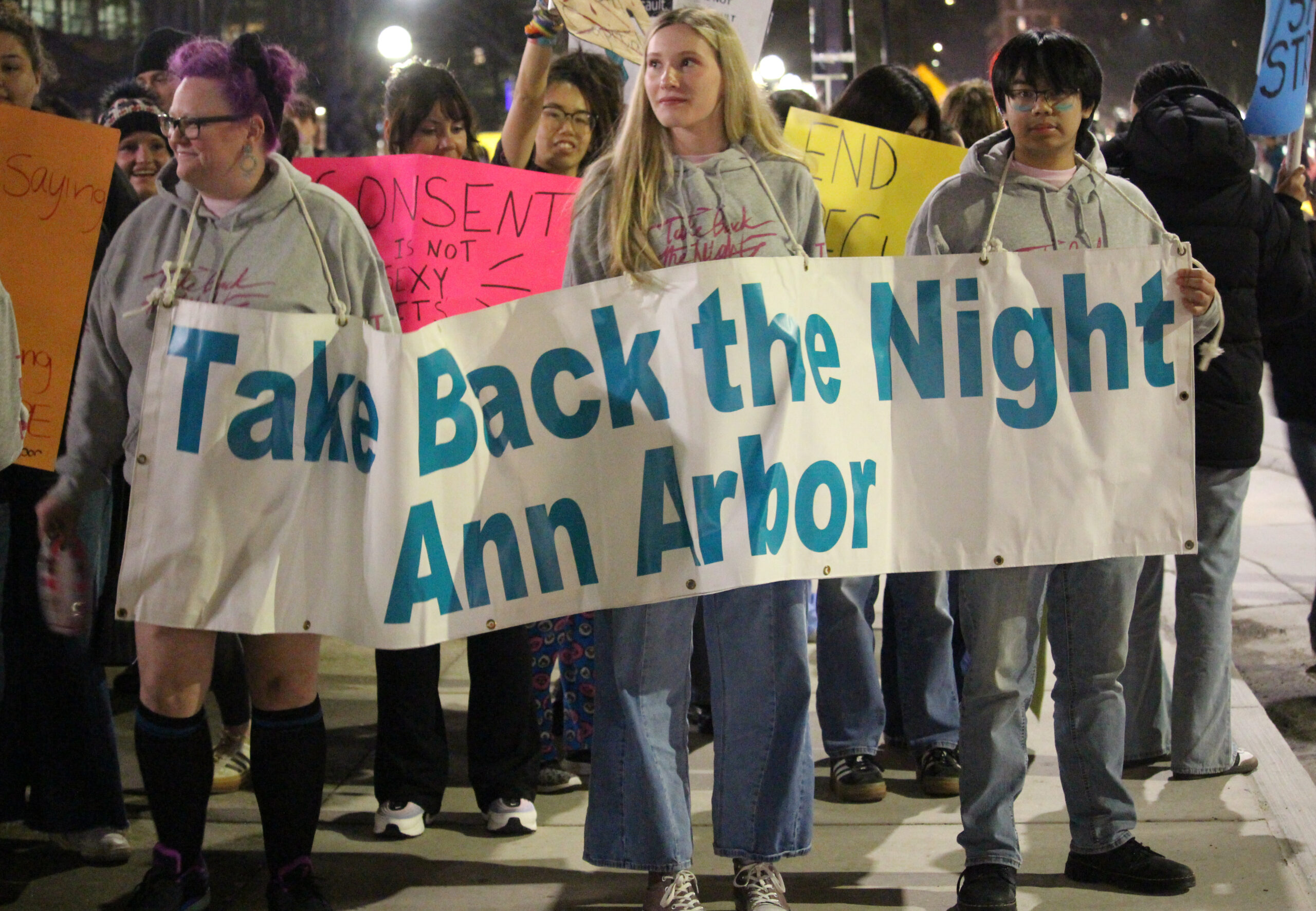
In Ann Arbor, a city often recognized for its activism and community engagement, Pamela Swider has spent nearly two decades working to support survivors of sexual violence.
As the executive director of STARS (Standing Tough Against Rape Society), her work is deeply rooted in both personal experience and a long-standing commitment to advocacy through initiatives like Take Back the Night Ann Arbor.
Swider’s path into advocacy began long before STARS was formally established in 2017. Her involvement dates back to 2007, when she first became involved with Take Back the Night, eventually taking on a leadership role. That journey, she explains, was shaped by the support she herself received as a survivor.
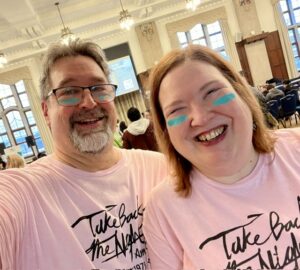
“I would have not been at the point I was without the help and kindness of others, so I wanted to pay it forward,” Swider said. “I participated in the Take Back the Night rally that Turning Point out of Macomb County held and it was such a healing and empowering event for me. I started searching for something to volunteer for and at the time I was making awareness jewelry. The Ann Arbor group was holding their first silent auction, and I donated some jewelry and attended the event and helped advise the person who was managing it.”
That initial involvement quickly grew into something much larger. Within a few years, Swider and her husband stepped into leadership roles, where they began to see firsthand the gaps in support systems—especially for college students navigating trauma.
RELATED: Hundreds Gather in Ann Arbor for 48th Annual “Take Back the Night” Program, March and Vigil
“Two years later, my husband Tom and I were asked to take over as leaders/mentors for the group,” Swider said. Once I got involved, I saw how so many survivors, especially on college campuses, didn’t know who to talk to or where to get support so we made this commitment to take on the leadership.”
The creation of STARS was, in part, a practical step—establishing a nonprofit structure to support Take Back the Night Ann Arbor and expand its reach. But it also reflected a broader vision: increasing awareness and creating meaningful, accessible support systems for survivors throughout Southeast Michigan.
 “We started STARS so that there was a legally run nonprofit arm to put on Take Back the Night Ann Arbor,” Swider said. “We needed a way to collect donations. Our long-term goal has always been to put on additional events in the Southeast Michigan area about sexual violence to raise awareness and to most of all empower survivors. The biggest need I see is trauma-informed sexual violence therapy that is easily and QUICKLY available for students.”
That urgency, Swider notes, is one of the most pressing challenges facing survivors today—particularly in a university town like Ann Arbor. While resources exist, access is often delayed or limited.
“SAPAC offers advocates to help survivors get through the Title IX process, and SafeHouse is wonderful, but with 2 major universities in their backyard, they do get spread thin,” Swinder said. “SafeHouse is also off campus. Students can also reach out to CAPS on campus, but those appointments can take time to get. When someone is at the point that they are ready for therapy, it is usually an urgent need. They also may have been assaulted prior to being on campus, but are now at a point to get help, and they may not want that therapy billed on their parents’ insurance for various reasons.”
At the center of STARS’ work is Take Back the Night Ann Arbor, an event that has evolved over time but remains deeply relevant. What began decades ago as a protest movement has transformed into a space for healing and empowerment.
 “TBTN’s have evolved,” Swider said. “They started as more of a protest—both for sex workers and acknowledging they can be assaulted, and to provide services for women who have been abused. Now we focus more on empowering survivors—showing those who are early in their journey that they can heal and there are resources and people who care, and celebrating those who are further along on their path of healing. We have parties for cancer survivors, funerals/celebrations of life for those who pass and those who mourn them.”
Despite increased awareness in the wake of movements like Me Too, Swider emphasizes that stigma and misunderstanding still surround sexual violence. Survivors continue to face doubt and harmful assumptions.
“Women are still not believed. They are still questioned—what were they doing? What were they wearing? What is their past like? No other crime victim is treated like this,” Swider said. “People still don’t get that most of the time it is someone the survivor knew on some level and not the man in the bushes. They still put the whole ‘well it could have been worse’ on it.”
She also highlights the complexities that often prevent survivors from coming forward immediately—factors that are frequently misunderstood by the public.
“Also, as we have seen lately, people do not understand why it could take decades for someone to come forward or that they can’t give all the details,” Swider said. “Coercion/manipulation is used in sexual violence as much if not more than physical threats, and it is a strong deterrent to reporting/talking about what happened. But just because someone took time to come forward doesn’t mean they are not being truthful.”
For Swider, meaningful support begins with something simple but powerful: listening without judgment. That principle extends from individuals to institutions and entire communities.
“Individuals want to be listened to and believed without judgment,” Swider said. “It doesn’t matter what someone did prior to being assaulted, nor how they acted after they were assaulted. The only person whose fault it is that a rape happened is the perpetrator. Institutions need to have clear policies and statements that they will NOT tolerate behavior that hurts others, especially under the sexual violence umbrella—whether that is sexual harassment or rape/assault.”
Creating spaces where survivors feel safe enough to share their experiences is another critical component of STARS’ work. Swider emphasizes the importance of consistency and clearly defined expectations in fostering that environment.
“Consistency is one of the most important things,” Swider said. “Stating goals about each event so expectations are set. The only space we have expectations of survivors/attendees to share their stories is our speak out that we hold a couple of days prior to TBTN Ann Arbor. We open the event with ground rules such as what is discussed here stays here, we listen and do not question.”
Like many nonprofits, STARS faces ongoing challenges—particularly when it comes to funding and community engagement. Swider notes that discomfort around the topic itself can be a barrier to broader support.
“Bias of people not attending or supporting because they do not want to feel uncomfortable,” Swider said. “Thinking we are going to sit around and bash men or cry and talk about specific situations constantly. Our Gala/silent auction is our biggest fundraiser but getting the community at large to attend is a challenge as they don’t want to think about it. Funding has also been difficult as it is hard for all nonprofits right now with programs being cut and funds being spread thin.”
Even in a city known for civic involvement, building stronger connections between the campus and the broader community remains an ongoing goal.
“Honestly, it has been a struggle getting support from the community in Ann Arbor,” Swider said. “I believe they see TBTN as a student event. But one of our goals is to bring community and campus together so survivors can see support in both aspects. This year, with having a nationally known keynote, it did bring in more community members and it made the event even better.”
For those looking to get involved, Swider points to both simple and meaningful actions—from supporting survivors directly to engaging with organizations like STARS.
“Helping survivors: Listen, believe, don’t judge, don’t question, don’t tell them they must report it, admit (unless educated in this) they don’t know the answers but do have the 800 national hotline memorized – 800-656-HOPE that can point the survivor toward resources. Helping STARS: volunteer! follow us on social media and share our posts… tell others in the community about the work we do, attend our events, donate!”
Looking ahead, Swider hopes to build on recent momentum and expand STARS’ impact, both on campus and across the wider community.
“We want to continue to hold more impactful events on campus and in the community. To grow our events to have higher attendance. Ultimately, we would love to be instrumental in helping to bring that trauma therapy to campus and help to sustain it. Of course, for all that, we need more volunteers and funding.”
With strong attendance at the most recent Take Back the Night event and continued support from city leaders, Swider remains focused on sustaining that progress.
“This year, with the keynote speaker being an Epstein survivor, attendance was very strong and the highest it has been since we took over 18 years ago. We appreciate that very much and are thankful for this. But every year is important. We always try to have the keynote be a survivor or someone who has been directly impacted by sexual violence, and even if they do not have national attention, it doesn’t make their message any less important.”
STARS also consistently holds an event in the fall—usually a movie/documentary screening that is connected to the subject of sexual violence, and they also hold self-care events like trauma-informed yoga as well.
For more information or to get involved visit tbtnannarbor.org and stars-mi.org. Find them on Facebook at Michigan Takes Back the Night.

Donna Marie Iadipaolo is a writer, journalist, and State of Michigan certified teacher, since 1990. She has written for national publications like The Village Voice, Ear Magazine of New Music, Insurance & Technology, and TheStreet.
She is now writing locally for many publications, including Current Magazine, Ann Arbor Family, and the Ann Arbor Independent. Her undergraduate degree is from the University of Michigan, Ann Arbor, where she graduated with an honors bachelor’s degree and three teacher certificate majors: mathematics, social sciences, English. She also earned three graduate degrees in Master of Science, Master of Arts, and Education Specialist Degree.

