
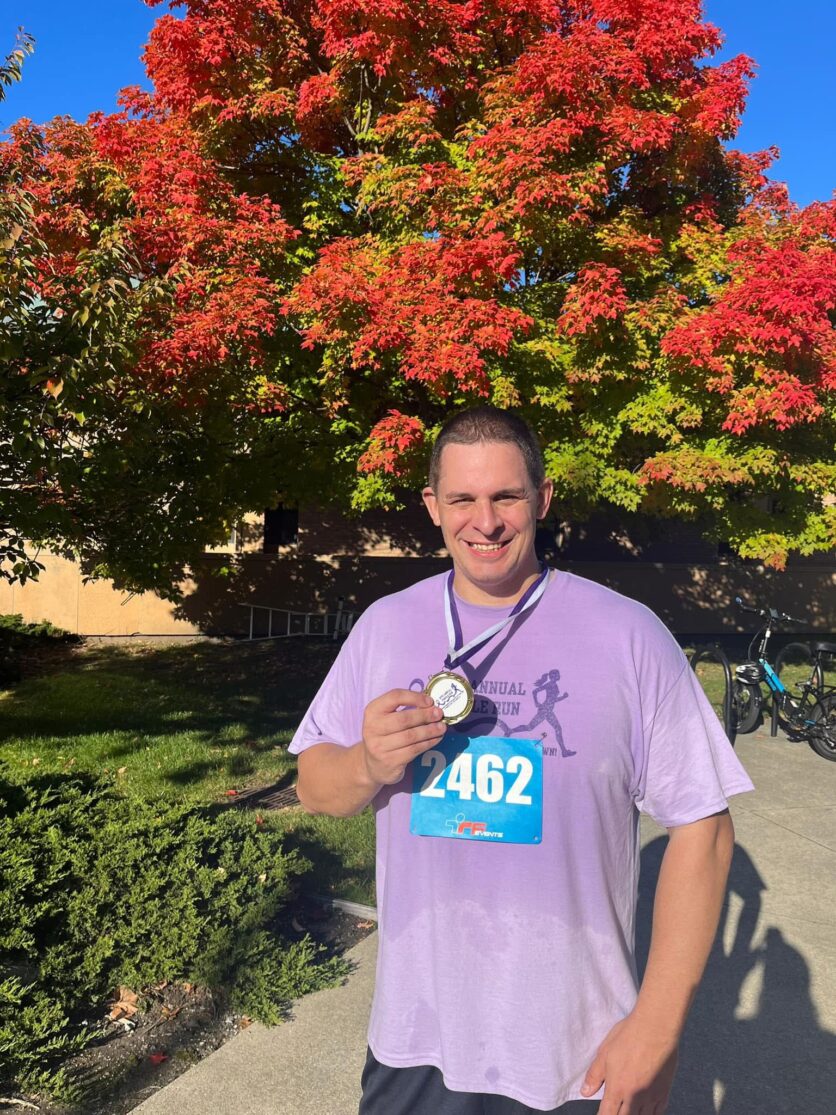
Washtenaw County Prosecuting Attorney Eli Savit’s work extends far beyond the courtroom. As a longtime participant and co-sponsor of the Purple Run—an annual 5K supporting domestic violence survivors—Savit sees community action as essential in the fight against intimate-partner violence.
Savit reflects on the Purple Run’s impact, systemic barriers for survivors, and how his prosecutorial philosophy may carry over into his run for Michigan Attorney General.
A prosecutor rooted in Ann Arbor
“I was born and raised in Ann Arbor, graduated from Pioneer High School, and attended the University of Michigan for law school,” Savit said.
Savit was first elected to office in 2020 and re-elected in 2024.
This local background shapes not only his approach to justice, but also his long-standing involvement with the Purple Run.
Why the Purple Run matters
“The Purple Run is, of course, an opportunity to raise funds for our partners at SafeHouse Center—which does tremendous work supporting survivors of domestic violence and sexual assault,” Savit said.
Savit said his office has worked in partnership with Safehouse for decades.
But for Savit, the event’s impact is even more symbolic: “More fundamentally… the Purple Run is an opportunity for our community to come together and demonstrate that domestic violence is not tolerated in our community, and that this community stands fully with survivors.”
The 2025 Purple Run in Ann Arbor is scheduled for Saturday, October 11.
Savit first joined the event in 2019, before taking office.
“I have personally been involved with the Purple Run—as a runner—since before I was elected Prosecuting Attorney,” Savit said. “I ran the race for the first time in 2019. I have participated, and our office has co-sponsored, every year in which I have been in office.”
Building a survivor-centered office
Savit’s commitment goes beyond events like the Purple Run.
“We have built out a domestic-violence unit staffed by specially trained prosecutors and victim advocates who recognize the unique dynamics—including trauma and coercion—that are at play in domestic violence cases,” he said.
These professionals don’t just work on active legal cases. They also “provide training to every member of our office on DV dynamics and trauma-informed practices. They also provide those trainings to our law-enforcement partners.”
That collaborative training culture extends into the community through the office’s joint S.A.F.E. (Stand Against Firearms Endangerment) program.
“We provide trainings and presentations on the dynamics of intimate-partner violence, the emotional and economic coercion that frequently underpins such cases, and the pronounced relationship between firearms and intimate-partner violence lethality,” Savit said.
Savit added, “S.A.F.E. team members are also available to serve as a resource to survivors who may need assistance with obtaining a personal protection order or an extreme risk protection order.”
Collaboration with SafeHouse and police
The power of partnership runs through every level of Savit’s work.
“Supporting survivors is a true collaborative effort,” he said. “Our law-enforcement partners are the first responders… and their compassion and understanding of DV-related trauma is key to being able to hold an abuser accountable.”
While his office prosecutes the cases, Savit is quick to acknowledge their limits: “We are lawyers, not direct-service providers. And the shelter, services and advocacy that SafeHouse provides is absolutely crucial to ensuring survivor safety.”
Addressing the challenges of prosecution
Domestic violence cases are notoriously difficult to prosecute. Survivors may feel unsafe, unsupported or unsure about coming forward. Savit says his office has taken that seriously.
“Our recent creation of a specialized domestic-violence unit ensures that cases are prosecuted by specialized, trauma-informed attorneys from start-to-finish,” Savit said. “Not only are our prosecutors and victim advocates trained… they are also well-versed in court rules that can overcome evidentiary barriers and allow us to obtain a conviction.”
Savit emphasized that their trauma-informed approach is more than policy—it’s personal: “We always strive to treat victims with care and compassion. That’s not only the right thing to do, it also ensures that we are able to build the trust necessary to successfully prosecute a case.”
The Purple Run’s growth and impact
In its early days, the Purple Run was relatively small. Today, it’s a central piece of Washtenaw County’s community calendar.
RELATED: Jeff Hauptman: Lifelong Ann Arborite with a Vision for Community
“The Purple Run has evolved over the years into a foundational annual event for our community,” Savit said. “It’s sent a powerful message that all of us must do our part to run domestic violence out of town.”
“Several hundred people usually participate (in the Purple Run),” he adds. “And I certainly hope that number will grow this year!”
Gaps that persist
Despite progress, Savit says one of the biggest issues facing survivors lies outside the legal system.
“Survivors of domestic violence frequently are unable to obtain safe and affordable housing,” he said. “That dynamic is exacerbated by the economic coercion that so frequently accompanies domestic violence cases.”
He highlights SafeHouse Center’s role as a lifesaving resource. “SafeHouse Center quite literally saves lives by allowing survivors to remove themselves from dangerous living situations.”
Raising awareness, changing culture
“Frequently, people are unaware of just how prevalent intimate-partner violence is,” Savit said. “It’s a crime that typically occurs behind closed doors and out of the public eye.”
SafeHouse states that every 60 seconds, 20 people are subjected to inter-partner violence.
He emphasizes that abuse isn’t always physical: “It can also encompass emotional manipulation, and coercive behavior relating to financial matters or child custody.”
Varieties of domestic violence include: physical abuse, sexual abuse, emotional abuse, economic abuse, psychological abuse, technological abuse.
But community support can have a real, measurable effect.
“At a political event about a year ago, I was approached by a woman who thanked us for helping to build a community in which domestic-violence victims are heard and supported,” he said.
“She mentioned that a friend—who had participated in the Purple Run—had recently been a victim of domestic violence, and that she came forward in part because she knew this is a community that stands with survivors,” Savit said.
A message to survivors
To those still suffering in silence, Savit offers reassurance:
“We see you. We hear you. We are here to support you. Please know that you’re not alone, and that we will work tirelessly to ensure your safety.”
A broader fight: running for Attorney General
Savit has set his sights on the state level with his campaign for Michigan Attorney General. He says the role is essential in protecting civil rights and standing up against abuses of power.
“I’m running… to stand up for the people of the State of Michigan—particularly when their rights are being attacked by powerful interests,” he said. “The Attorney General is the one position in the State that is empowered to fight back, on behalf of the People of the State of Michigan.”
Savit draws a direct connection to domestic violence advocacy: “We’ve seen the federal government arbitrarily cut back grants that are geared towards providing resources to crime survivors.”
“And though the underlying vulnerability that frequently exacerbates domestic-violence dynamics—for example, a lack of safe, affordable housing—isn’t something that the Attorney General’s Office can remedy on its own, we can prevent predatory actors from taking advantage of people’s vulnerability,” Savit said.
On sex trafficking and “Take It Down” laws
Savit’s office also works on trafficking cases—and his message is unequivocal: “We will zealously prosecute traffickers. We will zealously prosecute pimps. We will zealously prosecute those who have sex with, or seek to procure sex with, a trafficked person. We will zealously prosecute any third parties that are involved in trafficking or commercial sex.”
Victims, however, are treated with care. “We do not… prosecute the victims of human trafficking,” he clarified. “Instead, we seek to address the underlying vulnerability that traffickers so frequently take advantage of.”
That includes partnerships with the Human Trafficking Law Clinic and a focus on securing T-visas for immigrant survivors.
He’s also outspoken about the dangers of deepfake abuse.
“Deepfake, non-consensual AI pornographic imagery is a growing problem, and one we take very seriously,” Savit said.
“The Take It Down Act is a law that combats nonconsensual deepfake porn at the federal level; unfortunately, parallel state legislation stalled out last year in the Michigan Legislature. House Bills 4047 and 4048, introduced by state Reps. Penelope Tsernoglou and Matt Bierlein, would allow nonconsensual deepfake pornography to be criminally prosecuted in Michigan. I am hopeful that these bills will quickly pass our Legislature, and when they do, we will zealously enforce them.”
The Take It Down Act, officially named the Tools to Address Known Exploitation by Immobilizing Technology Deepfakes on Website and Networks Act. It is a federal law that makes it illegal to share non-consensual intimate images (NCII), including deepfakes, online.
Final thoughts
Whether he’s organizing a countywide initiative like the Purple Run or building new legal frameworks to protect survivors, Eli Savit said he sees the justice system as a tool for community care.
“Events like the Purple Run are important fundraising events,” he said. “But they’re also about sending a message about the support that survivors can expect from law-enforcement, from our office, and from the community at large.”
And in Savit’s eyes, that message is clear: survivors are not alone.
The 2025 Purple Run in Ann Arbor is scheduled for Saturday, October 11. It will begin at 9am at the Duderstadt Center on North Campus.
The event is a 5K fun run/walk organized by the University of Michigan Police Department, the Ann Arbor Police Department, and the Washtenaw County Prosecutor’s Office. Proceeds from the run benefit the SafeHouse Center, a local non-profit that supports survivors of sexual assault and domestic violence

Donna Marie Iadipaolo is a writer, journalist, and State of Michigan certified teacher, since 1990. She has written for national publications like The Village Voice, Ear Magazine of New Music, Insurance & Technology, and TheStreet.
She is now writing locally for many publications, including Current Magazine, Ann Arbor Family, and the Ann Arbor Independent. Her undergraduate degree is from the University of Michigan, Ann Arbor, where she graduated with an honors bachelor’s degree and three teacher certificate majors: mathematics, social sciences, English. She also earned three graduate degrees in Master of Science, Master of Arts, and Education Specialist Degree.

