
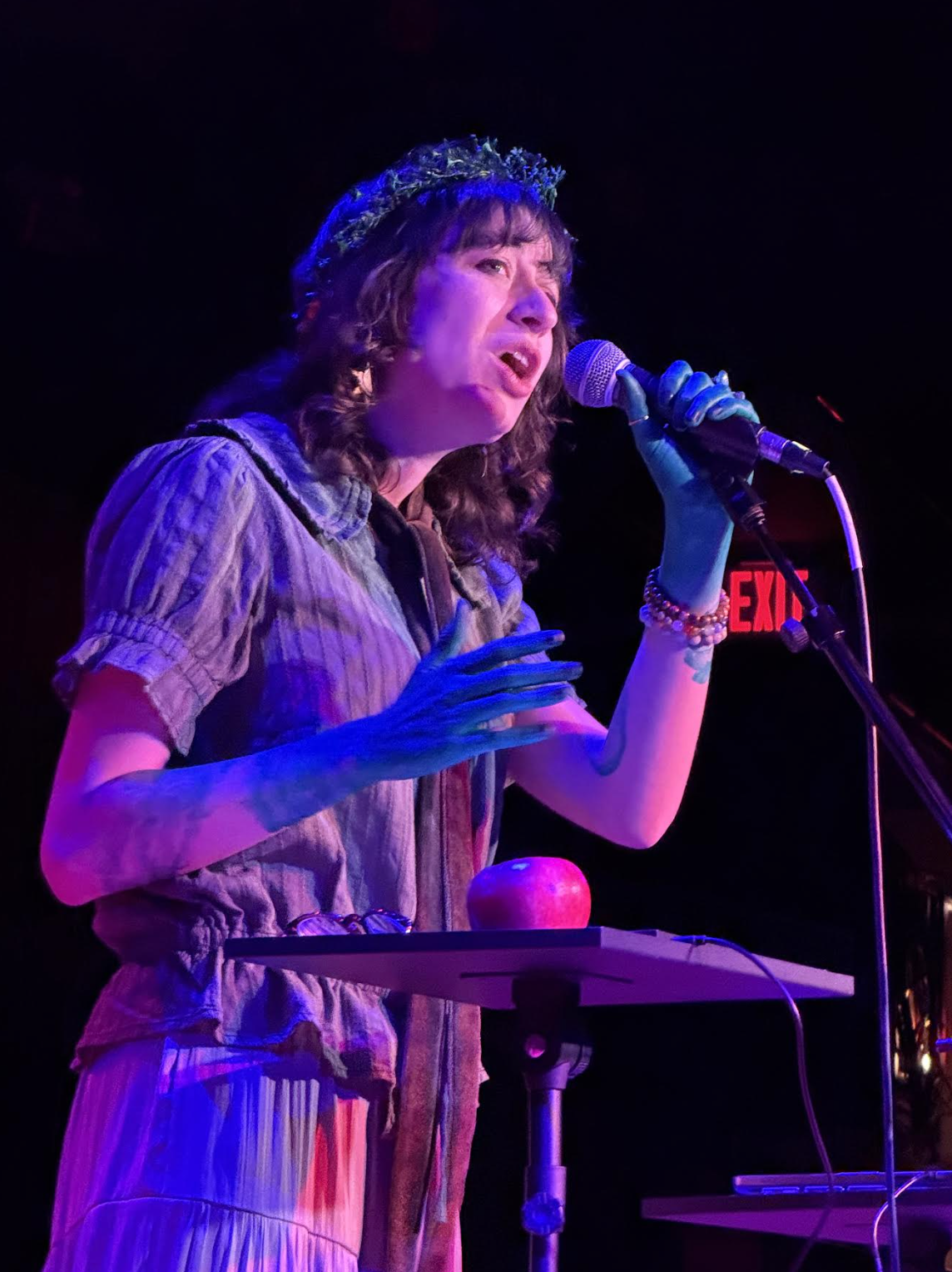
In the ever-evolving landscape of Ann Arbor’s arts scene, few emerging projects capture the city’s eclectic, experimental spirit quite like Rabbitology. Created by producer and songwriter Nat Timmerman in 2022, the project blends music, narrative and performance art into something at once haunting and inventive. Drawing from the natural environment, academic life and a deeply collaborative, creative community, Timmerman’s work reflects both the intimacy and expansiveness of the University of Michigan experience.
Timmerman’s number of listeners on Spotify has been in the millions, and she has also accrued an amazing following. Rabbitology performed at the Ann Arbor Folk Festival and often performs at The Ark with packed and loyal fans.
A project born from place
For Timmerman, Ann Arbor is not just a backdrop—it is embedded in the very fabric of Rabbitology’s sound. She uses all kinds of objects to create unique sounds in her music.
RELATED: Harmonious Voices: Local Artists Bring Intimacy and Connection to The Ark
“The sounds of Ann Arbor specifically can be heard in many of my songs. From Ann Arbor birds to fruit from the dining halls, Ann Arbor is laced within the ambiance and percussion of my tracks,” Timmerman said. “Additionally, I’m sure Ann Arbor’s offbeat, indie attitude has influenced my confidence in making songs within the similar vein.”
This fusion of environment and artistry gives Rabbitology a distinctive sonic identity. The natural and everyday sounds of campus life become instruments, transforming the ordinary into something atmospheric and evocative.
Creativity through constraint
Timmerman’s early years at the University of Michigan—particularly time spent living in the dorms—played a pivotal role in shaping the project’s experimental nature. Particularly her time in the dorms.
“Being in the dorms my first two years created a limitation on production and recording abilities that required me to come into music-making with an improvisational and out-of-the-box attitude,” she said. “I didn’t have access to standard instruments, so I had to think to myself, ‘what around me could make a similar noise for what I’m seeking?’ This resulted in synthesizers made from cow and fox calls, and percussion from the dorm heater, dining hall apples or recyclables left in the halls.”
What began as a necessity quickly evolved into an artistic philosophy. Rabbitology’s sound is built on ingenuity, with unconventional tools yielding unexpected textures and tones.
Beyond listening: art as interaction
At its core, Rabbitology is not just about sound—it is about experience. Timmerman’s work often invites audiences to engage beyond passive listening.
“UM-arts have always encouraged me to think about how we interact with art beyond its presented intention,” Timmerman said. “So I’m always trying to imagine new ways to interact with my music beyond just listening. A huge feature that arose from this is my efforts in audience involvement and participation—digital involvement through art initiatives for music videos, live audience sound-making during shows.”
This participatory approach reflects the interdisciplinary ethos of the University’s arts environment, where boundaries between media—and between artist and audience—are intentionally blurred.
Embracing the “beautifully strange”
Sometimes described as “horror folk,” Rabbitology leans into the eerie and unconventional, a label Timmerman both accepts and redefines.
“I originally came to Michigan with the goal of becoming a folk horror writer, planning for writing either plays or novels,” Timmerman said. “To be fair, I never specified how I’d be telling folk horror stories, and I suppose that it’s happened through music. I love the off-putting and macabre, so that label is welcomed, and even self-brought in some way.”
This narrative-driven approach ties music to storytelling traditions, transforming songs into immersive, often unsettling worlds.
A community that amplifies creativity
Ann Arbor audiences have played a crucial role in the evolution of Rabbitology, offering encouragement that allowed Timmerman to take creative risks.
“Ann Arbor has been super encouraging and receptive to my work,” she said. “When I first began performing, it was all Ann Arbor shows. I think the community’s warmness and praise toward my sets helped me build up my confidence in being openly strange onstage.”
Equally influential has been the collaborative environment fostered by campus organizations, particularly Filmic Productions.
“A program that has genuinely changed my life was a club on campus called Filmic Productions,” Timmerman said. “I joined my freshman year as one of their script writers for advertisements, and the community within this club can be directly thanked for my success. Every day, I am surrounded by so many multidisciplinary creatives — writers, directors of photography, sound engineers, producers, art directors, editors… so many different minds that approach creative problems in such diverse ways.”
This network of creatives has not only supported Rabbitology but actively contributed to its visual and performative elements, reinforcing its multidisciplinary nature.
Academia meets activism
The intellectual environment of Ann Arbor also finds its way into Rabbitology’s themes, where academic study becomes a springboard for artistic expression.
“Especially in my earlier work, Rabbitology uses academia for activism,” she said. “What I mean is that I would take my class readings, my academic background, and use them as inspiration for my creative works, most of which advocate for the quiet to lift their voices. For example, my first semester, I was in an apocalypse readings class, which directly resulted in the themes of ‘Preybirds,’ which references ‘The Second Coming.’”
Through this lens, Rabbitology becomes both reflective and purposeful, engaging with ideas of voice, identity and expression.
A distinctive fan community
Timmerman’s audience mirrors the project’s creative ethos—expressive, unconventional and deeply engaged.
“In terms of my fans, I can definitely spot them in a crowd, as I’ve discovered when opening for artists like Elio Mei, Cosmo Sheldrake, and The Oh Hellos. Already, these artists have fans who express themselves through creative outfits, but there’s some variance to Rabbitology fans that I’m able to spot. Main giveaways are handmade pieces.”
This shared spirit of creativity reinforces Rabbitology as more than a musical project—it is a community of artists and thinkers.
Inspired by the natural world
Among the many influences on Rabbitology, one location stands out: the Nichols Arboretum, known locally as “The Arb.”
“The Arb. As stated before, so, so, many of my songs feature sounds from the Arb. Bird calls, bushes rustling, mud squelching. Specifically, The Bog Bodies, FOXCRY, and Wolf House all have core elements to their sound that came from The Arb.”
Here, nature becomes both instrument and inspiration, grounding the project in a tangible sense of place.
Storytelling in a Digital Age
Part of Rabbitology’s success lies in its ability to connect with audiences in an increasingly crowded digital landscape.
“Being a creative writing and communications major, I came into connecting with audiences with a digital storytelling lens, informed by my studies. Coming into an incredibly commodified sphere of music, I believe some success of both my work and other similar artists can come from the fact that we began incredibly grassroots, with a hungry desire to tell a story. This hunger is palpable.”
That sense of authenticity has helped foster a growing online community of listeners and creators alike.
What’s next
A new release signals the next chapter for Rabbitology. “Magnanimity (Bigger Man)” is “an exploration into childhood frustrations of forced maturity at a young age.”
As Rabbitology continues to evolve, one thing remains clear: its foundation—built on experimentation, storytelling, and community—will continue to shape wherever it goes next.
Donna Marie Iadipaolo is a writer, journalist, and State of Michigan certified teacher, since 1990. She has written for national publications like The Village Voice, Ear Magazine of New Music, Insurance & Technology, and TheStreet.
She is now writing locally for many publications, including Current Magazine, Ann Arbor Family, and the Ann Arbor Independent. Her undergraduate degree is from the University of Michigan, Ann Arbor, where she graduated with an honors bachelor’s degree and three teacher certificate majors: mathematics, social sciences, English. She also earned three graduate degrees in Master of Science, Master of Arts, and Education Specialist Degree.

