
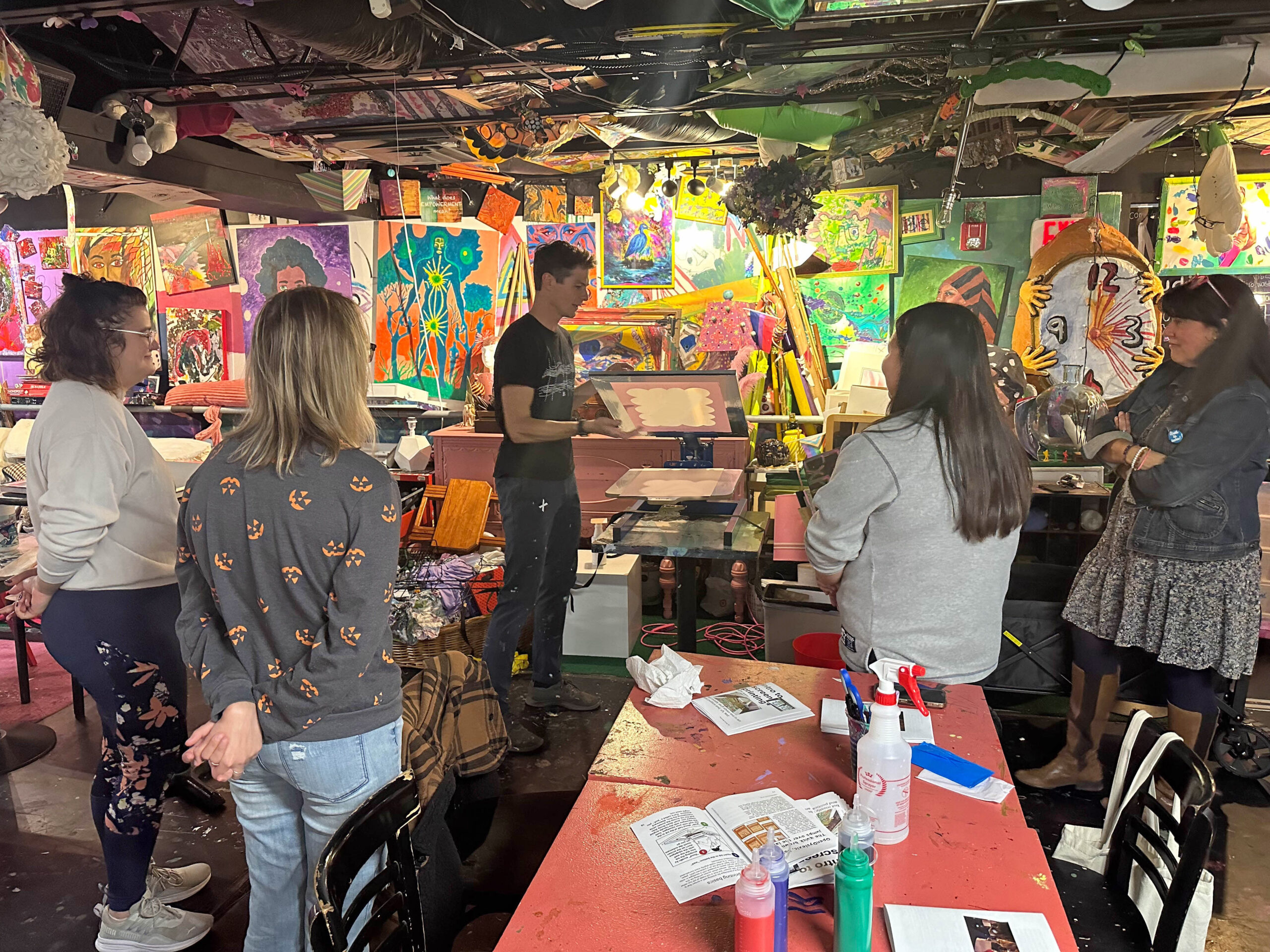
Ann Arbor has long been known for its intellectual curiosity and vibrant cultural scene — from world-class music at The Ark, to great films at the Michigan Theater, to community murals brightening local streets—and so much more.
Now, a new program at the University of Michigan is connecting the city’s deep artistic roots with another essential form of care: public health.
The ArtsRx program, launched through the University of Michigan Arts Initiative, explores how creative engagement can promote mental and physical well-being. Rooted in research but grounded in community, it aims to show that the arts are not just entertainment—they’re essential to human health.
The symbol “Rx” is the abbreviation derived from the Latin “recipes,” meaning “to take” or “receive.” In ancient Rome, medical practitioners used Rx to begin a prescription. The name ArtsRX could translate to “Prescription for Art,” though it is sometimes listed as “Rx Arts.”
The program was launched in September 2025.
A spark of inspiration
When Mark Clague, associate dean for collaborations and partnerships in the school of music, theatre & dance, joined the Arts Initiative in 2023, he saw an opportunity.
“When I first took on a leadership role with the U-M Arts Initiative in fall 2023, I attended a conference on the arts in higher education and was surprised by the range and depth of arts and health programs nationally,” Clague said. “It struck me then that U-M could and should be at the forefront of this work.”
RELATED: The Ann Arbor Guide For New Students
Soprano Renée Fleming’s advocacy particularly moved him for what she calls being “wired for art”—a concept supported by neuroscience that shows creative expression activates the brain’s reward systems and promotes emotional regulation. For Clague, this realization aligned perfectly with the University’s mission to integrate research, learning and public impact.
The prescription for art
At its heart, “Rx Arts” is designed to make the arts as accessible and essential as a fitness class or a counseling appointment.
“We are currently focused on two pathways to the ArtsRx program for students,” Clague said. “One is a formal research pilot study in which about 200 students will be screened for loneliness and social isolation, and those who test positive will be offered a formal prescription of three art doses. The other pathway is an open ‘invitation’ or self-prescribing model where students can simply choose to participate in an ArtsRx activity.”
Those “arts doses” might include attending a concert, taking part in a creative workshop, visiting a museum, or joining a campus performance. The program is unique in how it integrates with U-M’s health system.
“The distinguishing feature of our Michigan ArtsRx program is its integration with our healthcare partners in University Health and Counseling and Wolverine Wellness,” Clague said. “This is not just an arts program. It’s a deep collaboration between Michigan’s arts and health programs.”
This link between artistic engagement and medical support could redefine what it means to treat stress, anxiety and loneliness—issues that have surged among college students nationwide.
The science of feeling better
Elaine Sims, director of Michigan Medicine’s Gifts of Art program and a pioneer in the field of arts in health, has spent decades witnessing the power of creativity in clinical settings.
“The human response to the arts is hard-wired in,” Sims said. “I have seen in hospitalized patients how quickly they respond to art and music and how it can be transformative. The challenge is keeping that connection to the arts once patients return to their everyday life.”
Sims, who has led Gifts of Art for 26 years, calls the effort “art for the health of it.” She’s quick to clarify that Rx Arts is not art therapy — a clinical practice requiring certified therapists — but rather a community-wide approach to improving well-being through accessible creativity.
“Arts Rx is not art therapy,” Sims explained. “The latter is a clinical intervention that uses art as a modality to achieve a clinical goal or outcome. This is art for the health of it.”
Research has increasingly shown that music, painting, dance and storytelling can reduce stress hormones, improve mood and foster social connection. For Sims, these aren’t abstract ideas—she’s seen them firsthand.
“Today’s world is extremely stressful, and students are experiencing high levels of loneliness, stress and anxiety—all things that the arts can help with, especially when done in community,” she said. “Students are exactly the right age to build life-long habits and ways of living in the world. Rx Arts provides that opportunity, with vibrant invitations, peer support and easy access.”
From campus to community
ArtsRx isn’t confined to the university’s walls. By connecting local arts organizations, galleries, and performers with health and wellness pathways, the initiative could also strengthen Ann Arbor’s cultural ecosystem.
Clague sees it as an investment in both community vitality and student success.
“We know that many students use the arts to make friends and to manage stress, to discover and develop new skills, to nurture their creative voice and more,” he said. “Our pilot study will try to get more details on the contributions of the arts to student mental health and well-being.”
The potential benefits go far beyond the campus. Sims believes this kind of program can help cultivate a culture of empathy, creativity and resilience throughout the city.
“Everyone benefits,” she said. “Staff and community will also benefit as many of the offerings are open to all. A culture of creativity is always an asset and strengthens a community.”
Healing beyond the hospital
Sims’s work with Gifts of Art has already bridged healthcare and creativity for decades, bringing musicians, visual artists and storytellers into hospital spaces. Now, she sees ArtsRx as a way to extend that healing energy outward.
“What the Arts Initiative opens is the opportunity to extend those relationships and facilitate the connection to the arts from hospital to home,” Sims said. “One recent example: We worked with a student filmmaker on a series of videos we call ‘From Hospital to Home,’ demonstrating easy ways we can keep the arts in our lives and make them a part of a healthy lifestyle.”
She also sees potential for Michigan to follow global examples.
“That experiment is already going on in other universities across the country,” Sims said. “But it all began at the clinical level in other countries like England, where physicians prescribe visits to art museums or concerts or art and music classes. The arts are a wonderful tool for supporting the healing process, and healing happens not only in hospitals.”
Art as medicine
The science of healing through art isn’t just metaphorical. Sims describes how sensory experiences can directly affect the body’s physiology.
“Art as we know it provides clues to what does or does not provide safety and security,” she said. “Sound, color and pattern all have primal roots. Art in a healing context can promote calm and comfort, helping reduce anxiety and stress and maintain a sense of self and control—critical in the healing process.”
Clague agrees that the arts can complement medical care in ways still being explored.
“Our pilot study will lead to other research phases in which we’ll work to document the impact of ArtsRx,” he said. “Ultimately, we want to see students thrive, which means graduating and having the skills to succeed.”
A Vision for the future
Both Clague and Sims imagine a time when artistic prescriptions might be as common as physical therapy referrals—an idea already tested in parts of the U.K. and Canada. In such a model, a doctor might prescribe “three museum visits” or “a semester in a community choir.”
For Clague, that future feels within reach. “I hope and expect that ArtsRx will be a positive and consequential contribution to a thriving campus community and that we’ll be a model for other universities and organizations throughout the state of Michigan and beyond,” he said. “If Michigan ArtsRx can help make this a state-wide movement, that would be a huge success.”
Sims echoes that vision: “Over my 35 years, I have seen what began in hospitals extend to public health and community settings. Much, if not more, of healing takes place at home in the world.”
The art of living well
ArtsRx reframes the arts not as a luxury, but as a lifestyle—one that nurtures mind, body and community. By merging medical insight with creative engagement, Ann Arbor may soon lead a national movement that redefines what wellness looks like.
As Sims puts it simply: “Rx Arts is not creating something new. It is amplifying and showcasing what is already all around us to enjoy and explore on a regular basis. Go for it—and take a friend.”
Donna Marie Iadipaolo is a writer, journalist, and State of Michigan certified teacher, since 1990. She has written for national publications like The Village Voice, Ear Magazine of New Music, Insurance & Technology, and TheStreet.
She is now writing locally for many publications, including Current Magazine, Ann Arbor Family, and the Ann Arbor Independent. Her undergraduate degree is from the University of Michigan, Ann Arbor, where she graduated with an honors bachelor’s degree and three teacher certificate majors: mathematics, social sciences, English. She also earned three graduate degrees in Master of Science, Master of Arts, and Education Specialist Degree.

