
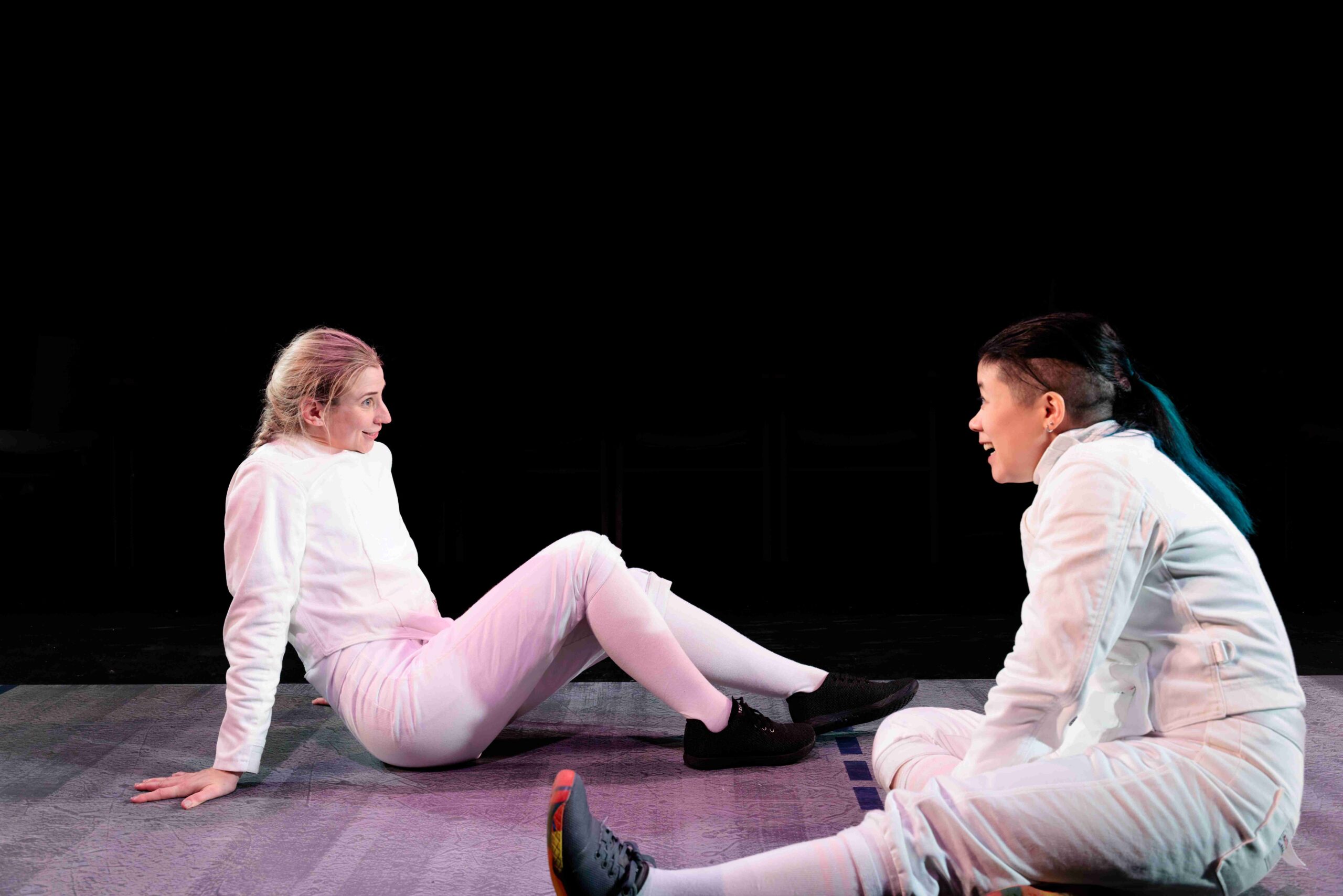
As a whole, Athena appears to be a play about teenage fencing.There are fencing swords called foils. There are duels. There are nationally ranked athletes training for the Olympics. There is fierce competition, lightning-fast choreography and enough live blade work to satisfy fans of action-packed spectacles like The Princess Bride or Game of Thrones.
Beneath every sound of steel is something far more intimate
Running through Aug. 9 at Theatre NOVA, Gracie Gardner’s Athena tells the story of Mary Wallace and Athena, two talented 17-year-old fencers whose lives revolve around practice, competition and relentless pursuit of excellence. They spend nearly every day together, constantly measuring themselves against one another. They want to be friends, but the ultra-competitive, technology-driven world around them continually insists they should be rivals.
The result is a smart, funny, and emotionally poignant coming-of-age story that explores friendship, identity, ambition and what it means to grow up in a culture that often teaches young women to see one another as hated rivals instead of companions.
For Theatre NOVA Producing Artistic Director Shelby R. Seeley, bringing the play to Ann Arbor has been a years-long passion project.
A play worth fighting for
Long before she became Theatre NOVA’s Producing Artistic Director and Literary Manager, Seeley knew Athena was a play she wanted audiences to experience.
“I found this script at a very artistically defining moment for me,” Seeley said. “I was young and thirsting for plays that portrayed me and the young women in my life with the complexity and care we deserve on stage. I was developing my sense of taste in theatre and what kind of work I wanted to pursue. When I first read Athena by Gracie Gardner, I knew I’d found it.”
She spent years pitching the play to professional theatres across Michigan before Theatre NOVA finally welcomed the production.
Her determination stemmed from the way Gardner portrays teenage girls—not as stereotypes, but as fully realized young women wrestling with ambition, vulnerability, and the desire to belong.
“Athena stood out because of the action and spectacle, the violence and feral-ness, but also the intimate, tender and devastating platonic love story between two friends,” Seeley said. “It’s a portrayal of the unique complexities of friendship between young women who just want to connect in a world that would rather they arbitrarily be in competition with one another as athletes, and even as women.”
She believes Gardner’s script gives its characters a rare emotional honesty.
“Athena takes these girls seriously and allows them to be fierce, loud, imperfect, youthful, emotional, funny, but also incredibly skilled (talented, passionate, disciplined), intelligent, and proud of their own successes,” Seeley said. “It celebrates them for all they are and all they are not. It allows them to fail as they figure out how to love. That’s what it felt like to be 17.”
The play also arrives at a moment when stories centered on teenage girls are receiving renewed attention in professional theatre.
Seeley points to recent successes such as John Proctor Is the Villain and the growing popularity of what many critics have begun calling “girl theatre.”
“Athena feels vital right now because we are in a moment where stories about young women and teen girlhood are finally being recognized as urgent, complex, and worthy of the stage,” she said. “This trend of ‘girl theatre’ is giving space to the messy, intense, and complex inner lives of young women, and audiences are showing up for it in a real way. At Theatre NOVA, championing new work means engaging directly with that shift, and Athena brings the same momentum and excitement they’re seeing Off-Broadway to Southeast Michigan in real time.”
RELATED: Friendship Takes Center Stage in Purple Rose’s World Premiere of Emma’s Wedding(s)
Fencing as a language
The production’s biggest visual and choreographed draw is its extensive live fencing.
Fight-directed by Joe Wright, Athena stars Jennifer Pan in the title role alongside Brittany Batell as Mary Wallace and Amanda Buchalter as Jamie. Wright and Pan are founders of Theatrica Gladiatoria, a Ypsilanti-based company dedicated to advancing stage combat through training, choreography and performances for stage and screen. Batell has earned SAFD certification in singlesword, while Buchalter is a five-time certified SAFD Actor Combatant and a certified Intermediate Actor Combatant with Fight Directors Canada.
Jennifer Pan believes audiences are in for something special.
“This cast has some of the most trained stage combatants in the entire southeast Michigan area, and I can’t wait for audiences to experience how good and story-driven it can look in a live show,” she said.
Batell said the fencing itself becomes another form of storytelling.

“The thing about stage combat is that each fight is a mini-story in itself, of trading advantages and disadvantages, strengths and weaknesses, wins and losses.”
For Seeley, fencing perfectly mirrors the emotional contradictions at the heart of Gardner’s script.
“I think fencing is a sport inherently full of juxtaposition,” she said. “You have to be both an athlete and a strategist, aggressive yet restrained, violent and graceful. Those contradictions fascinate me.”
She says the sport gives young women permission to embrace emotions that are often discouraged.
“Fencing, and this script, asks women to take up space, be unapologetically competitive, and channel aggression without softening it for anyone else’s comfort. The athleticism is raw, the emotions are messy, and the stakes feel primal. That’s the kind of femininity I’m drawn to onstage—not passive or polished, but fierce, instinctive and human.”
While audiences may expect the fencing matches to dominate the production, Seeley said Gardner’s writing effortlessly balances action with emotional depth.
“The show is just so well written,” she said. “It’s built to hold all of these complexities.”
An elite cast makes the impossible possible
Producing a play built around realistic fencing would be daunting for most theaters, but Theatre NOVA assembled an unusually qualified cast.
“It made it possible to achieve at all,” Seeley said. “I’ve been relentlessly championing directing this play in Michigan without worrying about how we would find actors with the physical skill necessary to make this production possible, just a kind of blind confidence that if we put it out into the world, everything would eventually work itself out.”
Looking back, she believes timing was everything.
“Call it naive, or wildly optimistic maybe, but I kept getting ‘no’ for a reason,” she said. “I think the universe was holding me off from this production until the right moment, when everything would fall into place, and I would have this team to make it happen.”
Working alongside Wright only reinforced that belief.
“I believe each person in the room is the expert in their own field, and my job is to help unleash that expertise toward a shared vision,” Seeley said. “Joe is the expert. He understood the show right away, and it’s been an honor to watch someone so passionate, specific and so deeply committed to storytelling approach the fights. I didn’t have to explain much. He just got it, and we were off!”
An immersive experience
Theatre NOVA has also transformed its performance space specifically for Athena.
Instead of its traditional thrust stage, the production uses an alley—or tennis-court—configuration, placing audiences on opposite sides of the action. The unique setup required significant work from the production team, including lighting designer Jade Guerriero, set designer Amanda Bates, and numerous volunteers.
“We are doing this show in a tennis-court style, or alley configuration, with the audience on two sides of the stage, which is new and exciting for NOVA,” Seeley said.
She praised the collaborative effort that made the transformation possible.
“Having a team of people willing to believe in this vision and then put their time and talents toward making it happen is really empowering and exciting,” she said. “Their attention to detail also helped us make this production safe in our space.”
For Seeley, the configuration isn’t simply a staging choice—it’s an essential storytelling device.
“Putting the show in an alleyway configuration was the only way I could direct this play,” she said. “When you experience a production in an alley configuration, you should leave thinking, ‘There was no other way this story could have been told.’ That’s exactly what I’m hoping audiences will feel.”
The arrangement also reinforces one of the play’s central ideas.
“It also deepens the play’s themes of connection,” she said. “Throughout the performance, you’ll be looking across the stage and catching the reactions of the people sitting opposite you. The audience becomes part of the storytelling, witnessing not just the actors but each other.”
Finding connection in a competitive world
Although Athena revolves around elite athletics, Seeley believes its message extends far beyond sports.
The production updates the timeline to 2025-26, making its teenage characters part of the generation whose middle-school years were disrupted by the COVID-19 pandemic.
“We are forever changed as a society because of COVID,” she said. “The American loneliness epidemic is worse than ever, especially for young people.”
Ultimately, she hopes audiences recognize that the play isn’t asking viewers to choose between ambition and compassion.
“I think women are often taught they have to choose a single box to fit into: wildly successful or broadly liked, relentlessly ambitious or deeply loved, competitive or connected,” Seeley said. “I think Athena asks why those have to be mutually exclusive.”
Her hope is that audiences leave believing “they don’t have to make themselves smaller, softer, or less driven to deserve both success and love.”
For those wondering whether a play about competitive teenage fencers is really for them, Seeley offers a simple invitation.
“At its core, Athena is about competition, friendship, and ambition in the high-stakes world of teenage fencing. It’s fast, funny, physically explosive and emotionally charged. You don’t need any prior knowledge of fencing or theatre to connect with it.”
In the end, she said, audiences may arrive for the thrilling live swordplay—but they’ll leave remembering something much more personal.
“The spectacle of live fencing may get you in the door,” Seeley said, “but what stays with you is a friendship changed by an act of love.”
Athena runs through Aug. 9 at Theatre NOVA, 410 W. Huron St., Ann Arbor. Performances are Fridays at 8 p.m., Saturdays at 3 p.m. and 8 p.m., and Sundays at 2 p.m. Tickets are $30 for general admission, $25 for patrons 65 and older, and $15 for students with a valid student ID. Theatre NOVA is a nonprofit professional theater dedicated to developing and producing new plays while supporting emerging playwrights.

Donna Marie Iadipaolo is a writer, journalist, and State of Michigan certified teacher, since 1990. She has written for national publications like The Village Voice, Ear Magazine of New Music, Insurance & Technology, and TheStreet.
She is now writing locally for many publications, including Current Magazine, Ann Arbor Family, and the Ann Arbor Independent. Her undergraduate degree is from the University of Michigan, Ann Arbor, where she graduated with an honors bachelor’s degree and three teacher certificate majors: mathematics, social sciences, English. She also earned three graduate degrees in Master of Science, Master of Arts, and Education Specialist Degree.

