
As the nation approaches the 250th anniversary of independence, the William L. Clements Library at the University of Michigan is inviting visitors to step back into the turbulent world of 1776.
The exhibit, Revolutionary Paine, commemorates the 250th anniversary of Thomas Paine’s Common Sense — a pamphlet that helped transform colonial unrest into a movement for independence.
But the exhibit does more than celebrate a famous text. It explores the fierce debates, rival publications and global reverberations that surrounded Paine’s ideas — and asks visitors to consider how persuasion works in moments of political crisis.
Who: Curators, Students, and a Revolutionary Voice
Maggie Vanderford, Librarian for Instruction and Engagement at the William L. Clements Library, co-curated the exhibit with Professor Andy Murphy, Emiko Hastings, and the POLISCI 495 class.
She explained her hands-on role in bringing the project to life: “I was responsible for coordinating all efforts involved with producing the exhibit, from communicating with the library staff working on the project (in conservation, digitization, marketing and curation) to planning and teaching class visits for the students in POLISCI 495. I worked closely with my colleagues and Dr. Andrew Murphy to shape the learning experience for the students working on an exhibit for the first time!”
That collaboration between faculty, librarians and students became central to the exhibit’s vision. Rather than simply mounting rare books in glass cases, the team approached the project as both scholarship and pedagogy.
What: 58 Editions and a Story Beyond the Textbook
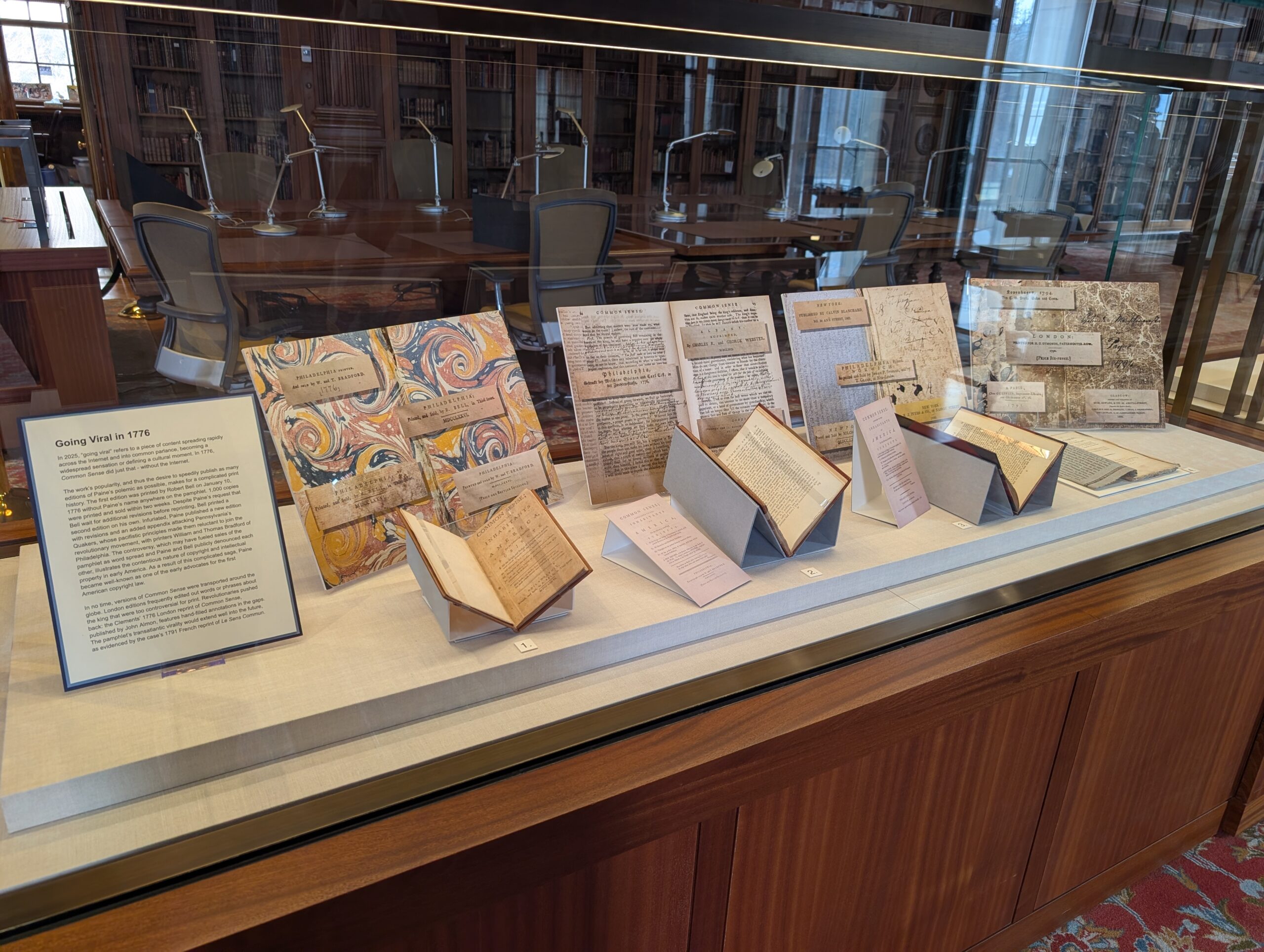
At the heart of the exhibit is the Clements Library’s extraordinary collection of 58 editions of Common Sense. The opening display makes that abundance immediately visible.
“The first case of the exhibit showcases four of the library’s 58 copies of Common Sense, accompanied by a backdrop of the various title pages from some of the other copies,” Vanderford said. “Visually, it’s a striking representation of the extent to which this pamphlet was printed, reprinted, republished and amended in a way that was unusual for early American printing. We wanted viewers to get a sense of that textual overwhelm, and it seems to have been successful!”
Selections include the first edition, a second edition that featured a polemic against Philadelphia’s Quakers, a London edition with censored passages, and a French translation, Le Sens Commun, published during the French Revolution.
RELATED: 10 Spots in Ann Arbor for History Buffs to Visit
“Students worked with the Clements staff to find historically significant editions — the first one, of course; then the second, which included a polemic against Philadelphia’s Quakers and gave them a window into 18th century publishing battles; then a London edition, in which censors tried to obscure Paine’s criticisms of the monarchy (and dogged, industrious readers wrote the words back in!); and then a French version, Le Sens Commun, which appeared during the French Revolution,” said Andrew Murphy, co-curator and professor of political science. “Each one showed an important aspect of this very important book.”
When: 250 Years Later
The exhibit coincides with a major anniversary moment in American history.
“It’s important to remember that the 250th anniversary of the Declaration of Independence is also the 250th anniversary of Common Sense; and that Common Sense was published six months earlier, in January 1776,” Murphy noted. “So if you really wanted to push the point, you could say that it’s possible that without the publication of Common Sense to help mobilize people in favor of independence, there might not have been a Declaration of Independence.”
The timing invites visitors to reconsider the pamphlet’s catalytic role — not just as commentary, but as momentum.
Why: Debate, Polarization, and Political Persuasion
Both curators emphasize that independence was not inevitable in early 1776.
“The effectiveness of Common Sense depended on Paine’s ability to polarize public opinion: to force people to take a side between American independence or reconciliation with Britain,” Murphy said. “It seems unclear that independence was the majority position in early 1776 — but Common Sense is part of the story of how more and more people began to be able to envision an American future as an independent nation, not just as colonies of Great Britain. So it was as much a way of convincing Americans to THINK differently about themselves as it was about wars and battles and taxes and the like.”
The exhibit also highlights Paine’s critics, including loyalist responses such as James Chalmers’s Plain Truth and Charles Inglis’s True Interest of America.
“We were surprised to realize how much close immersion in an object influenced a student’s perspective on it,” Vanderford reflected. “For example, the students who worked on Case Two were deeply engaged with Loyalist responses to Paine. By the time they gave their final presentations, many of them were very much convinced by the Loyalist reasoning and were turned off by Paine’s emotional rhetoric. It signals to me that there is no substitute for deep, thorough, hands-on learning that helps students develop original thought.”
In other words, the exhibit does not present revolution as a foregone conclusion. It presents it as argument.
How: Making History Come Alive
The project was carefully integrated into a University of Michigan political science course.
“We worked closely with Dr. Murphy to integrate the exhibit into the syllabus of the course,” Vanderford said. “The first few months were spent not only helping students acclimate to understanding Paine and his world, but to understanding how that information could be distilled and presented to a general public. We had sessions on selecting items for cases, researching individual items and writing effective captions, and making choices about how to display an object for the intended effect. The students rose to the challenge and ended up taking real ownership over their choices.”
Visitors are encouraged to approach the exhibit with fresh eyes.
“One of the students in the class said that their advice was for visitors to ‘pretend that they don’t know how the story ends,’” Vanderford said. “Let the exhibit put you into the mindset of a Revolutionary-era American living in an incredibly turbulent time, immersed in pamphlets with all sorts of opinions and arguments to inform their awareness. There is no news television, no Twitter, no public radio — print media is what exists to communicate and debate for the majority of the public, even if that print was being read aloud.”
The exhibit also includes sensory elements: a dramatic audio recording created in collaboration with students from the School of Music, Theatre, and Dance and a 3D-printed model of an illustration featured in one case.
Where: An Archive That Still Tells New Stories
For Vanderford, the exhibit underscores the enduring power of archival work.
“The archive is still a place where new stories can be told about our familiar versions of the past,” she said. “Producing an exhibit is one way to help students study history in a way that makes it come alive, because it has real-world implications in a sense that an essay (which might only ever be read by one professor) does not. At the Clements, we are always interested in finding new ways to create rich learning experiences by creating hands-on engagement.”
Located at 909 South University Avenue in Ann Arbor, the William L. Clements Library houses Revolutionary Paine in its main exhibit gallery. The exhibit runs through May 8 and is open to the public during regular library hours, typically Monday through Friday from noon to 4 p.m.
Visitors are encouraged to check the library’s website for any special programming or schedule updates tied to the 250th anniversary commemorations. For more information: https://clements.umich.edu/exhibit/revolutionary-paine/

Donna Marie Iadipaolo is a writer, journalist, and State of Michigan certified teacher, since 1990. She has written for national publications like The Village Voice, Ear Magazine of New Music, Insurance & Technology, and TheStreet.
She is now writing locally for many publications, including Current Magazine, Ann Arbor Family, and the Ann Arbor Independent. Her undergraduate degree is from the University of Michigan, Ann Arbor, where she graduated with an honors bachelor’s degree and three teacher certificate majors: mathematics, social sciences, English. She also earned three graduate degrees in Master of Science, Master of Arts, and Education Specialist Degree.

