
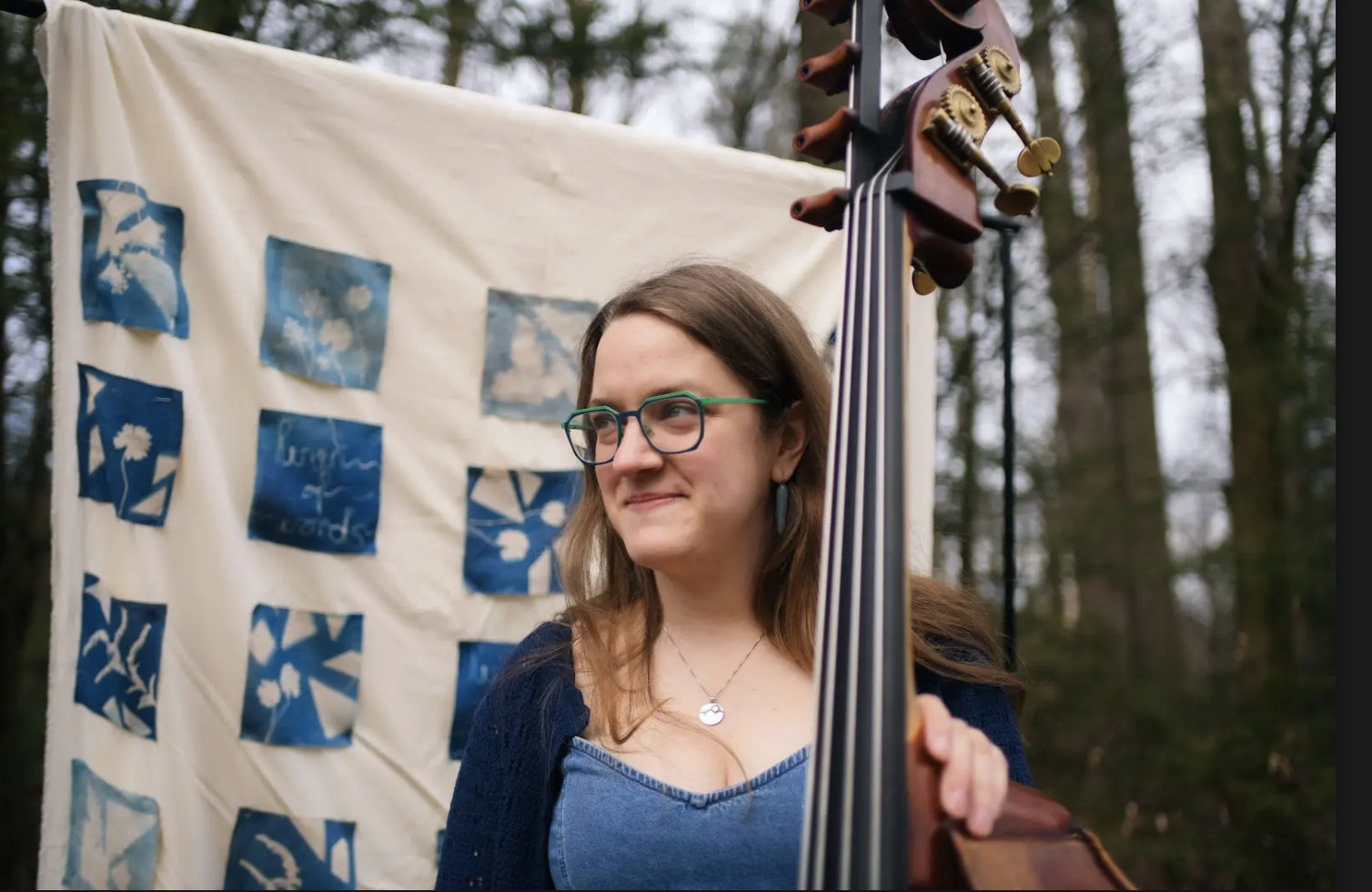
Annick Odom’s project Linen of Words is a blend of modern sonic pleasantries matched with the charm and attraction of a small village placed in a world where magic exists. Equipped with an orbit’s roster of instrumentation, ranging from soft-humming strings to plucking guitars and subtle basses, Odom, through 12 tracks, takes the listener to the audio equivalent of the town tour, where tempos vary from conversation to conversation and there’s always a high chance of you hearing or seeing a fiddle.
For those unfamiliar, Odom is from the Ann Arbor and Southeast Michigan music community. She is a singer, bassist, clarinetist and composer who studied at the University of Michigan. For her album “Linen of Words,” she describes the album as a multi-year process.
“The title comes from a phrase by the poet Mary Oliver: ‘the linen of words.” I kept returning to that image while making the album. Linen is something practical, handmade, and durable,” Odom said via email. “It softens with use and carries traces of the people who worked with it before you. That felt very similar to the songs on this record. Many of them come from Appalachian ballad traditions, oral histories, and stories passed down through generations. The album is really about what we inherit through language and song, and how we continue weaving those stories into our own lives.”
RELATED: Concert of Colors 2026: Detroit’s Free Global Music Festival
While the project draws on Appalachian ballad traditions from her home state of West Virginia, it is deeply shaped by the collaborative music community in Ann Arbor and Detroit. Sonically, the album does everything to take the listener on a journey, incorporating subtle elements to make the shifting journey as realistic as possible, from the sounds of birds chirping to the clanking of pots and pans between her singing. The instruments’ sometimes chaotic nature shifts between organized and independent at a moment’s notice. The album maintains that you should always expect the unexpected from second to second, solely ensuring you will enjoy the ride.
“I’ll admit I wasn’t consciously trying to create a specific emotional arc, but I do think the album reflects different stages of life and different ways people make sense of the world. I also don’t think I could have made an album with a single emotional tone because the project took nearly five years to complete,” says Odom. “I started some of these original songs while living in the Netherlands during the pandemic, feeling very far from home and reconnecting with Appalachian music from a distance. Others came later, after I’d returned to West Virginia and become more involved in community arts, storytelling, and traditional music. So the album naturally ended up containing different versions of myself.”
The album features more than 20 musicians, including 15 based in Southeast Michigan (Detroit, Ypsilanti, Ann Arbor, and Hamtramck), working across folk, jazz, and contemporary music. However, the album itself does not include a single instrument outside of Odom’s voice until the third song. She said, without the range of artistry, the project would have lacked its diverse storytelling and completeness.
“This album took almost five years to complete and involved an extraordinary community of collaborators,” Odom said. “Some were friends I’ve played with for years, mostly University of Michigan grads, who I’d known during school, or who went through the music school after me. Some were friends I made in West Virginia or the Netherlands, and others were old-time musicians or local musicians in the Southeast Michigan scene who came into the project because they had exactly the sound a particular song needed.”
With a runtime of just under an hour and multiple songs lasting nearly ten minutes, Odom’s power as a conductor and a storyteller stands tall on this project. Whether it is the range from youthful innocence to adulthood stresses like the tracks “Amity” and “Lone Pine,” or fantasy and subtle folklore elements existing in a world outside our own, such as “Last Week’s Flowers” or “Bingham Baily,” Odom captures a unique mixture throughout this project for listeners to enjoy. She said that throughout this album, she hopes people understand that her music was created by those who shaped her musical influence.
“This album wouldn’t exist without community. Albums are often talked about in terms of individual artists, but these songs emerged from relationships – with teachers, collaborators, singers, archives, audiences and places,” Odom said. “The album may have my name on the cover, but it’s really the product of many people sharing songs, stories, encouragement, ideas, couches, rehearsal spaces, rides to gigs, meals after concerts and countless conversations over several years. That’s something I’m deeply grateful for, and I hope listeners can hear that sense of connection throughout the record.”
“I also hope the album serves as a thank-you to some of the people who helped shape me. To mentors like Phyllis Marks and Gerry Milnes. To friends in Michigan, West Virginia, and Europe who kept making music with me. Traditional music and experimental music both remind me that culture isn’t something we consume—it’s something we can make together and let our wildest imaginations and deepest feelings out. If there is a thread running through the entire album, I think that is probably it.”

Antonio Cooper is a freelance journalist from Detroit, Michigan. His coverage of music festivals and interviews with local celebrities appeared in The E-Current Magazine, The Detroit Metro Times, XXL Magazine, RichMagDigital, The Ann Arbor Observer, and Pop Magazine.

