
What does it mean to be a loser?
For writer-director Megan Rico, it may be one of the coolest things a person can embrace.
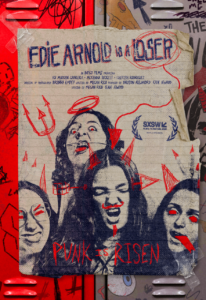 Audiences will have an opportunity to explore that idea when the Michigan Theater hosts a special screening of “Edie Arnold Is a Loser,” followed by a conversation with Rico and co-director Kade Atwood. The independent coming-of-age comedy has earned praise on the festival circuit for its blend of sharp humor, heartfelt storytelling, and memorable characters, but its roots are surprisingly personal.
Centered on Edie, an awkward Catholic school student who unexpectedly discovers her talent as a drummer and forms a punk band with her friends, the film celebrates creativity, friendship, and finding a place where you belong. During the post-film discussion, Rico and Atwood will offer audiences a behind-the-scenes look at how the movie came to life, from its earliest draft to the realities of making an independent feature on a shoestring budget.
A story born from personal experience
Although the film is packed with humor, Rico says it began with memories of her own adolescence.
“This was the first feature film I had ever written—I wrote it like a decade ago—and I think because of that, I kept the story pretty simple,” Rico said. “I pulled a lot of it from my own experiences as a loser at an all girls Catholic school in Miami, FL. I think at the time, I was just writing what I thought was a funny little movie, but revisiting it years later, it’s clear I was working through some real angst there.”
RELATED: September Movies at the State Theater
That authenticity gives the film emotional depth beneath its comedy. Rather than creating an idealized teenage heroine, Rico wrote a character who struggles to recognize her own worth.
When asked whether it was difficult to make audiences root for Edie despite her flaws, Rico said she never saw the character as difficult to love.
“I never really felt like it was challenging,” Rico said. “I think her flaws are truly just that she doesn’t see herself as she is, which is a genuinely cool person with inherent value. Sure, she’s a little sarcastic and maybe a bit of a brat, but I think those are endearing qualities in a teenaged girl.”
Comedy with heart
For Rico, comedy has always been her natural storytelling language. Even while exploring themes of loneliness, identity and belonging, she wanted audiences to laugh without losing sight of the humanity behind every character.
“I’ve always written comedy—it’s just the lens through which I view the world, so even if I was trying to tell a hard hitting period drama, the jokes were always going to sneak in,” Rico said. “I really wanted to make sure the characters felt authentic, and not like flat caricatures. Everyone has an inner life, even the most minor character who exists only for a joke, and by remembering that and letting it inform the jokes you write, you can have the humor without letting the humanity go by the wayside.”
That balance between comedy and sincerity is one of the reasons Atwood was immediately drawn to the project.
“The characters,” Atwood said. “A lot of my friends growing up were like these characters but I hadn’t ever seen them—especially girls—portrayed on screen in this way. So I was very excited to bring that to life. Also the comedy was huge for me. Most comedies are released straight to streaming nowadays, which is unfortunate. There’s nothing like sitting in a packed theater laughing together with a group of strangers.”
The Michigan Theater screening offers exactly that communal experience—one of the reasons the filmmakers are excited to share the movie with audiences in person.
Making a feature in just ten days
Independent filmmaking often demands creativity that extends far beyond the screenplay.
For Atwood, the biggest obstacle wasn’t a lack of ideas—it was time.
“The biggest hurdle was time,” Atwood said. “We filmed the movie in ten days. This forced us to find creative solutions for how we would cover certain scenes. We relied on blocking the actors to keep it engaging, but ultimately we love this approach and feel the movie is better because of these limitations that were imposed on us.”
The collaboration between Rico and Atwood also evolved in unexpected ways. Although they initially expected to divide responsibilities according to their professional backgrounds, the process became much more collaborative once production began.
“We thought there’d be a much clearer division of labor going into the shoot,” Atwood said. “Megan comes from a writing and performance background and I come from a technical background. So we assumed she would lead cast and I would lead crew. But that wasn’t the case. Whoever had the note or felt more strongly about it would be the one to give it.”
Rico also discovered that directing a feature-length film required a different level of endurance than anything she had experienced before.
“The sheer amount of stamina needed to complete a feature length film was surprising to me,” Rico said. “It’s a grueling process, and your brain feels like it’s going to leak out of all the holes in your face some days, but it’s not. That’s physically impossible. So you don’t have to be scared. And I discovered I speak more in sound effects than in human language when directing.”
Finding your people
While the film’s comedy may attract audiences, Rico hopes viewers leave the theater thinking about something deeper.
“I hope teenage audiences see themselves in these characters and come away with a feeling, not just of self-acceptance, but of self-celebration,” Rico said. “I want them to know that even if they feel like they don’t fit in, their people are out there somewhere, and the fastest way to find them is by making art—any art, even shitty art. Maybe especially shitty art.”
That message is reflected in the film’s provocative title.
Asked what “Edie Arnold Is a Loser” really means, Rico offered a simple answer: “It means that sometimes embracing the loser within is the coolest thing you can do.”
Atwood says completing the project itself remains his proudest accomplishment, regardless of the recognition it has received on the festival circuit.
“Honestly, I’m most proud of the fact that we even made a feature,” Atwood said. “It’s a miracle any movie gets made, let alone one on a micro budget. All the accolades are really exciting but we never set out to achieve any of that. We just wanted to make a movie that we would love and we did that.”
More than a movie
The Michigan Theater event offers audiences more than an opportunity to watch an acclaimed independent comedy. It provides a chance to hear directly from two emerging filmmakers about collaboration, perseverance and the creative risks involved in bringing a deeply personal story to the screen.
Whether viewers connect with Edie’s awkwardness, laugh at the film’s offbeat humor, or remember their own teenage search for belonging, Rico hopes the conversation continues long after the credits roll.
“I’m hoping they’re immediately calling their friends to start a band,” Rico said. “And then quoting their favorite jokes from the movie at each other.”
For anyone who has ever felt out of place—or discovered unexpected confidence by pursuing a creative passion—”Edie Arnold Is a Loser” promises to be both entertaining and affirming. Combined with the filmmakers’ post-screening discussion, the Michigan Theater event offers audiences a rare opportunity to experience an independent film while learning firsthand how an intensely personal story became a festival favorite and, perhaps, a reminder that being different can be something worth celebrating.
Screening details
- Date: Tuesday, September 29, 2026
- Time: 7pm
- Special Event: Post-film Q&A with filmmakers Megan Rico (writer/director), Kade Atwood (director/producer), Adi Madden Cabrera (lead actor), and Bryson Alejandro (producer/actor), plus a temporary tattoo station
Donna Marie Iadipaolo is a writer, journalist, and State of Michigan certified teacher, since 1990. She has written for national publications like The Village Voice, Ear Magazine of New Music, Insurance & Technology, and TheStreet.
She is now writing locally for many publications, including Current Magazine, Ann Arbor Family, and the Ann Arbor Independent. Her undergraduate degree is from the University of Michigan, Ann Arbor, where she graduated with an honors bachelor’s degree and three teacher certificate majors: mathematics, social sciences, English. She also earned three graduate degrees in Master of Science, Master of Arts, and Education Specialist Degree.
