
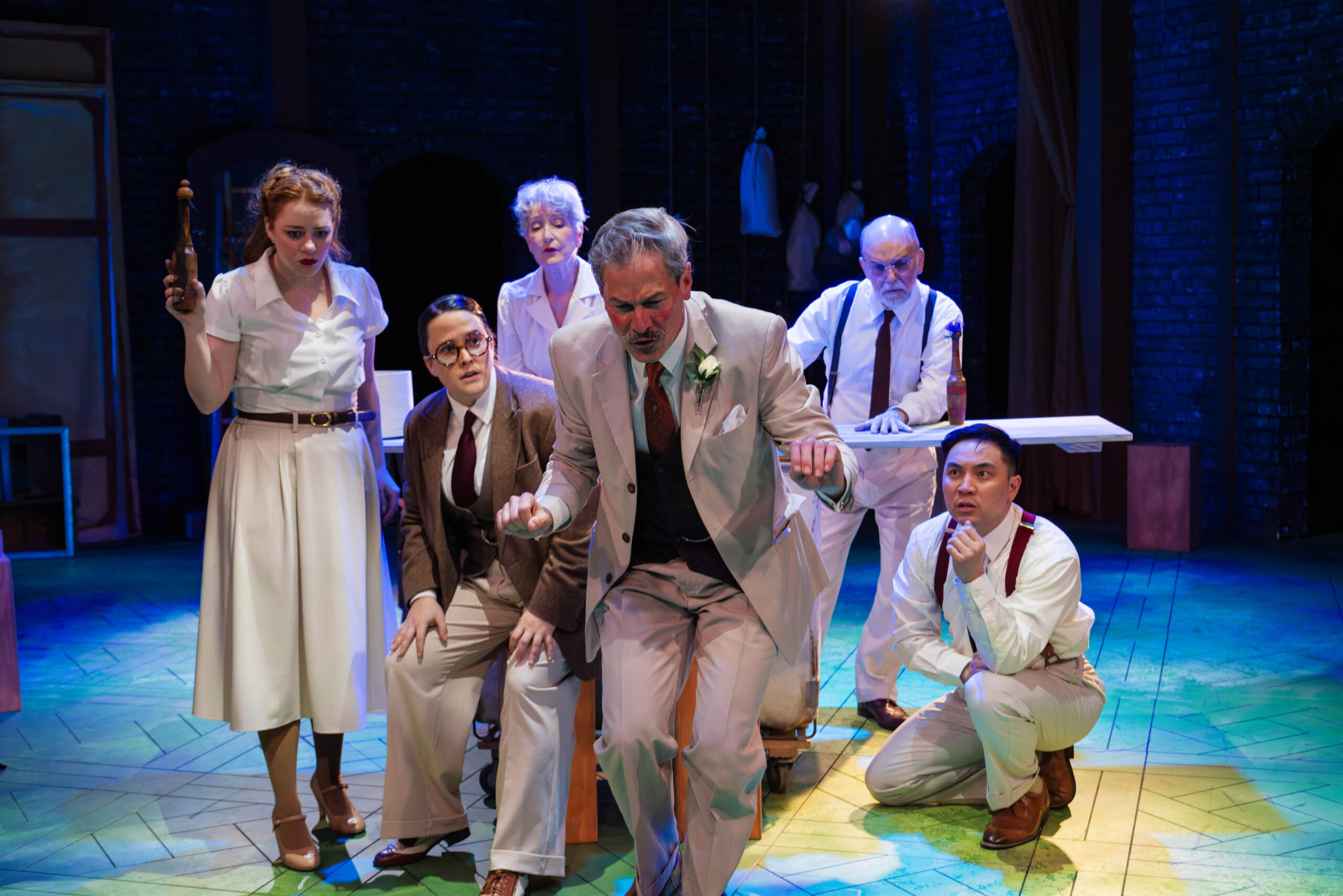
The lights dim, the air in the intimate Chelsea playhouse thickens with anticipation, and suddenly, the quiet of the countryside is shattered.
But at The Purple Rose Theatre Company, this isn’t the somber, cigarette-smoke-filled mystery you might expect from a 1923 Agatha Christie novel. Instead, the Michigan premiere of Steven Dietz’s adaptation of “Murder on the Links” is a high-octane, comedic whirlwind that celebrates the chaotic, beautiful machinery of live theater.
While the core of the story remains a classic whodunit—the legendary Hercule Poirot arrives at a villa only to find his client already dead and buried on a golf course—the production itself is a feat of modern theatrical stamina. With a cast of only six actors tasked with bringing dozens of characters to life, the show is less of a standard period piece and more of a precision-engineered marathon.
The art of the quick-change: A precision machine
For the actors involved, the production is a departure from the typical rhythms of stagecraft. Usually, a play allows for moments of reflection backstage, but “Murder on the Links” demands a level of technical rigor that begins the moment the actors arrive at the theater.
Ashley Wickett, who portrays “Woman 2,” is a prime example of this versatility. Her track includes a dizzying array of personas: Dulcie, Bella, Leonie, Marte and even a Gendarme. For Wickett, the challenge wasn’t just in the acting but in the sheer logistics of the performance.
“The biggest challenge with this particular script is just how intricate and precise each scene is,” Wickett said. “We truly had to work as an ensemble and with the director, designers, everyone to get extremely specific with every move, every transition, every costume change. It is a group effort, and if one cog of the machine is missing, it stops working!”
This “machine” extends far beyond the footlights. Because the show relies on a small cast to create a populated world, the actors are responsible for the physical transformation of the stage in real-time.
“Typically, at the Rose, we don’t set blocking and tech elements right away; there is a lot of time to explore and discover those elements,” Wickett said, comparing this to more traditional dramas. “But for this show, it was really important that we set as many components as we could as early on as we could. It’s also a bit different from a typical show in the sense that normally in a play if you aren’t in a scene, you may have some downtime backstage… not with this show! We are all running around, changing costumes, setting the stage, making sound effects… we are doing everything the whole time! No downtime!”
Finding the character in the chaos
John Seibert, a veteran of the stage with over 40 years of professional experience, brings a seasoned perspective to the role of “Man #1.” Like Wickett, Seibert is responsible for six different roles within this single adaptation. For a performer “of a certain age,” as Seibert humorously puts it, the physical and mental demands are significant, but the reward lies in the creative problem-solving.
RELATED: Stitching Community Into Film: Heidi Kumao’s 35 Days and the Art of Care
“My clues come from the writing,” Seibert said, noting that he draws from both Agatha Christie’s original prose and Steven Dietz’s modern flair. “This cast had scripts in hand at least a month before rehearsals began. As you familiarize yourself with the dialogue, little clues start to emerge as to how you might use voice and body to make each character unique. You bring that to the table and rehearsal room and offer those early choices up and then let the director guide you from there.”
The rehearsal process at The Purple Rose, led by director David Bendena, focused heavily on this collaborative spirit. Seibert emphasizes that even with the tight choreography required to keep the play from descending into actual chaos, there was a sense of shared ownership.
“David Bendena created a tremendous rehearsal environment,” Seibert said. “Every person in the room was made to feel a part of the creative problem-solving process. While a director always has ‘final say,’ David made us all feel that we had a stake and our share of ‘ownership’ of the final outcome. It was a great deal of fun to go to work every day!”
For Wickett, the nine-week rehearsal and performance cycle allowed the characters to settle into her muscle memory. What began as a complex series of cues eventually became a fluid transformation.
“For me, it was so lovely to have such a nice, long rehearsal process which allowed us to find the specificity of each character over time,” she reflects. “Because we were given time to play and explore, I felt like I could get very specific with each character. And now—after almost 9 weeks, as soon as I switch a hat or a scarf, the new character just comes immediately. It’s quite fun.”
Breaking the fourth wall
Audiences walking into The Purple Rose might expect a literal interpretation of a French golf course and a 1920s villa. However, Steven Dietz’s adaptation is “meta-theatrical,” meaning it acknowledges that it is a play being performed by a troupe of actors. This stylistic choice adds a layer of humor and whimsy that distinguishes it from more traditional Christie adaptations found on film or television.
“The biggest departure is that Dietz has written a troupe of actors putting on a play of the story,” Wickett said. “I think all of us have taken inspiration from the original story and characters, but ultimately wanted to make them our own and put our own spin on them.”
Seibert believes this transparency is exactly what makes the production special. By leaning into the limitations of the stage, the play invites the audience to use their own imaginations.
“Steven Dietz, as he does in many of his plays, gives the audience the extra gift of letting both the actors and audience use their imaginations in ways we can ONLY stage in a theatre with a live audience,” Seibert said. “He makes no apologies for, and also celebrates the fact that these are a handful of actors putting on a play in a theater with limited space and resources. He wants it to be playful and unique and it certainly has been!”
Solving the mystery or enjoying the ride?
As the body count rises and Poirot twirls his mustache, a question remains: is the audience there to play detective, or simply to enjoy the comedy? Even within the cast, there is a playful debate regarding the show’s true intent.
“I love when the audiences try to guess the killer… that’s the fun of a murder mystery,” Wickett said. “But also, the story is half the fun—enjoy the ride of all the crazy people you are going to meet in France!”
Seibert, however, leans toward the “ride” side of the debate. “To me, there are simply too many clever coincidences and sensational bits of information involved in solving the murder(s) to expect an audience to be fully capable of solving it themselves,” he said. “But WATCHING it unfold, I think, especially in this really beautiful and creative staging of the mystery, is MORE than worth the price of admission!”
Whether you are a die-hard Christie fan looking for clues or a theatergoer looking for a laugh, “Murder on the Links” offers a rare glimpse into the sheer athleticism of acting. It is a production where the sweat and the spirit of the ensemble are just as visible as the mystery itself—and in the world of The Purple Rose, that is the greatest reveal of all.
If You Go:
- Production: Murder on the Links by Steven Dietz
- Venue: The Purple Rose Theatre Company, 137 Park St, Chelsea, MI
- Dates: Now through May 31, 2026
- Tickets: Visit purplerosetheatre.org or call the box office at (734) 433-7673.
- Note: Many of the performances are sold out, but you can put your name on the Waitlist by calling the Box Office.

Donna Marie Iadipaolo is a writer, journalist, and State of Michigan certified teacher, since 1990. She has written for national publications like The Village Voice, Ear Magazine of New Music, Insurance & Technology, and TheStreet.
She is now writing locally for many publications, including Current Magazine, Ann Arbor Family, and the Ann Arbor Independent. Her undergraduate degree is from the University of Michigan, Ann Arbor, where she graduated with an honors bachelor’s degree and three teacher certificate majors: mathematics, social sciences, English. She also earned three graduate degrees in Master of Science, Master of Arts, and Education Specialist Degree.

