
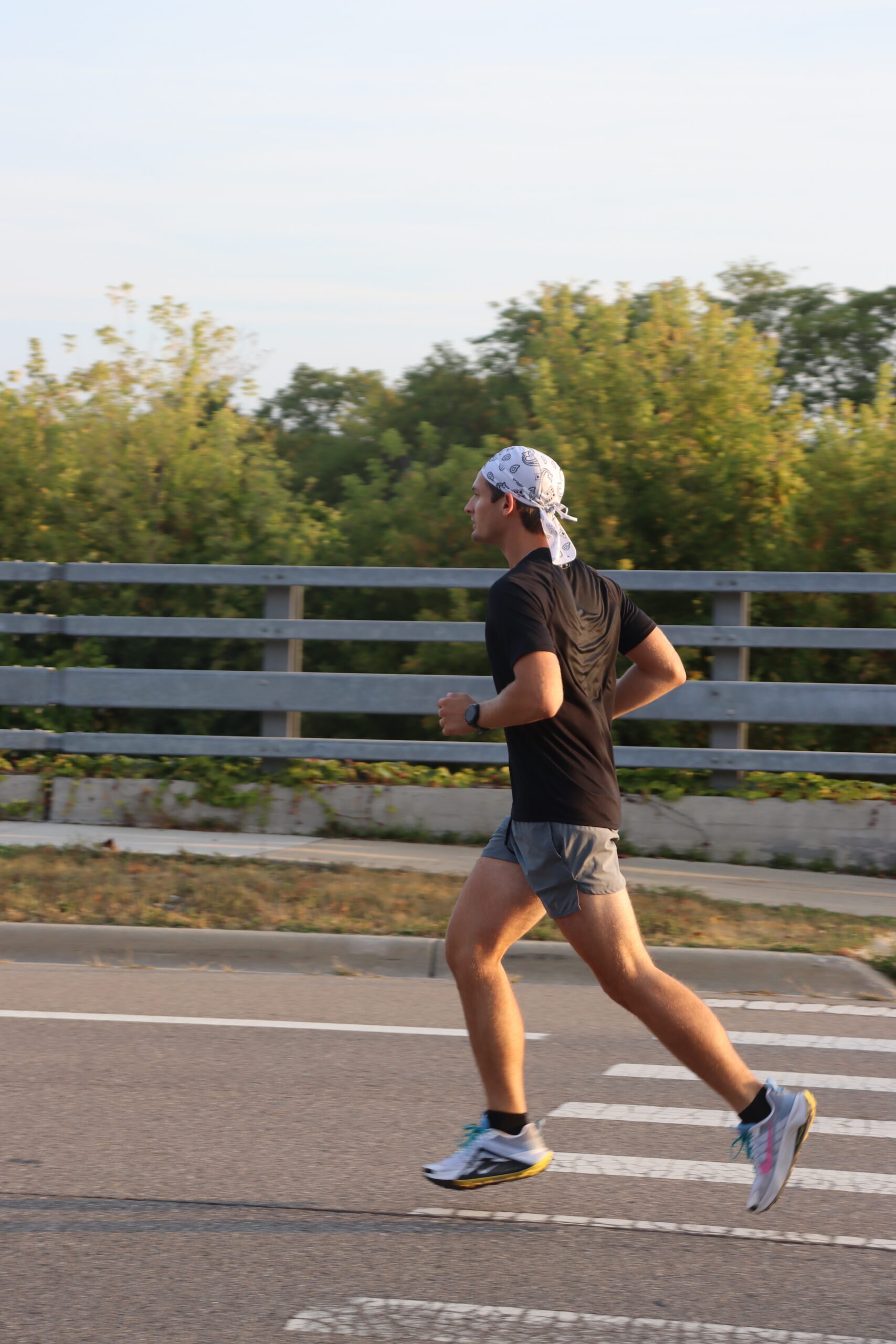
University of Michigan senior Brendan LaFrenier recently completed a 214-mile run across Michigan on March 4 to raise awareness and funds for shelters, including Shelter Association of Washtenaw County and Ozone House, raising over $33,000 so far.
 The effort was part of a larger initiative called “Endurance for Change: Run Across Michigan,” a project designed to raise awareness about homelessness while ultimately raising $100,000 for shelters throughout the state.
His journey was documented by student filmmaker Nick DelFranco, capturing both the physical challenge and interviews with shelter staff and residents. The resulting documentary, exploring homelessness and LaFrenier’s endurance feat, is in post-production and set to premiere in fall 2026.
The documentary is part of a broader collaboration with a team of University of Michigan film students, focusing on the physical challenge of running across Michigan, the community effort needed to address homelessness, and the lived experiences of people navigating housing insecurity.
A childhood moment that sparked a mission
For Brendan LaFrenier, a senior studying chemistry at the University of Michigan, the roots of his advocacy for people experiencing homelessness go back to his childhood in western Michigan.
“I am from the Grand Rapids area, and growing up, I got really emotional seeing somebody battle homelessness on the street. I cried and asked my mom what was going on,” LaFrenier said. “She told me about homelessness, and that was the first time in my life that I realized how blessed I was. That inspired me to volunteer for shelters in Grand Rapids throughout my childhood and teenage years. I stopped when I moved to Ann Arbor for college, but I wanted to give back, so I did it with my talents in this way.”
That early experience planted the seeds for a project that now combines endurance athletics with social advocacy. The Endurance for Change initiative uses extreme endurance running and storytelling to build empathy, increase visibility for the issue of homelessness, and support shelters doing critical work across Michigan.
Homelessness is a growing crisis in Michigan and the U.S., with data showing a steady, multi-year increase in people without stable housing. The State of Michigan’s homeless population rose 8% between 2021 and 2022, with over 33,000 individuals experiencing homelessness in 2023. Key drivers include a severe lack of affordable housing, with only 39 units available for every 100 extremely low-income renters.
According to HUD’s latest Homelessness Assessment Report, homelessness reached an all-time high in 2024. Approximately 771,480 people were experiencing homelessness on a single night in January 2024.
A project shaped in Ann Arbor
Being part of the Ann Arbor community and studying at the University of Michigan helped LaFrenier transform an idea into a full-scale project involving students, professors and filmmakers.
“Being a student at the University of Michigan has done a lot for this project: Being in this diverse community has widened my view on the world for the better,” LaFrenier said. “I also think that being a student here has opened me up to so many resources and allowed me to assemble the greatest team of students to pull this project off. We have also been working with various professors in different avenues of this project, and we are honored to represent the University in this endeavor. I don’t think being a student directly influenced my perspective on homelessness, but it opened so many doors in my life.”
The project has also brought together partnerships with shelters, local businesses, and nutrition companies supporting the effort. Fundraising is being administered through a fiscal sponsor, the Michigan Coalition Against Homelessness, helping to ensure transparency and accountability as funds are distributed to partner shelters.
Turning the journey into a film
The project is also being documented in a feature-length film led by a fellow student filmmaker.
“My friend Nick DelFranco is a film student, so I pitched this project to him about a year ago, and he loved the idea. I hope that audiences can truly understand what homelessness looks like and how to combat it. I also hope that audiences are inspired to take on large, challenging endeavors for things greater than themselves. The film is currently in the post-production stage and is set to release in the fall of 2026.”
Filming continued throughout training and the run itself.
“The cameras haven’t been too obnoxious during the whole process, and over the last eight months I have gotten used to having a camera and microphone on me. I just feel honored that I can suffer for a great cause and hopefully that will inspire others to do the same,” LaFrenier said.
RELATED: How the Student Advocacy Center Stands Up For Michigan’s Students
The film will explore several intertwined narratives, including the physical challenge of completing an extreme endurance run, the community collaboration required to address homelessness, and personal stories from individuals who have experienced housing insecurity.
Pushing the limits of endurance
LaFrenier has already built an impressive resumé as an endurance athlete, competing in marathons, triathlons and ultramarathons. Each race requires months of preparation and a willingness to push far beyond physical comfort.
“I have completed a few different races, most of which were not tied to any causes: I have raced two marathons, one Ironman triathlon and now five ultramarathons – 50k, two 100 miles, a backyard ultramarathon, and now this 200-mile shore-to-shore run,” LaFrenier said. “It usually takes about 16 weeks to train for any one of these, but this 200-miler took eight months (double the time). All of the experiences have been extremely unique in their own way.”
LaFrenier had previously used endurance athletics for charitable work, completing a 100-mile run to support addiction recovery initiatives and raising several thousand dollars. The Michigan run expanded that concept into a larger statewide effort combining athletic endurance, fundraising and documentary storytelling.
The toll can be immense, but the lessons learned along the way keep him returning to the starting line.
“My first 100-mile run took me 30 hours. I was sleep deprived, hallucinating and in the worst pain of my life,” LaFrenier said. “Some of these ultramarathons leave you with pain that can really scar the soul, but at the same time, you learn so much about yourself in the process of training and completing one of these events. On the emotional side, spending four months training for an event and then seeing it come to fruition is one of the feelings that keeps me doing these. I find myself crying throughout these races, just from seeing how far I have come. The journey is the best part about these events.”
Running across Michigan

LaFrenier’s most ambitious challenge so far has been a 214-mile run across Michigan, connecting communities from the Detroit area to Lake Michigan while highlighting the work of shelters across the state.
The run began March 2 and continued for several days as LaFrenier moved across the state, stopping at partner shelters along the route. During those stops, he delivered supplies, met with staff and residents, and helped draw attention to the challenges shelters face while supporting people experiencing homelessness.
“Along the route, some of the most memorable moments came from stopping at the shelters. Some of the shelters’ residents made encouraging signs like ‘never give up,” LaFrenier said. “Just seeing how supported I felt from the shelters helped keep high morale and a positive mindset, which is extremely important if you are going to run for 4 days straight.”
Support from volunteers and fellow runners also played a key role in helping him finish the grueling route. He remains humble and grateful to the entire team involved.
“I also think all of the pacers that joined me for miles helped to keep the pain off of my mind,” LaFrenier said. “People often give too much credit to the runner and don’t realize how much goes into the logistics—the crewing and the pacing. I had pacers join me for probably 140 out of the 214 miles total, and by talking to them, the pain was temporarily ignored.”
Raising money for shelters
Beyond the physical challenge, LaFrenier’s runs have become a way to raise funds for organizations helping people experiencing homelessness throughout Michigan.
“During this project, we have raised $33,000 and counting,” LA Frenier said. “We will keep our fundraiser up for the rest of the month, as we have more media appearances coming up. Our fundraiser has some neat functionality—you can donate to a specific region of shelters (i.e. Ann Arbor), or you can donate to a specific shelter, or you can just have your donation be split amongst all shelters in the state that we are fundraising for.”
“We are fundraising for 10 shelters throughout Detroit, Ann Arbor, Lansing and Grand Rapids. The two in the Ann Arbor area are Ozone House (in Ypsilanti technically) and Shelter Association of Washtenaw County,” LaFrenier said. “But I think the impact of this project goes well beyond the number of dollars we raise – we hope to call attention to the topic of homelessness, and we hope the film covers the misunderstood aspects of homelessness and how to really address the issue.”
Stories that change perspectives
Along the way, interviews with people experiencing homelessness left a deep impression on LaFrenier.
“I think there are a lot of stories from this project that will stick with me throughout my lifetime,” LaFrenier said “I don’t want to say too many of the best stories because those will be in the film, but I think one that really hit me was hearing the story of this young man, about my age. He was one of the first interviews we did.”
One particular encounter reshaped his understanding of how people experience homelessness.
“He told us that he left home because his family members were struggling with drug addictions…” LaFrenier said. “He fled home, couch-surfed for a few months until he found one of our partner shelters. He is one of the brightest people I have ever met and is going into the Army. It really stood out to me because people see the panhandler on the side of the highway exit and see that as the face of homelessness. That is not a very good representation of homelessness.”
Looking ahead
As LaFrenier prepares to graduate and head to graduate school, he is still considering what role endurance running will play in his future.
“I get this question a lot. I am not sure if I will continue ultrarunning,” LaFrenier said. “They say you don’t peak endurance-wise until you are 40, and I am only 21 years of age. But these events take a lot of time and sacrifices, and personally, I think I need some time to focus on other priorities of my life at the moment.”
Still, he says one thing is certain: whatever path he takes next will continue to involve giving back.
“I don’t know how I will give back, but I can promise that I will be giving back to this world in some way. I am getting ready to graduate and go to grad school in New York, so if I do anything, it probably won’t be connected specifically to Ann Arbor,” LaFrenier said. “I will say that if I do extreme endurance events like this, I will want to do them for a cause greater than myself – because when you are 20 hours into physical exercise, you need a really strong ‘why’ to keep you going.”
And despite the suffering that comes with running extreme distances, the pull of the challenge never seems to disappear.
“After my first 100-mile run, I said I never wanted to run again, then four weeks later I realized that it was kind of fun, and I signed up for another one. I am not sure where life will take me, I am just here for the ride.”

Donna Marie Iadipaolo is a writer, journalist, and State of Michigan certified teacher, since 1990. She has written for national publications like The Village Voice, Ear Magazine of New Music, Insurance & Technology, and TheStreet.
She is now writing locally for many publications, including Current Magazine, Ann Arbor Family, and the Ann Arbor Independent. Her undergraduate degree is from the University of Michigan, Ann Arbor, where she graduated with an honors bachelor’s degree and three teacher certificate majors: mathematics, social sciences, English. She also earned three graduate degrees in Master of Science, Master of Arts, and Education Specialist Degree.

