

In 1986, on a sun-drenched day on the University of Michigan’s Diag, three punk-rock women with skateboards, pet rats and fierce independence unknowingly created a piece of cultural history.
The short Super 8 film “Skate Witches,” directed by University of Michigan student Danny Plotnick, lasted only two minutes—but its impact has lasted nearly forty years. What began as a spirited afternoon of DIY rebellion has now landed in one of the nation’s most esteemed institutions: the Smithsonian Museum.
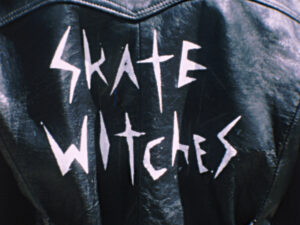
For co-star Dana Forrester, today the owner of Lucky Monkey Tattoo and Ritual Body Art in Ann Arbor, Lovely Monkey Tattoo in Whitmore Lake, and Electric Superstition Tattoo in Brighton, the journey from campus outlier to Smithsonian honoree has been as surreal as it is gratifying.
“The addition of the jacket into the Smithsonian Museum was a huge surprise. Never in any of our wildest dreams could we imagine that almost 40 years later there would still be interest in this short film—let alone inclusion into America’s most esteemed museums,” Forrester said. “The lessons here are (1) Anything, and I mean ANYTHING, is truly possible, and (2) you just never know what the impact of your actions—especially creative ones—will be in the long or short term. Sometimes recognition comes much, much later for your creative efforts. We didn’t realize the cultural impact “Skate Witches” would have on female skateboarders at the time or in the future. It’s just a wonderful surprise and an honor.”
RELATED: John Cameron Mitchell Fosters Creative Confidence through “Problemagic” and Punk
A cult classic born on the diag
Shot in a single day on Super 8 film, “Skate Witches” features three women—Forrester, Karen Kibler (the self-proclaimed “Queen Witch”), and Jenny Parker—who reclaim the male-dominated world of skateboarding with equal parts humor and attitude. Dressed in punk gear and accompanied by pet rats, the trio zoom through campus, knock male skaters off their boards, and chant tongue-in-cheek incantations like “We are the Skate Witches, and we will destroy all male skateboarders!”
The film was meant as a parody and an act of empowerment—satirizing macho skate culture while asserting women’s right to take up space in public, creative and athletic realms. It’s anarchic, funny and unapologetically feminist, though none of the participants would have used that term at the time.
“It was a super fun day riding our boards around the Diag with our rats on our shoulders—and with our best friends,” Forrester said. “Nothing stands out except we definitely got some odd looks from our fellow students since we were the punk rock outliers on campus.”
Their playful rebellion captured something essential about Ann Arbor’s 1980s underground scene: its collision of art, music and social experimentation. The punk aesthetic—raw, imperfect and proudly self-produced—wasn’t a marketing strategy. It was a way of life.
From campus rebellion to museum collection
Decades later, what started as a spontaneous student project became a cultural artifact. The Smithsonian’s National Museum of American History recently added Dana Forrester’s original leather jacket from the film to its permanent collection. The hand-painted “Skate Witches” logo on the back—white acrylic over black leather—embodies a DIY spirit that museums are increasingly recognizing as a legitimate form of American creativity.
The acquisition joins a growing effort by the Smithsonian’s Lemelson Center for the Study of Invention and Innovation to document skateboarding as both a sport and a cultural movement. Alongside early skateboards, zines and videos, Forrester’s jacket symbolizes how grassroots creativity can shift national narratives about gender, art and rebellion.
As Forrester puts it, the Smithsonian’s recognition serves as a reminder that no act of creation—no matter how small—exists in a vacuum.
Skating against the grain
In 1986, skateboarding remained an overwhelmingly male space. Women who skated were often dismissed, harassed or simply invisible within the subculture’s lore. Forrester and her friends didn’t set out to make a feminist statement; they just wanted to ride their boards and have fun. Yet, in doing so, they cracked open space for future generations of female skaters.
“We were very aware that skateboarding was considered a male sport at the time. We didn’t know any other female skateboarders,” Forrester said. “Ultimately, though — being three punk rock gals—we were just having fun—doing what we loved to do and not caring what anyone else thought. I think “Skate Witches” has inspired generations of female skateboarders, encouraged them to follow their own North Stars, and we’re super proud of that.”
Her words echo through modern skate culture, where collectives like Brujas in New York and Skate Like a Girl in Seattle cite the film as a formative inspiration. Long before “representation” became a buzzword, “Skate Witches” offered a visual manifesto for self-determination—showing women not as muses or sideline spectators, but as creators of their own mythos.
The power of authenticity
Forrester’s reflections reveal that the real magic of “Skate Witches” lies not in its production values or cinematic polish, but in its authenticity. Everything—from the clothes and the rats to the laughter between takes—was real. It wasn’t trying to impress anyone. That rawness has helped the film age better than most professional skate videos of the era.
“I would tell them ‘Skate Witches,’ in a wider sense, is about blazing your own trail, being your truly authentic self without caring what others might think,” Forrester said. “There’s real freedom and power in that. You are more than okay just the way you are.”
That message resonates powerfully today, especially for those navigating social media’s pressures toward conformity. The Skate Witches weren’t performing rebellion—they were living it. In a world that often rewards polished personas, their scrappy authenticity feels more radical than ever.
A local legacy with global reach
Ann Arbor has long been fertile ground for countercultural creativity, from the 1960s student movements to the city’s punk and art scenes in the 1980s. “Skate Witches” sits firmly within that lineage. Its success also highlights how local acts of expression can ripple outward in unpredictable ways—from a university lawn to YouTube archives to the Smithsonian’s national collection.
Forrester’s current life as a successful business owner and artist mirrors that same blend of independence and artistry that animated the film. In owning four tattoo shops and running these shops and working with tattoo artists, she is involved with creativity.
“I also express myself creatively by playing bass guitar in original rock bands “True Devil” and “Crud,” Forrester said.
What began as a weekend project among friends has become a cultural touchstone. It’s been screened at film festivals, featured in academic essays, and dissected in feminist skate zines. More importantly, it continues to inspire young women to grab a skateboard—or a paintbrush, or a camera—and make something of their own.
The lesson that lasts
Forrester hopes the story of “Skate Witches” reminds creators that greatness doesn’t always come from big budgets or mainstream approval. Sometimes it comes from passion, friendship, and a refusal to fit the mold.
“Anything, and I mean ANYTHING, is truly possible,” she said, emphasizing each word. It’s not just a reflection—it’s a challenge to future generations to take risks, make art, and trust their instincts.
Nearly forty years later, “‘Skate Witches’ continues to cast its spell—not through witchcraft, but through creativity, courage and the enduring spirit of doing your own thing. The women who once turned heads on the Diag now have a place in the nation’s historical memory, and they earned it the same way they did everything else: on their own terms.
To view the original short film, please see this YouTube link:
Donna Marie Iadipaolo is a writer, journalist, and State of Michigan certified teacher, since 1990. She has written for national publications like The Village Voice, Ear Magazine of New Music, Insurance & Technology, and TheStreet.
She is now writing locally for many publications, including Current Magazine, Ann Arbor Family, and the Ann Arbor Independent. Her undergraduate degree is from the University of Michigan, Ann Arbor, where she graduated with an honors bachelor’s degree and three teacher certificate majors: mathematics, social sciences, English. She also earned three graduate degrees in Master of Science, Master of Arts, and Education Specialist Degree.

