
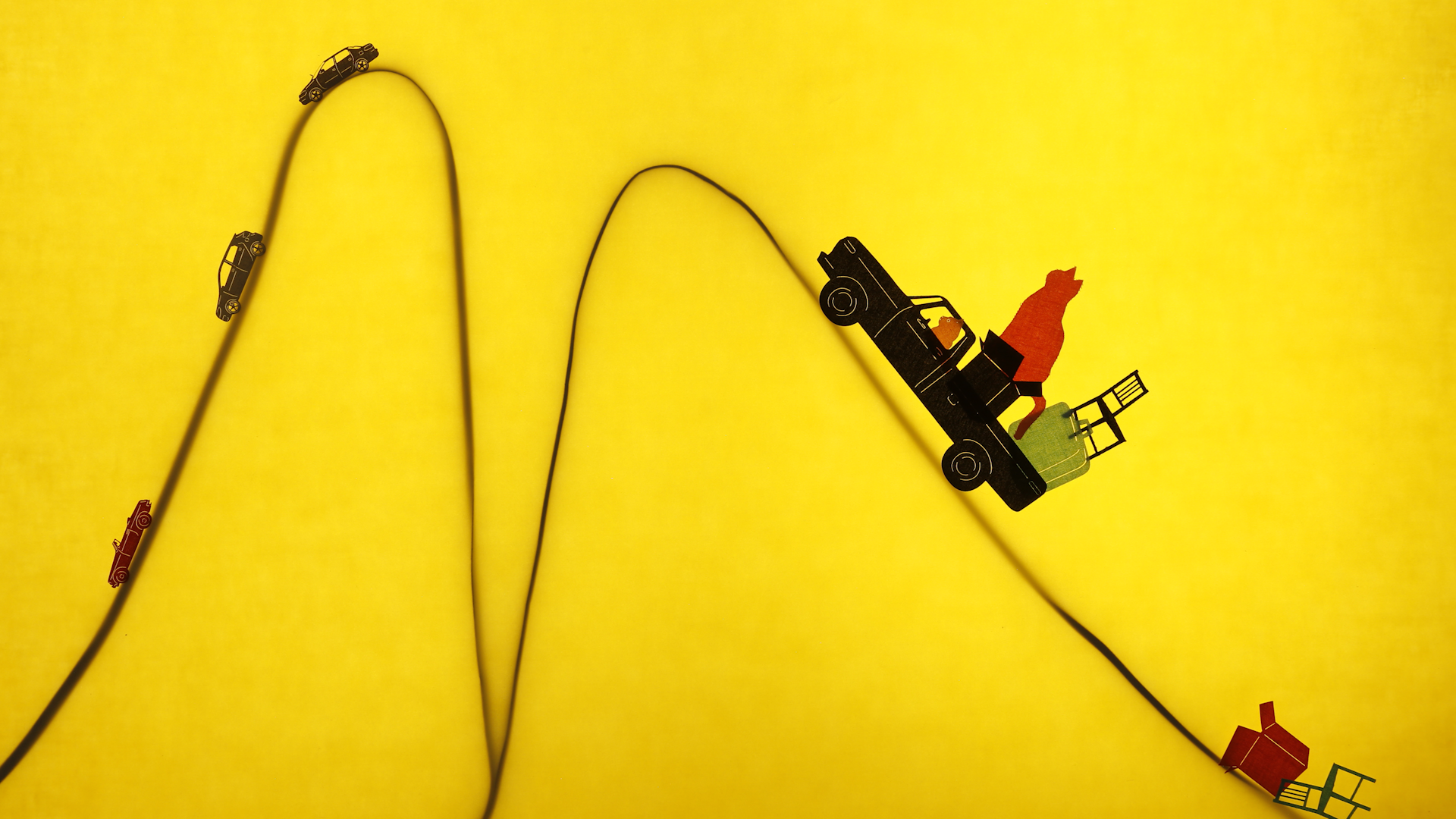
When artist and University of Michigan professor Heidi Kumao’s film “35 Days” won Best Michigan Filmmaker at the Ann Arbor Film Festival, the recognition resonated deeply—both personally and within the broader experimental film world.

In the film, Kumao highlighted voice messages left for her about an ordeal she encountered while trying to find her missing cat.
“It means a lot on several levels,” Kumao said. “I worked on this film for a couple of years, and while I thought many of the calls were hilarious or touching, I wasn’t sure other people would respond in the same way. It’s great to receive recognition for a super-local project about my neighborhood in Ann Arbor and to have it screened at the AA Film Fest. The film festival is an incredibly important experimental festival that is well respected around the world. Recognition from the experimental film community is a real confidence booster.”
From voicemails to visual narrative
At the heart of 35 Days is a simple yet compelling premise: a missing cat during the isolation of the COVID-19 pandemic. But the project began not with images, but with sound—specifically, a series of unexpected voicemails.
“The whole piece originated with the voicemails,” Kumao said. “In 2020, when my cat went missing, I plastered my neighborhood with flyers with his photo and my phone number. Many people called me and left messages. Later, when I was deleting voicemails from my phone, I listened to them again, and my gut feeling was to save them.”
She added, “I wasn’t sure what I would create with them, but they were too good to throw out. At first, I thought I would create an audio/radio piece. I began to edit the audio and played it for different friends who remarked on the number and variety of calls I had received,” Kumao said.
Those messages, left by neighbors searching for her cat Ruben, became a window into how people connected during lockdown—walking neighborhoods, noticing details and reaching out to help.
Humor, heart and handmade aesthetics
The emotional texture of “35 Days” is shaped as much by its materials as its message. Kumao combines real voicemails with tactile, handcrafted visuals—fabric, thread and paper cutouts—to create a film that feels both intimate and universally relatable.
“The voicemails provide the tone of the entire piece. I was so moved by the fact that so many people were looking for him and cared enough to call me. There are helpful calls, less helpful calls (‘I saw an orange cat 3 days ago’), and calls from people who seemed to need to talk to someone (longer messages). The calls were heartfelt but also hilarious (woman who forgets her own phone number). I wanted the piece to reflect both of those emotions,” Kumao said.
She added, “The film is made from fabric and paper cutouts, thread and wool. I wanted the imagery to feel home-made to reflect the domestic and neighborhood spaces of the callers, but also to feel accessible to the general public.”
Evolving an interdisciplinary practice
Known for working across animation, sculpture, and “cinema machines,” Kumao sees “35 Days” as both a departure and a natural evolution of her artistic trajectory.
“This film is very different from most of the art I have created in the past,” Kumao said.
“Over the course of my artistic career, I have challenged myself by shifting the media and materials I use to find the artistic voice that best matches my ideas. I started my artistic life as a photographer and transitioned into building devices that could project my photos then creating physical spaces and sculptures for projected films.”
She continued, “As a studio photographer who makes physical objects and scenes for the camera, creating an animated film like ‘35 Days’ from thousands of still photos is a natural next step. This is the first time I created a film with the audio track set in place before the visual imagery. As a very visual thinker, I found this quite challenging.”
Community care as an unexpected centerpiece
While “35 Days” captures a personal story, it ultimately reveals something broader: the quiet, persistent presence of community care.
“The community of care emerged naturally from the collection of calls,” Kumao said. “I was so surprised and moved by the number of calls, but also the messages from people who just wanted to express their concern and sympathy for me and my cat. I knew I wanted to highlight some of these in the film because they illuminate basic human kindness that might seem rare these days,”
Teaching, learning and creative exchange
As a professor at the University of Michigan’s Stamps School of Art & Design, Kumao’s teaching practice feeds directly into her filmmaking—and vice versa.
“As a teacher, I am privileged to invite animators from all over the world to speak to my students,” Kumao said. “I select them specifically to augment the content of my classes (experimental, stop motion, puppet, cutouts, etc.), but I find that I also learn so much from hearing about their animation or filmmaking practice. No two animators work the same way. There is a lot of problem-solving in animation, and every guest gives my students AND me lots of ideas and inspiration.”
Making experimental film accessible
Though experimental film can sometimes feel daunting to general audiences, Kumao intentionally designed 35 Days to be inviting and widely understood.
“I agree that some experimental film can feel more like an audio/visual test of my patience than a conventional piece of entertainment,” Kumao said. “I also tire of some of those types of films! ’35 Days’ is intentionally a very ‘pop’ film with a clear narrative and recognizable imagery. It’s experimental in its approach to documentary (based on real events) and the type of visuals it uses (fabric cutouts), but it is intentionally designed to be accessible to the general public and children.”
The challenges of stop-motion storytelling
Creating the film required careful balancing between sound and image, especially given the central role of the voicemails.
“One of the biggest creative challenges for me was coming up with visuals that complemented or contrasted with the audio/voicemails,” Kumao said. “As a filmmaker, I have 2 channels of information to give to the audience at any point in time: visual info and audio info. To avoid competition between them, I modulate one or the other depending on what is most important. For this piece, the audio was the most important part of the story.”
She added, “This forced me to make spare and minimalist imagery so that viewers could listen to what each of the callers is saying. The film uses hundreds of fabric cutouts, thread and wool roving. Thread and wool can be quite difficult to animate frame by frame because even the smallest change can make the image appear to jump or move in an unnatural way. I had to shoot most of the animated sequences multiple times.”
Inspired by Ann Arbor’s creative ecosystem
Kumao also credits Ann Arbor’s vibrant arts community as a continual source of inspiration.
“Both the AA Film Festival and the Stamps School (especially the Stamps Speaker Series) regularly expose me to new artists and ways of thinking, and have for many years,” Kumao said. “These provide me with the most inspiration for making experimental art in Ann Arbor. The featured artists change from year to year and are unpredictable in the best possible way.”
She continued, “The work I see in those venues and also at UMMA, the Stamps Gallery, and even the Art Fair help to recharge my art ‘battery’ and have kept me inspired over the years.”
Looking Ahead: From Playfulness to Power
After the warmth and humor of “35 Days,” Kumao is turning her attention back to more serious themes—while continuing to explore the tactile language of fabric and animation.
“This project was focused on FUN, humor, a sense of playfulness, and the genuine care and concern people can express towards one another,” Kumao said. “I usually make work that is more serious in tone and after this project I am ready to return to that. I am continuing to work with fabric and animation to address power structures that affect the lives of women and girls. The Trump-Epstein files are giving me a lot to think about right now.”
With “35 Days,” Kumao transforms a deeply local experience into something universal—an exploration of connection, creativity, and the quiet ways people show up for one another.
Other festivals:
“35 Days” won the Audience Award at @iffypsi (Indep Film Fest Ypsilanti).
Humboldt International Film Festival, Arcata, CA: Sat April 25, @3pm
Philadelphia Independent Film Festival: May 5-8, 2026
New Jersey International Film Festival, New Brunswick, NJ: Saturday, May 30, 2026 @5pm
Trailer and other info is on her website: heidikumao.net
Donna Marie Iadipaolo is a writer, journalist, and State of Michigan certified teacher, since 1990. She has written for national publications like The Village Voice, Ear Magazine of New Music, Insurance & Technology, and TheStreet.
She is now writing locally for many publications, including Current Magazine, Ann Arbor Family, and the Ann Arbor Independent. Her undergraduate degree is from the University of Michigan, Ann Arbor, where she graduated with an honors bachelor’s degree and three teacher certificate majors: mathematics, social sciences, English. She also earned three graduate degrees in Master of Science, Master of Arts, and Education Specialist Degree.

