
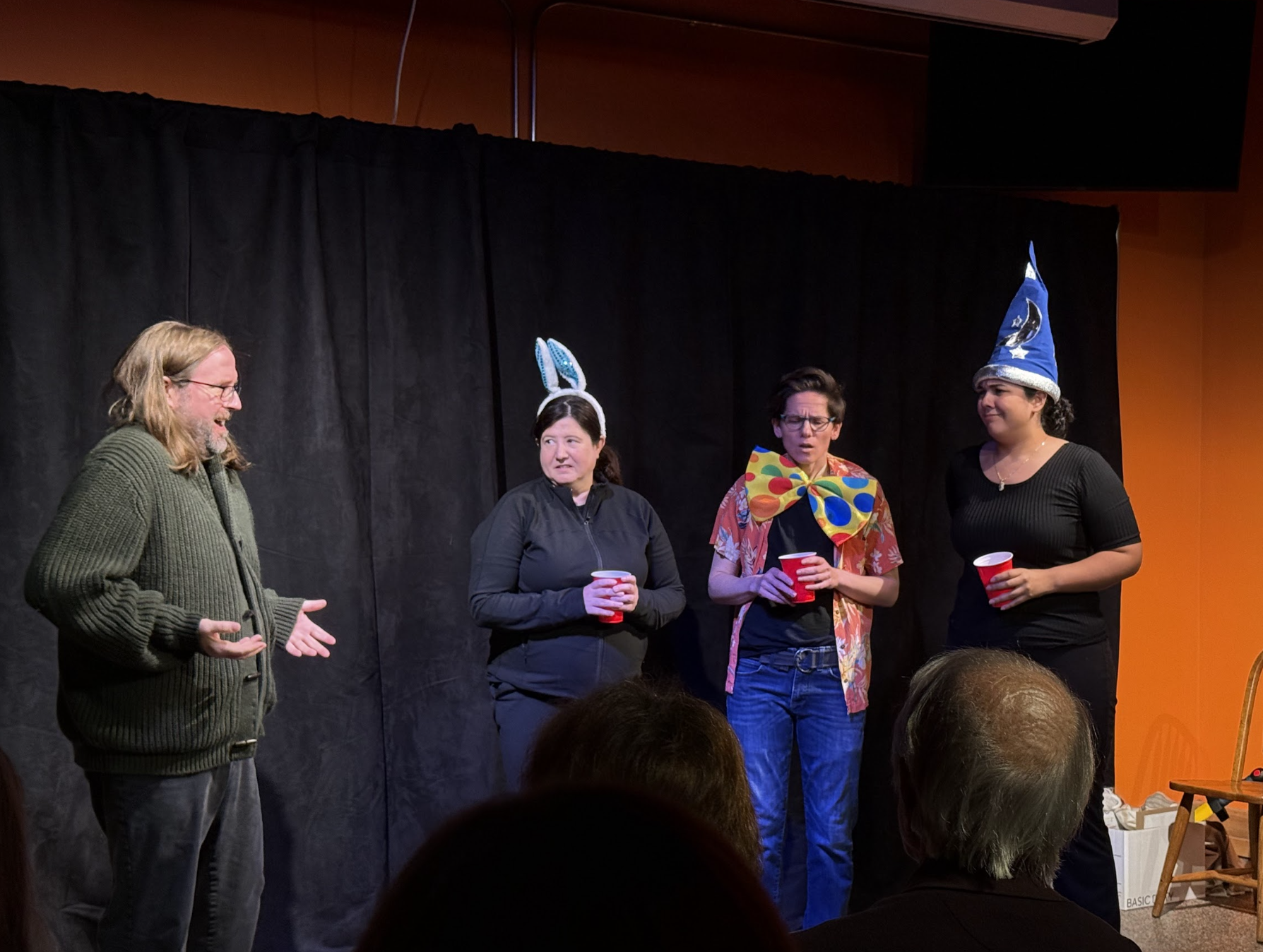
Can sketch comedy help people better understand mental health? For local social worker, artist, and writer Kara Williams, the answer is yes.
Her original production, “Mental Health Isn’t Funny,” recently enjoyed a sold-out run at Hear.say, offering audiences something unusual: an evening of laughter built around evidence-based mental health education. Rather than relying on lectures or clinical presentations, the production uses absurd characters, imaginative situations, and theatrical storytelling to make complex psychological concepts approachable while encouraging compassion and understanding.
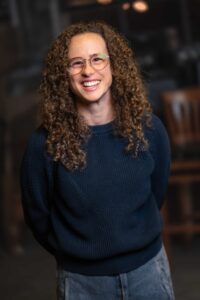
Williams created the production with a clear educational mission. Drawing from years of experience working in mental health and public schools, she recognized that many people simply lack access to basic information about emotional wellness, prevention, and available resources. Instead of viewing comedy as minimizing serious issues, she believes humor can lower defenses, increase engagement, and help important lessons stay with audiences long after the curtain falls.
Two careers, one shared purpose
Williams brings together two seemingly different professional worlds.
She earned an undergraduate degree in theatre from Hope College and later completed a master’s degree in social work at the University of Michigan. Today, she works primarily with children, teenagers and the adults who care for them while also remaining active in the local community theatre and improvisation scene.
Her experiences in both fields naturally merged into the creation of “Mental Health Isn’t Funny.”
“My inspirations came from my own observations,” Williams said. “In work and in life, I see gaps in basic mental health knowledge all the time. I hear common misconceptions, lack of resource knowledge, and lack of basic preventive care. Those observations were my biggest inspiration.”
Those observations led Williams to ask larger questions about how communities learn about emotional wellness.
“It led to important questions,” she continued. “How can we help equip people on a larger scale about mental health 101? How has public health been able to effectively embed important physical health information into communities? What might we have to do differently to combat stigma and attract buy-in to the topic of mental health?”
Why comedy works
Rather than presenting mental health education through traditional workshops or lectures, Williams chose sketch comedy.
Her reasoning, she says, is remarkably straightforward.
“I could wax poetic about my deep philosophies, but I think it’s pretty simple,” Williams said. “Funny is fun. Fun is engaging. Engagement leads to learning.”
RELATED: Affordable Mental Health Resources in Ann Arbor
Throughout the production, audiences encounter exaggerated characters and increasingly ridiculous situations that illustrate psychological concepts through metaphor instead of realism. The result allows audiences to laugh while simultaneously recognizing patterns that exist in everyday life.
Balancing humor with compassion
Although comedy drives much of the production, Williams emphasizes that education—not entertainment alone—remains its central purpose.
“It was important that we always kept the goal of the show in mind: education,” Williams explained. “This show does not replace going to therapy, doing your own personal work, and engaging with your own emotions in safe ways. It is a teaching tool. To teach, we used environments, characters and situations so absurd that it wasn’t scary anymore.”
The creative team intentionally avoided portraying realistic crises for comedic effect. Instead, metaphor became the bridge between humor and understanding.
“People can’t relate to the situations because they weren’t based in reality, but they can apply the metaphor to a larger understanding of the concept,” Williams said. “Comedy can come more naturally that way. In improv, they call it ‘heightening the game,’ finding every possible way to demonstrate an idea through increasingly ridiculous choices while still supporting the educational point.”
Not every moment is intended to make audiences laugh.
Williams noted that one scene focusing on crisis intervention deliberately shifts tone to teach audiences when and how to seek emergency support while carefully avoiding sensationalizing depression or suicidal thoughts. Extensive conversations with performers centered on portraying vulnerability honestly while maintaining emotional safety for viewers.
Building the show through both science and art
Williams says both her clinical expertise and artistic background shaped every stage of development.
“My professional background and my artistic background were both foundational to this project,” Williams said. “When writing the first draft, I used the two parts of my brain separately. My professional brain identified the seven educational beats I wanted the audience to come away with. From there, my artistic brain worked to find the metaphor, looking for the ridiculous situations, scenes, jokes or characters that could hammer this point home.”
The educational framework grew from research, professional development, and years of clinical experience.
Williams credits learning from the Mental Health Literacy Collaborative, ongoing collaboration with educators throughout Washtenaw County, and more than a decade working in mental health. She also emphasizes that the project became stronger through collaboration with producer Ashley Hughes and additional clinicians and artists who helped refine both the educational accuracy and theatrical storytelling.
Supporting Garrett’s Space
Williams and producer Ashley Hughes wanted the premiere to celebrate mental health beyond the stage itself.
That vision led them to partner with Garrett’s Space, a local organization dedicated to suicide prevention and mental health support.
“It was important to Ashley and me that the ‘Mental Health Isn’t Funny’ debut weekend be a celebration of mental health in general, not just the show,” Williams said. “A community partner felt like a great way to do that. I learned about Garrett’s Space from colleagues years ago when I worked in youth homelessness and have admired what they are doing for suicide prevention for a long time.”
The September performances coincided with Suicide Prevention Month, making the partnership especially meaningful.
A memorable response from audiences
While Williams hoped audiences would enjoy the show, she admits she wasn’t certain how the comedy would land.
“Maybe it’s my imposter syndrome talking, but the best and most relieving reaction was all the laughter,” Williams recalled. “Not just giggles. Genuine laughter. As soon as the audience broke into laughter during the first scene on opening night, my nervous system relaxed.”
The emotional conversations after performances proved equally significant.
“I had several audience members connect with me personally to talk about a loved one who has struggled with mental health, their own mental health journey, and several people who had lost someone to suicide,” Williams said. “They expressed gratitude for this show and what we’re building, often wanting to support its growth or get involved. Each interaction was meaningful, and I am grateful for so much vulnerability in the room each night.”
Characters built from metaphor—not real people
Although many audience members may recognize familiar emotions in the sketches, Williams stresses that the characters are fictional.
“No character is based on anything or anyone real,” she explained. “All of the characters are metaphors, foils, learning tools. We developed these sketches by drafting, discussing in a writer’s room style, redrafting, and discussing again.”
Throughout the writing process, the creative team continually evaluated each sketch’s effectiveness.
They asked whether scenes supported the educational goals, whether jokes landed, and whether increasingly absurd choices strengthened rather than distracted from the concepts being taught.
An ensemble committed to the mission
Williams describes rehearsals as joyful despite the emotionally challenging subject matter.
“Fun! Yes, there were some personal moments,” Williams said. “Moments of growth, discovery, and emotion, but as is true with all artistic projects, these performers were committed to the work. There was no pressure to self-disclose or make it personal, but always space for natural human feelings that may arise.”
She praised the cast for developing multiple distinct characters while embracing experimentation.
“I want to give everyone in the cast a ton of credit for their work and development of all these characters,” Williams said. “Each actor, other than the narrator, played five or six characters. In rehearsal, they explored accents, body movement, and points of view. It was a joy to watch them explore until they found something that fit.”
Williams also singled out narrator Andy Jones for balancing educational information with humor throughout the production while continually discovering fresh moments through improvisation.
Looking beyond the theater
Although the production debuted in a traditional performance venue, Williams envisions a much broader future.
“The ideal ‘home’ is a town, a city, a community,” Williams said. “We built this show to be accessible to a wide variety of ‘homes.’ It could play in a school, hospital, church, community event, corporate training, conference, luncheon, theatre—you name it.”
She even noted that one audience member expressed interest in bringing the production to a yoga studio after seeing the performance.
That flexibility reflects the production’s broader mission: bringing mental health education wherever communities gather.
Planning for sustainable growth
As interest grows, Williams recognizes that expansion presents practical challenges.
“The biggest hurdle we see is sustainability,” she explained. “We want this to remain accessible to all communities, regardless of financial means; however, we need it to be financially sustainable for ongoing operations. We also want all our cast and crew members to be able to continue contributing beautiful work to this project.”
To address those challenges, the team is developing a financial model aligned with its values, pursuing grant opportunities, and expanding its pool of performers and collaborators to ensure flexibility as the project grows.
The message Williams hopes audiences remember
If audience members leave remembering only a few ideas, Williams hopes they continue thinking about both emotional awareness and intentional self-care.
“I think there are two things, two concepts,” Williams said. “The first is a concept summed up beautifully in this quote by Dr. Jill Bolte Taylor: ‘Most of us think of ourselves as thinking creatures that feel, but we are actually feeling creatures that think.’ And the second is a quote from the show: ‘Let’s just say, our current world doesn’t value mental restoration. It’s not built in. We’ve got to value it for ourselves, because our environment isn’t going to do it for us.'”
Those ideas reflect the central purpose behind Mental Health Isn’t Funny: helping communities view mental health not as something reserved for times of crisis, but as an everyday part of living that deserves attention, education, and care.
As the production looks toward future performances in schools, workplaces, community centers, faith organizations, conferences and theatres, Williams hopes more communities will embrace the conversation—and perhaps discover that laughter can sometimes be one of the most effective ways to begin it.
For organizations or communities interested in bringing Mental Health Isn’t Funny to a future venue, the creators invite inquiries at [email protected].
Donna Marie Iadipaolo is a writer, journalist, and State of Michigan certified teacher, since 1990. She has written for national publications like The Village Voice, Ear Magazine of New Music, Insurance & Technology, and TheStreet.
She is now writing locally for many publications, including Current Magazine, Ann Arbor Family, and the Ann Arbor Independent. Her undergraduate degree is from the University of Michigan, Ann Arbor, where she graduated with an honors bachelor’s degree and three teacher certificate majors: mathematics, social sciences, English. She also earned three graduate degrees in Master of Science, Master of Arts, and Education Specialist Degree.

