
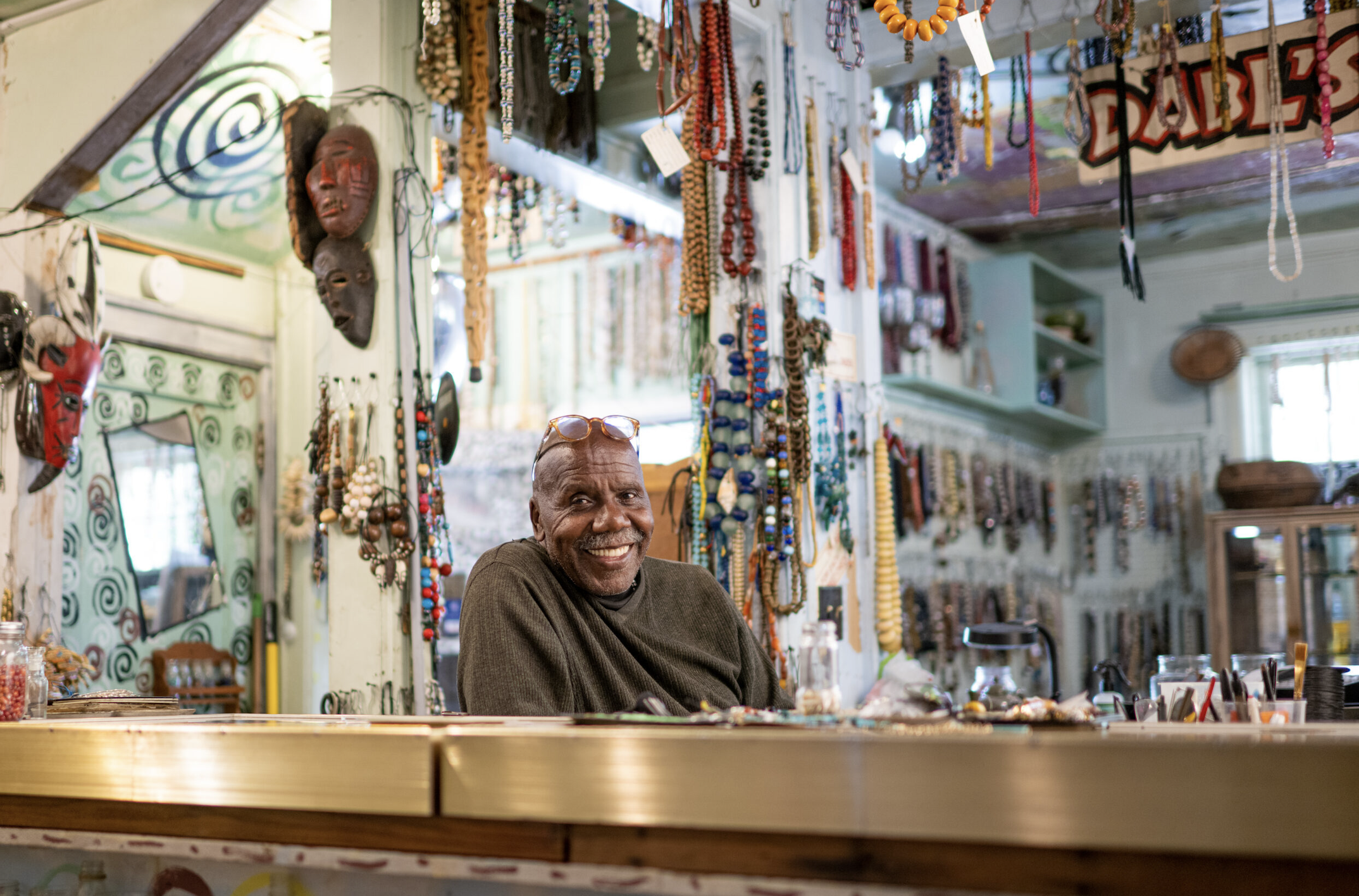
For more than four decades, Olayami Dabls has created large-scale installations, sculptures, and cultural spaces that encourage people to think more deeply about history, identity and their place in the world. The founder of Detroit’s MBAD African Bead Museum, Dabls describes himself not as an artist, but as a storyteller who uses visual forms to communicate across cultures.
His retrospective exhibition at the University of Michigan Institute for the Humanities, on view through Oct. 28, 2026, offers visitors an opportunity to explore that philosophy through artwork, artifacts, storytelling and interactive experiences.
Storytelling came before the materials
Although many people associate Dabls’ work with reclaimed industrial materials salvaged from Detroit, he says those materials were never the source of his philosophy.
“The philosophy was there before I decided to use materials that had been discarded as waste or trash,” Dabls said. “The materials simply became the vehicle I used to tell the story. The philosophy did not come from the materials; the materials gave me another way to communicate what I was already trying to say.”
Discovering identity became the foundation
Dabls traces the beginning of his life’s work to discovering his own cultural identity.
“It began when I discovered who I was,” he said. “It was through the absence of my own culture and identity that I began to make sense of what was going on around me.”
He said studying African material culture transformed the way he understood both himself and society.
RELATED: UMMA To Reopen Historic Wing With Two Day Celebration
“Once I began to study my own material culture and cultural identity, I could better understand myself and the world I was living in. That became the foundation for the stories I tell.”
An invitation to ask bigger questions
Rather than hoping visitors leave with a specific lesson, Dabls believes meaningful engagement naturally leads to self-reflection.
“I’m not hoping,” he said. “I know that if people hear and see what I have done and engage with the work, they will begin to ask questions about their own place on the planet.”
He believes every person possesses a unique cultural identity that is too often overlooked.
“Each and every one of us has an identity,” Dabls said. “The way things are set up now teaches people not to know their own identity. We are told that we live in a melting pot, but that melting pot does not exist. Cultures do not simply melt and become something else. Too often, culture is suppressed.”
According to Dabls, understanding one’s own heritage encourages greater appreciation of others.
“When people begin asking questions about who they are, where they come from, and what their culture means, they begin looking at themselves and the world differently.”
Public art as cultural connection
Dabls said bringing installations into public spaces allows people to connect with familiar aspects of their own experiences.
“It’s not a belief; it’s a knowing,” he said. “When people connect with something from their own culture and identity, they respond because there is something familiar there.”
He emphasized that embracing one’s own culture should never divide people.
“Being connected to your own cultural identity does not repel other cultures,” Dabls said. “The planet exists because of different cultures. Understanding your own culture does not have to frighten or threaten somebody else. In fact, knowing who you are can allow you to better recognize and respect who someone else is.”
Decades of watching visitors respond
The relocation of portions of his public installation near the University of Michigan has not changed his perspective, Dabls said, because he has observed similar reactions for decades.
“It hasn’t changed my perspective because I have been watching people interact with what I do for almost 30 years,” he said.
“For the past 30 years at the African Bead Museum, I have watched people from various cultures from around the planet come through, look, comment, ask questions and leave feeling good about themselves.”
Seeing visitors engage with the Ann Arbor installation, he said, is simply “another continuation of something I have witnessed for decades.”
Beyond ‘art’
Despite receiving honors such as the Kresge Eminent Artist Award, Dabls does not define himself primarily as an artist.
“To me, those were not ‘prestigious’ awards in the way people might assume, because they were identifying me as something I have never said I was,” he said. “I have always said I am a storyteller. I never said I was an artist.”
He believes many cultures have long created meaningful objects that were never intended to fit Western definitions of art.
“I use formats that people perceive as art—murals, painting, sculpture, installations—but that does not necessarily describe what I am doing,” Dabls said.
“I see what I do through storytelling, culture and communication.”
Seeing everyday life through new eyes
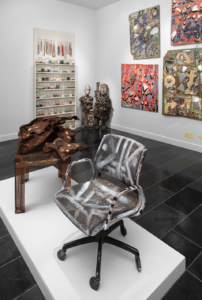
Part of the exhibition recreates Dabls’ office mantel and personal chair.
“It’s interesting because it is something that existed somewhere else and has now been duplicated in another space,” he said.
“Seeing someone else recreate a space that is simply part of my everyday life allows me to look at it from a different perspective.”
Artifacts that carry history
Dabls believes historical objects communicate far more than many people realize.
“I wasn’t there when those beads were originally used, so any assessment or comment I make about them is my opinion based on what I have learned,” he said. “But the items themselves communicate information that people can hone in on, and that is what is most important.”
“Artifacts communicate information about the people who used them,” he continued. “That information is a form of energy held within the artifact itself. That is why artifacts are important. They give us another way of connecting with people, places and histories that existed before us.”
Hands-on connections across generations
Interactive bead workshops allow participants to handle African trade beads that are centuries old.
“They are actually handling beads that may be 200 or 300 years old, and sometimes older,” Dabls said. “Interacting with those beads is more important than people may realize.”
“When someone holds those beads, they are interacting with something they may not consciously understand or know how to communicate with on another level,” he said.
“When you are handling those beads, you are connecting with something that was previously handled and worn by someone else. That interaction matters.”
Looking toward the future
The exhibition remains on view at the University of Michigan Institute for the Humanities through Oct. 28.
Looking ahead, Dabls said his primary goal is preserving the African Bead Museum for future generations.
“What I’m looking for next is someone willing to donate the money it will take to rebuild and restore the installation at the African Bead Museum so that it can operate for another 30 years,” he said.
“The original design was never intended to last forever without repair. It can be restored so another generation of children can come through, experience it, be inspired by it, and have the opportunity to see it without the story being disturbed or lost.”

Donna Marie Iadipaolo is a writer, journalist, and State of Michigan certified teacher, since 1990. She has written for national publications like The Village Voice, Ear Magazine of New Music, Insurance & Technology, and TheStreet.
She is now writing locally for many publications, including Current Magazine, Ann Arbor Family, and the Ann Arbor Independent. Her undergraduate degree is from the University of Michigan, Ann Arbor, where she graduated with an honors bachelor’s degree and three teacher certificate majors: mathematics, social sciences, English. She also earned three graduate degrees in Master of Science, Master of Arts, and Education Specialist Degree.

