
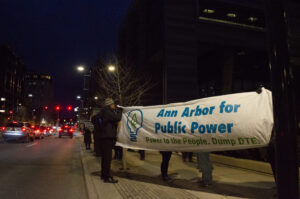
Ann Arbor for Public Power has succeeded in getting enough signatures for a question to be put to voters on the November ballot regarding municipalization — whether to sever ties between Ann Arbor and DTE Energy, and instead to establish a city owned-and-operated electric power utility. And now Ann Arbor for Public Power’s rival, the Ann Arbor Responsible Energy Coalition, is suing to stop, questioning the validity of the process.
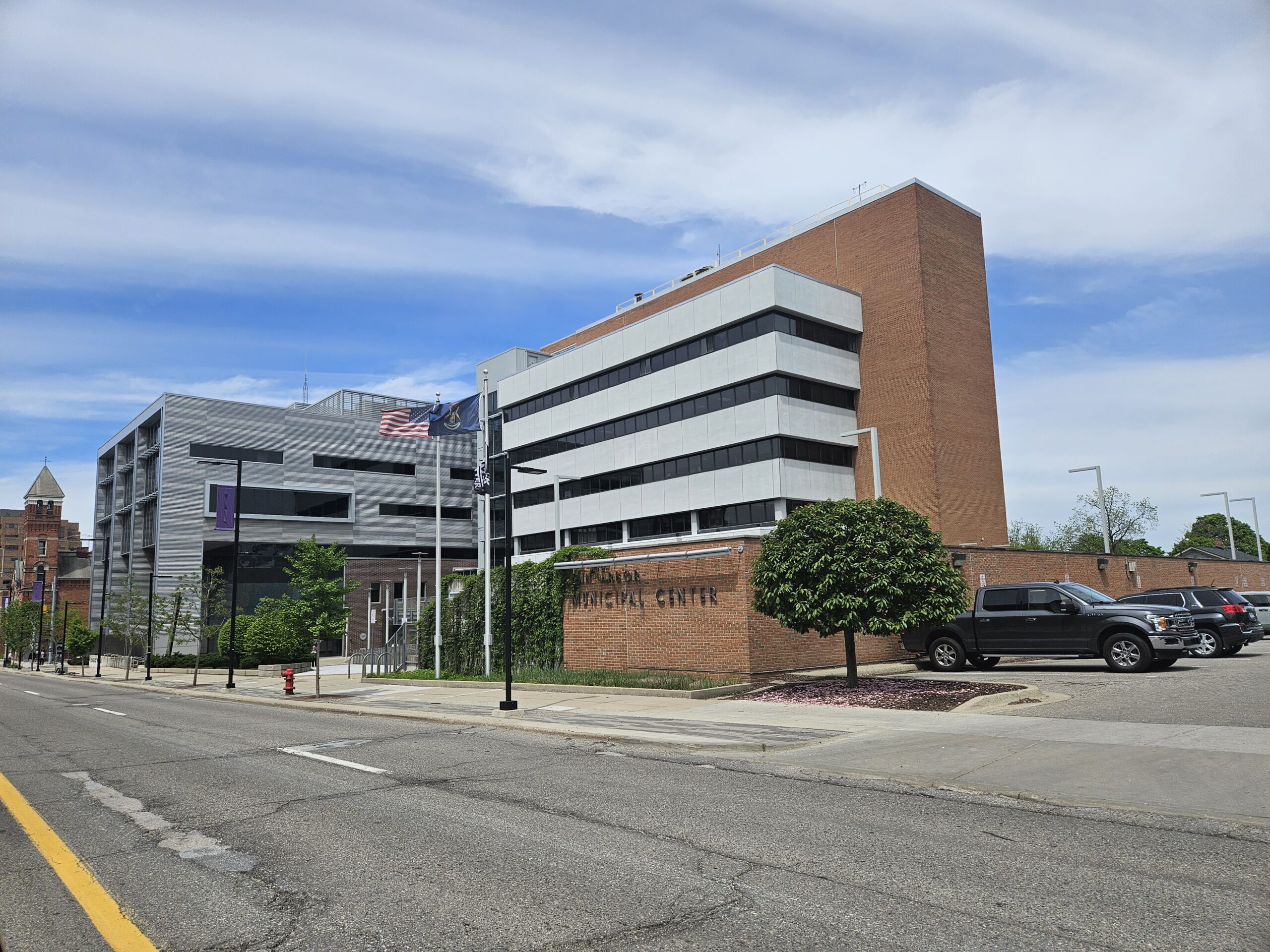
Jacquline Beaudry, the Ann Arbor City Clerk, declined to comment on the situation, citing the ongoing litigation. She deferred all questions to the Ann Arbor City Attorney and the Communications Office, neither of which responded to inquiries for this article.
“We’re confident that Clerk Beaudry followed procedures correctly,” A2P2P Executive Director Brian Geiringer said in a press release, Friday. “Her reputation for both rigor and fairness is impeccable. This groundless lawsuit is a direct attack on the will of the people to have an alternative to DTE on the ballot this November.”
The AAREC did not immediately respond to a request for comment. Friday morning DTE Energy declined to comment on the lawsuit.
What is at stake
DTE Energy has been the long-standing, publicly traded electric power company supplying Ann Arbor for decades.
A2P2 argues that DTE’s transition from fossil fuels to an entirely renewable power system is not happening fast enough to meet the A2ZERO goal that has been repeatedly approved and ratified by Ann Arbor voters. They argue that it is a matter of democratic fairness and accountability to establish a City owned-and-operated electricity company, while also citing reliability and transparency motivations. DTE Energy has long argued that they are making good progress on achieving environmental sustainability, improving reliability, and that the economies of scale that they can generate given their organization’s sheer size means that they are always going to be able to provide better quality services, at a lower cost to consumers, compared to a relatively small, city run utility.
It is the norm in the United States for most electricity to be controlled by a for-profit like DTE Energy. While they do technically compete with Consumers Energy, the Lower Peninsula’s other for-profit utility, they have faced little comparable competition. Other cities – such as Chelsea – can and do have their own publicly funded electric utility, but establishing a new one has been a rarity in the last century, even though it has always been a legal option.
Ann Arbor for Public Power is working to achieve municipalization in the city.
A2 Mayor Chris Taylor promised a statement regarding the proposal before the primary, but after the mayor lost to democratic socialist challenger Rabhi on Tuesday, his campaign then declined to make a formal statement. He was not immediately able to respond after the lawsuit was filed, due to being out temporarily. Rabhi openly accused DTE Energy of using the AAREC as a front organization for the utility in a phone interview shortly after the A2P2 signatures were submitted.
“The only way that we’re going to achieve our A2ZERO energy goals is to create a full municipal energy utility. DTE is a fossil fuel company that will never meet our renewable energy goals as a community. Furthermore, they are completely unreliable, and have caused many power outages in our community, which have threatened the lives and livelihoods of our residents. We have an opportunity to create a municipal utility in our community, which will create more green, more reliable energy, that will be, in the end, more affordable, because we will not be paying for the executive compensation packages for DTE executives, all the lobbying… and DTE profits. And instead, all of the money that we are currently paying will stay in our grid, to fix it up, to make sure it’s reliable, and make sure that its serving our needs,” Rabhi said.
He supports the A2P2 ballot initiative “because what’s been put on the ballot is simply an opportunity to allow the voters to decide whether or not to create the system by which we can approach these problems. The voters will have to approve, in a separate vote, whether or not to actually borrow the money necessary to buy the infrastructure; so there actually ( would be) two votes to move down this path. This is just the first.”
Ann Arbor for Public Power has been advocating its position for a while now. They originally attempted to achieve their goal through public education efforts and advocacy before the Ann Arbor City Council. Some progress was made for their cause, but when time came for a decision to be made on whether or not to conduct a feasibility study on the subject, the City Council deadlocked on whether or not to authorize spending money on the study. As Current Magazine previously reported, the Councilors who withdrew support all said they supported the idea in principle but thought that this was not the right time; citing cost concerns, given the cuts being made to programs from the federal government. A2P2 responded with this ballot proposal effort.
Ballot signatures
The Ann Arbor Responsible Energy Coalition is a group that opposes the A2P2 effort – citing the fact that it is going to be expensive. Even if voters do pass the measure this fall, what will result is a drawn-out process over price. The law makes clear that the city can’t simply seize DTE Energy’s power lines, transformers or other property in Ann Arbor, even if voters do vote for it, but rather, Ann Arbor has to pay DTE Energy for them.
The utility company could potentially hold the city up in court for years over the procedure of the ballot initiative process and the cost of the electric assets within Ann Arbor’s borders, costing millions in court; and even then, the system won’t be fully green, as A2 would need to purchase power from another utility while spending more taxpayer money to build more green power infrastructure.
RELATED: So, Who is the Ann Arbor Responsible Energy Coalition?
“But before voters ever weigh those costs, there is a more basic question: whether this petition qualified for the ballot at all. Ann Arbor for Public Power filed its petition on June 22 and fell short of the valid signatures required to force a city-wide referendum vote,” Rudy Harper, the CEO of Real Solutions RS, who represents the AAREC, said. “The campaign then submitted additional batches of signatures weeks later — twice in July. Michigan’s Home Rule City Act provides for a single petition filing on a single filing date. It does not contemplate a rolling, file-until-you-pass process. And even if those supplemental petitions were accepted, we believe they still do not contain enough valid signatures to qualify for the ballot. The coalition has raised these concerns with the City.”
Current Magazine has reached out to the Ann Arbor City Clerk, Christine Jacqueline Beaudry, to ask about this. Beaudry has yet to respond.
When asked to comment on this ballot challenge by DTE, Geiringer told Current “DTE has proven time and again that they will attempt to stymie the democratic will of the people by any means necessary— luckily, over 120 volunteers have collected a surplus of valid signatures from registered voters in Ann Arbor, and thus the people will get to vote on this popular initiative this year.”
On the point raised by Harper, Rabhi said “The City Clerk’s office told the petition gatherers that this was an acceptable way to submit their petitions. There’s no question in my mind that that is a non-issue; and the fact that this group is bringing it up is a desperate attempt by DTE to hold on to the power that they hold over our community. That is the practice of not only the City of Ann Arbor, but other communities across the state as well, to allow for petitions to come in up to the statutory deadline. The A2P2 petition gatherers met that statutory deadline. … They are afraid of the power of the people in Ann Arbor coming together to reclaim their power. When it comes to the validity of the signatures, we have a staff people at the Ann Arbor Clerk’s Office, that diligently review each and every signature, to make sure that each one is a registered voter, that there are not duplicates, and if the City of Ann Arbor’s Clerk’s Office has reviewed each signature and determined that they are enough valid signatures to appear on the ballot, I trust the Ann Arbor Clerk’s Office, and the staff, to know what they’re doing here.”
But who are the AAREC?
The AAREC has repeatedly denied accusations, made by the A2P2, that they are simply a front organization for DTE Energy, nor that they exist to mislead A2 voters. DTE Energy has also repeatedly denied that any sort of connection exists between them and the AAREC.
However, neither organization has responded to Current’s/ our question – if that is true, why was the AAREC originally registered with the State of Michigan using the same address as the headquarters of DTE Energy?
The AAREC has since changed their address and headquarters location to what appears to be the Goin’ Postal location in a strip mall on Washtenaw Avenue. State records also show that DTE Energy has donated at least $1.8 million to the AAREC.
One study, by Boston-based consulting firm Charles River Associations, has estimated that it would cost around $2 billion to activate the municipalization plan. DTE Energy and AAREC both rely on that study to arrive at the numbers they quote on municipalization cost. But as Current Magazine previously reported, that study was paid for by DTE Energy.
“The proposal to take over Ann Arbor’s electric grid will cost the City of Ann Arbor … leading to skyrocketing costs for Ann Arbor businesses and residents,” says a statement provided by DTE Energy’s Ryan R Lowry before the lawsuit was filed. “Last year, DTE delivered the best electric reliability Ann Arbor has experienced in nearly 30 years. It’s proof that DTE’s five-year, $270 million plan to modernize Ann Arbor’s electric system is working. We will remain focused on our work and will continue to deliver the reliable, affordable, clean energy future Ann Arbor deserves.”
Who are the players in the future of Ann Arbor’s Power and sustainability
DTE Energy “invested more than $2.6 billion in its utilities during the first half of 2026 to strengthen its electric and natural gas infrastructure” according to a press release detailing information sent to investors in the second quarter of this year. According to an unaudited assessment from DTE Energy, their “second quarter earnings of $282 million or $1.35 per diluted share, compared with $229 million, or $1.10 per diluted share in 2025. Operating earnings for the second quarter of 2026 were $274 million, or $1.32 per diluted share, compared with 2025 operating earnings of $283 million, or $1.36 per diluted share.”
“The only way for the city to achieve its climate goals is to break the DTE monopoly on distribution… We can set an example for other Michigan communities,” A2P2 President Sean Higgins said, while also accusing DTE Energy of, again, of attempting to mislead voters.“
State records show that the AAREC has been involved in transactions with the Washington DC lobbying firm Aristotle. They have also had involvement with the Edison Electric Institute, an organization affiliated with America’s regional, for-profit energy utility semi-monopolies; as well as with Willy Ritch, a consultant from the PR firm Salt Public Affairs. Ritch has been involved with the process of defeating other municipalization efforts, in Florida and Maine; according to the Tampa Bay Times and Maine Public.
Willy Ritch did not immediately respond to a request for comment. The Edison Electric Institute, and representatives from Aristotle also didn’t immediately respond to requests for comment.
“They have money, but we have people,” said Geiringer. “We’re confident that voters will see through the misinformation and fear mongering.”
It is unclear and unlikely that the lawsuit will be settled prior to the ballot proposal being presented to Ann Arbor voters, and further, how the case may affect the vote. Current Magazine will be following developments at ecurrent.com.

Drew Saunders is a freelance business and environmental journalist who grew up just outside of Ann Arbor. He covers local business developments, embraces his foodie side with reviews restaurants, obsesses over Michigan's environmental state, loves movies, and feels spoiled by the music he gets to review for Ann Arbor!

