
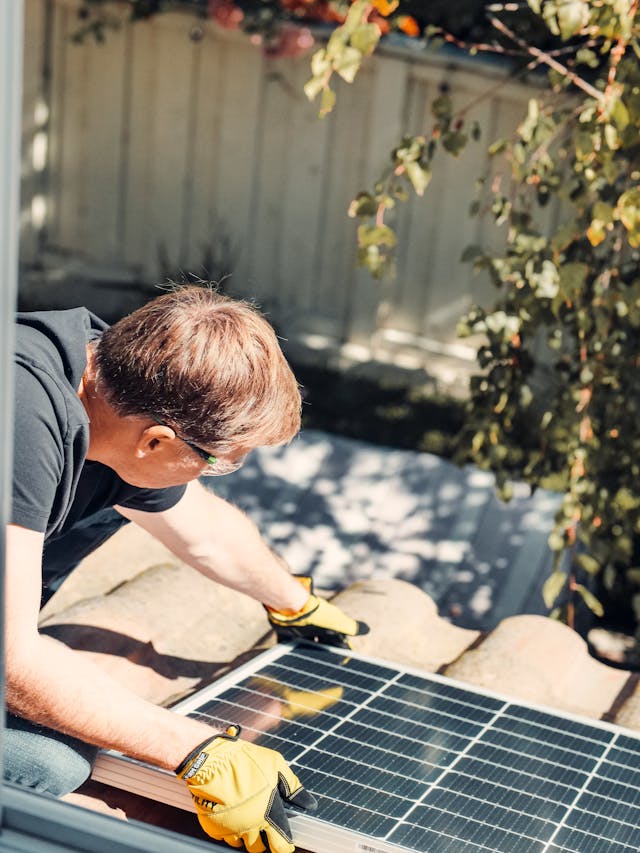
If you have ever wondered why Ann Arbor is not a city where every single roof is festooned with solar panels to get the community and the state off of fossil fuels, well, the Sustainable Energy Utility is an attempt to do just that. Recently, the City has officially opened up lines of communication between City Hall and homeowners interested in participating in the SEU program, to volunteer their roofs for solar panels.
Achieving A2ZERO goals
Ann Arbor is taking a multi-pronged approach to achieving its A2ZERO goals of achieving a city powered entirely by sustainable sources; which is taking a big step forward with the SEU. The City told Current Magazine that Ann Arbor has seen around 1,000 solar installations in the last half-decade. While how many solar panels can be installed on the SEU depends upon how much interest they actually get, the city is hoping to install as many as 1,000 solar installations every year under the current scheme.
“This spring we will be installing pilot solar and battery storage systems in the Bryant neighborhood. Residents in that neighborhood will be receiving information directly and will be able to sign up and get on the schedule in the coming weeks, with installations anticipated to begin in April and continue through the fall. For residents and businesses outside of the Bryant neighborhood, installations are expected to begin in 2027. We are still in the ‘interest-gathering’ phase for most of Ann Arbor,” Shoshannah Lenski, the Sustainable Energy Utility Executive Director for the City of Ann Arbor, said.
Here’s how it works
The City itself would purchase green power sources – solar panels, domestic batteries, geothermal systems, and possibly even small-scale wind – and install them on your property, if you choose to participate.
What you want, and where you want it installed, would be controlled by you, the homeowner; or business owner, if you own the building your firm operates out of. The power would then be split between your home or business and the rest of the grid.
This will boost the ability of DTE Energy to meet its own carbon neutrality goals; although it is important to note that DTE Energy is operating on a time frame 20 years longer than A2’s carbon neutrality ambitions. The more that homeowners and businesses volunteer to get green energy infrastructure bolted onto their property, the more capital the SEU can raise, and spend the money on the green energy infrastructure, providing a rocket boost for A2 to become a permanently and entirely sustainably powered community. And if you do not want to have green powers installed on your property, all that you have to do is not sign up.
Gathering interest from residents
“The amount and speed of SEU installations will be limited primarily by our ability to raise capital, or financing. We’re asking for resident interest now because demonstrating strong demand for the SEU’s services is key to getting that capital,” said Lenski.

The SEU was voted into law in the 2024 election, with 78.63 percent of votes going for it. Part of the money for the project comes from the utility fees, and $250,000 of it comes from a grant from the Local Governments for Sustainability USA and the Coalition for Green Capital.
The ICLEI – Local Governments for Sustainability USA did not immediately respond to a request for comment. The Coalition for Green Capital did not immediately respond to a request for comment.
Other sustainability efforts
It is not the only effort to achieve a fully sustainably powered community though. DTE Energy, the city’s for-profit regional utility company, has given the idea their tacit approval.
“DTE is dedicated to supporting the City of Ann Arbor’s clean energy goals. Much like DTE’s MIGreenPower – which is one of the largest voluntary programs in the country – the SEU would provide Ann Arbor’s residents and businesses with another option to reduce their own carbon emissions,” DTE Energy Spokesman Ryan R Lowry said. “When coupled with DTE’s planned investments in clean energy, these voluntary, fee-based programs help accelerate economy-wide decarbonization while maintaining reliability and affordability.”
The other movement is Ann Arbor For Public Power. This grassroots organization is advocating for a full break with DTE Energy on monopolistic competition, reliability, and democratic control grounds – and they are attempting to do so with a public vote this November. While the SEU falls short of their vision, they have also generally seen the SEU as a step in the right direction.
RELATED: Downtown Ann Arbor Library to Hold First of Five Sustainability Forums
“The SEU is an innovative approach to local distributed generation. But it’s an opt-in, limited program that leaves DTE in full control of the local grid” Brian Giringer, the Executive Director of the A2P2. He said that the SEU could only deliver a fraction of the city’s power, but “the city-wide public power utility that A2P2 advances will work with the SEU to cover the” remainder of the power not supplied by the SEU, and in-so-doing “ensure a reliable, renewable, and affordable future for every Ann Arborite.”
More information
More information can be had on the City’s SEU webpage, where you can sign up for updates. And if you are interested in signing up your home or business for the program, you can also do that online. Renters can also participate, so long as they and the City both get formal written permission from your landlord.
Lenski said, “the SEU is an ever-evolving project, since we’re creating something completely new with no playbook to follow. Like any startup, while staying true to our mission – and the voters’ authorization! – we’re adapting as we go. We also can’t offer everything at once and have to phase in our service offerings. One example of this: Many residents who already have solar are excited about the idea of hooking up to the SEU grid and sharing their energy with neighbors. That’s still very much on the table, but the SEU isn’t likely to build distribution – wires – in the first couple years. Our first priority is getting more renewable generation built.”

Drew Saunders is a freelance business and environmental journalist who grew up just outside of Ann Arbor. He covers local business developments, embraces his foodie side with reviews restaurants, obsesses over Michigan's environmental state, loves movies, and feels spoiled by the music he gets to review for Ann Arbor!

