

It is a coincidence that the Helmut Stern Auditorium at the University of Michigan Museum of Art will spend the next 18 months dedicated to the history of protesting between the 1950s and 1970s during a time of widespread and unusually sustained protesting. But American Sampler still provides a sharp contrast and interesting mirror in the time-stands-still nature that life can sometimes present us with.
That’s the pessimistic view, but you could also see it as a way to take notes on what has and hasn’t worked in the history of non-violent resistance, and to see how to apply it to the protest movements that you care about today. If you have never been to the UMMA but want to figure out how to succeed in the protest movements you care about, this is the show to you.
“The history of decent and political unrest in the U.S. is very, very long and deep, and cyclical. That’s deeply evidenced by the show and the materials in the archive,” Christina Olsen, the Director of the UMMA, explains.
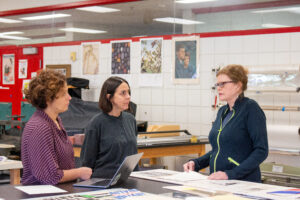
Julie Ault is a curator artist with decades of experience. A MacArthur fellow, she was educated at Hunter College and Lund University and has had a long professional relationship with Olsen.
“I reviewed UMMA’s collection and identified a large pool of works for consideration, which I pared down as the framework came into sharper focus. I selected artworks, photographs, graphics, and posters for their aesthetic and visual interest in conjunction with direct and symbolic content and associations. I also drew on my collection, which largely results from long-term affinities, relationships, and collaborations with artists whose practices have been formative for me. I distributed a dozen works by Corita Kent – formerly Sister Mary Corita, IHM – throughout the show, including several from her 1968–69 Heroes and Sheroes series. I was fortunate to find works by Felix Gonzalez-Torres and Roni Horn in UMMA’s collection, with whom I have strong affinities,” Ault said. “The museum owns powerful works by Gordon Parks and several of Danny Lyon’s civil rights movement photographs. I selected several 1968 screenprints of colorful, graphically bold numbers by Robert Indiana and his 1971 screenprint Mississippi, which commemorates the civil rights organizations working to register Black voters in the South who were met with racist violence and the three activists murdered by Ku Klux Klan members in 1964.”
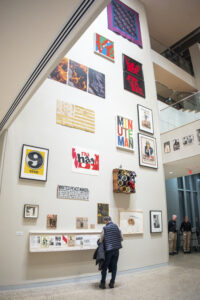
Ault selected her pieces from the Joseph A. Labadie Collection, which is housed within the University of Michigan Library, which was started when Mr. Labadie donated his collection to the University in 1911, according to the university. It has been expanded since, including through a large donation from the National Transgender Library and Archives.
“This is the first time in the Collection’s 115 year history that so many individual historical documents and posters have been on display for public viewing in a museum,” Labadie collection curator Julie Herrada said.
The pieces line the 40 foot tall atrium that separates that gift shop from the café. There you can see everything from photographs, to posters, to video pieces from the era.
“The Labadie is rich in many periods and arenas—from the 1870s to the present, from labor history and anarchism to civil rights to numerous antiwar and liberation movements. To limit the field, I decided to focus on activities and events within my lifetime that I wasn’t directly involved with and wanted to dive into. When President John F. Kennedy was assassinated, I was a child; I was a preteen when Dr. Martin Luther King Jr. and senator and presidential candidate Robert F. Kennedy were assassinated. I remember young men fleeing to Canada to evade the draft,” said Ault. “After spending a lot of time meandering and contemplating in the archive, I began focusing on inquiries into the Black Freedom movement and the antiwar movement during the American War in Vietnam. These intertwined and overlapping coalitions gradually came into focus as my subject terrain.”
RELATED: No Kings Protests Swell Across Washtenaw County on October 18
The show also has an interesting reason for you to justify taking multiple trips. It consists of original paper materials that is inherently fragile and can’t be out in the light very long. That is why different pieces in the show are going to be swapped out periodically, so you’ll be able to come and see new things several times a year.
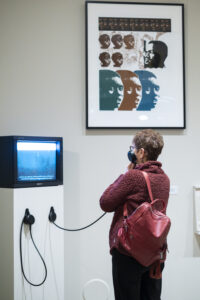
“I plan to rotate some of the posters, photographs, artworks and archival items on display periodically. A couple of artworks have limits on light exposure, but primarily I am swapping out material so I can present more artworks, documents, and points of view and maintain the vitality of the exhibition. History isn’t static and neither should American Sampler be fixed,” said Ault. “We haven’t worked out the details or schedule for this yet, but for example, Nancy Spero’s Pacification F111 from her Vietnam War Series will be replaced with another of her works after six months. The pages that the Detroit 1967 Scrapbook in the vitrine is opened onto will be changed to different spreads several times. One of the Danny Lyon photographs from his Memories of the Civil Rights Movement will be replaced with another. And several documents, flyers and newspapers in the wall cases will be swapped out for others after three months.”
The UMMA is located in a neoclassical palace of a gallery with a minimalist edition, northeast of the corner of State Street and South U. They are open from 11am to 5pm p.m. Tuesdays and Wednesdays, 10am. to 8pm on Thursdays and Fridays, and from 11am to 8pm. Saturdays and Sundays. They’re never open on a Monday. Admission is always free, but they accept donations.

Drew Saunders is a freelance business and environmental journalist who grew up just outside of Ann Arbor. He covers local business developments, embraces his foodie side with reviews restaurants, obsesses over Michigan's environmental state, loves movies, and feels spoiled by the music he gets to review for Ann Arbor!

