
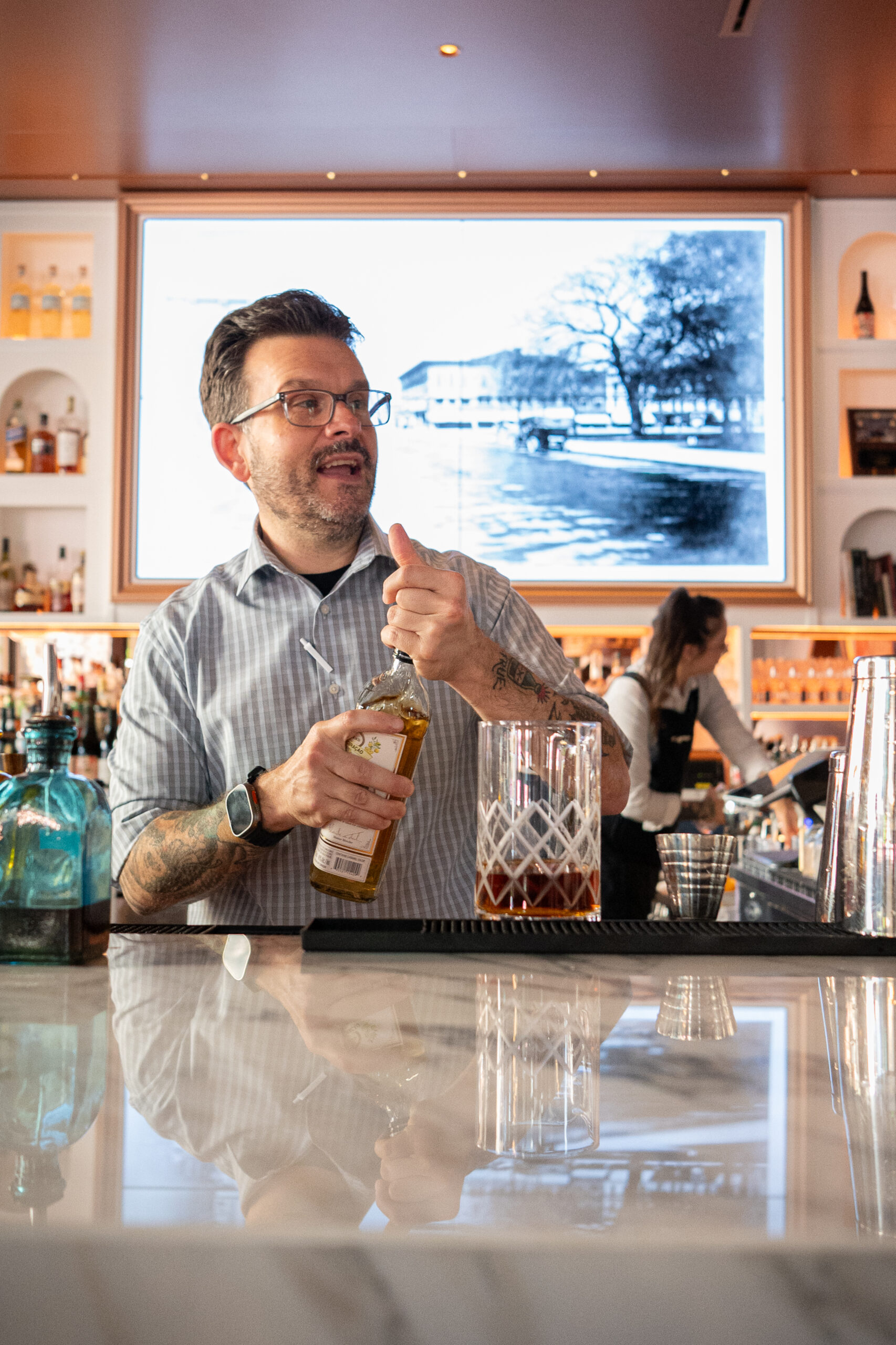
There’s a surprise waiting for you the next time you sit at the bar or order an after-dinner cocktail at Echelon—the bar manager serving you is sober. Max Schikora took the helm of the wood-fired fine dining establishment’s sculptural, immaculately stocked bar less than eight weeks ago. With years of experience in fine dining, he brings an intriguing perspective on why he’s remained in the industry despite completing Alcoholics Anonymous—and why he now chooses not to drink any of the spirits he serves.
The following interview was conducted at one of the two-person high-top tables across from Echelon’s bar, as the autumn leaves were just starting to turn and the light still shone warmly through the floor to ceiling windows that separate Echelon’s ornate bar from Main Street. It has been edited for clarity.
How did you get to Echelon?
Schikora: I wasn’t a hospitality guy at first. I went to school to be a teacher at the University of Michigan – Dearborn. I didn’t end up teaching but went into sales instead at Best Buy for many years. Then one of my regulars offered me a job at a tech sales company, but I had to move to Texas for about a year and a half.
I ended up coming back to Michigan because my grandma got cancer. She and I were very close, so I moved back but I had no job. So a friend of mine [offered] me a job at a restaurant even though I had no experience. So I went into hospitality when I was just shy of 30. I worked there for five years. One of my friends left to the Root in White Lake, so I got hired at the Root, worked there for eight months, and then I got hired to work at Mable Gray. While I was working there, I met Chef Joe.
[Joe VanWagner is the executive chef at Echelon]
It was always a dream of mine to work with him because we became very close. We’re both sober, have a lot in common. I ended up here because he told me that Echelon had a job opening and it felt like the right fit.
Especially in downtown Ann Arbor, you can get a cocktail most any place and bars like this ride or die based on their signature cocktails. So what signature drinks are you most proud of?
Schikora: I’ve only been here just shy of two months, so a lot of the drinks are already existing drinks that we have just adjusted. The biggest thing that I want to do is do things that are seasonally appropriate. I don’t want you to come here and have strawberries in the middle of December or apples and pears in the middle of the summer.
I want to be local and that’s what’s cool. Our chefs get fresh eats from our produce vendors, and they can tell me what is available right now, and I can snap shot it. We have a cocktail on the menu that’s actually spirit free, which we donate the proceeds to the Ben’s Friends. It’s near and dear to my heart, because it’s the reason that I stay sober; that and AA, obviously.
[Ben’s Friends is a coalition that helps professionals in the food and beverage industry who are struggling with addiction to help get sober, and then stay sober. Schikora runs the in person meetings Ann Arbor chapter out of Echelon, 10am every Wednesday. You can also visit online daily at 1pm over zoom; or you can join a late-night session at 11pm every Monday, Tuesday, Thursday, Saturday and Sunday; according to the local chapter web page.]
I also recently got peaches. Michigan peaches are great but there’s a super short season. Until its seasonally inappropriate to use them, they’re going to be in drinks and they’re grown just [a few] miles from here.
Are people surprised when they find out that you’re a sober bar manager?
Schikora: I think so because I’ve never tasted hardly any of the cocktails. I learned to bartend while I was sober. I never bartended as an active alcoholic, which is really rare. A lot of bartenders I know taste every drink they ever made whether they’ve made it a hundred times, or if they’ve made it twice. I don’t taste any of them.
So you’re basing it on your customers reaction and you have a mathematical formula on what amounts of ingredients will result in a certain kind of drink?
Schikora: You have a base volume that you play with, you just kind of have to manipulate it. You can take a recipe and break it down into as many parts as you want, as long as it doesn’t exceed the original volume when you put it back together and it tastes good.
That can be challenging. I’ve failed a lot of times early in my career at a lot of this because over-complication; you try to make things that nobody has ever made before and you end up making things that nobody wants to drink. [But] that can be fun.
Can you walk me through how and why you made the decision to go sober?
Schikora: It was when Covid happened. I was working at Mable Gray and the restaurant shut down. Luckily one of the owners owned a couple of storage companies, so he hired us to work there, and it was an eight to five job. I [was] used to being a restaurant guy. So I’m going out, having drinks and waking up every day.
It was early March when I decided ‘maybe this isn’t a good idea’ because I was waking up every day with a hangover and having to go and drive a fork lift, lifting 50 pound boxes all day. If I hadn’t stopped drinking it only could have gotten worse.
No real collateral damage. I didn’t go to jail. I didn’t get arrested. I don’t have any illegitimate children or do anything crazy. There are a lot of people in recovery who have wildly incorporate stories. I don’t’ have that. I’m a high bottom guy. [But] I knew if I didn’t stop, I would go downhill.
I will say I was fully out of control. My drinking was all the way up or all the way off. Some people can have just one. I’ve never been that person, ever in my life.
I’m great at drinking; literally incredible at it. But I am awful at living when I’m drinking; and I would rather be good at living.
Any major relapses?
Schikora: I’ve never had one. And I attribute that to connection. The biggest thing that I think keeps people sober is connection. I have a home group that I go to once a week—I used to go five days a week.
There’s also a lot of sobriety in this building. I think there are eight or nine people in recovery here. Are there times I have wanted to drink in the last five years? Absolutely. But have I? No.
How has becoming sober changed the way that you approach drinks?
Schikora: I think the biggest thing is that even though I don’t get to consume what I’m making; it is still impactful and important. And I have to rely on other people. That’s scary, especially when you’re so committed to what you do, that other peoples’ feedback supersedes my own thought.
A lot of people reading this are going to think: if you decided to go full sober, why did you stay in the bar keeping business at all?
Schikora: That’s a great question. My first sponsor said ‘You have to quit your job’ and my response was just ‘No, not at all.’ I think that if I do the right things—go to meetings, meet other alcoholics, and understand that I am unable to drink—I don’t have to change anything about my life.
It is dangerous for people who don’t do the right things, to be in front of 150 bottles of liquor, and wine, and beer, and cider, at all times. If I did the right things, it would be really easy at any time to just not.
There are so many people who get sober and think “I can’t work in hospitality” and I’m living proof that you can. And you can do it at a high level. You just have to admit that you can’t drink.
RELATED: Echelon: Where Fine Dining Meets Sustainability in Ann Arbor
When I walked in here you told me you had just made pears into a syrup to make your own pear liquors. Can you walk me through that?
Schikora:There’s a company out of St. George’s out of California that makes a cocktail that we have currently. They make this really awesome pear liquor but once fall hits, it becomes hard to get ahold of, so I recreated it, and I think I did it pretty darn close. I talked to one of our chefs about local purveyors that’re offering Michigan pears. He got Michigan pears, and I just spiced it like fall—took the pears and steeped them with raw sugar, and added neutral grain spirit, some cinnamon, some star anise and some clove. And it turned out as good or better than the counterpart, and it’s all local stuff, which I think is really true.
If you have something that becomes seasonally inappropriate, do you just toss it, or do you donate, or repurpose it for something else?
Schikora: Any of the produce that goes out of stock, or that won’t work currently, will be recycled or composted. That’s the beauty—nothing goes to waste here if we can help it. When we zest oranges to make old fashions, we’re juicing them for drinks or the kitchens use it.
All bartenders have a habit of talking to customers. But the press release emphasized how you design drinks around the conversations that you have with customers. Can you go into that in more detail on that?
Schikora: The thing that’s always been fun for me is that we always try to design a drinks list that cater to a wide array of people. But there’s always someone who feels like they’re not quite represented.
The key is finding out what spirit they gravitate to, and what mood they’re in. Especially when I was behind the bar more, the key is just talking to people. Once I get two or three drinks to someone, they almost never need to tell me what they like because I already know.
Curating experiences to people is super impactful because most places don’t do that. I have always looked up to the bartenders at At a Boy because they don’t have a menu. Their entire philosophy is “tell me what you like and I’ll make you something that you love.” How cool is that?
Echelon’s proprietors have been up front about being zero waste, or as close to zero waste as they can. How has that luxury-but-sustainable ethos jelled with you?
Schikora: I think just being aware of what we’re using, what’s available, and not overordering [is key]. If I get sage from a purveyor, and not all of it looks nice – I can’t put wilted sage in a cocktail, but I can use it in a syrup.
Same with pears. I ordered pears that I made a syrup from, to make a spice pear liquor. And they sent more by me than I could possibly use. So I said when I got here; what can I do with this? And I just turned it into a syrup, and I’m going to use this in a Michigan Manhattan tonight.
A lot of it is just being efficient. We don’t need to order 16 pints of blackberries or 16 ounces of sage in a week. Small ordering makes sense because I might have to make a lot of orders, but what I get is continently fresher.
I use mint in multiple drinks. And if you order eight ounces of mint at the time, is the last three ounces going to be usable? Probably not. And a lot of the times, the things I can’t use, the kitchen will happily take them. They use tarragon, mint, sage—which they use in our staff meal, or products that they’re making. The goal is to not waste and be cognizant; which is hard if you’re not paying attention to what you’re using.
A lot of the traditional way of doing things in the hospitality industry is to mass order for the economies of scale favors it, in order to get a consistent lower price. Is that still true here, or does the constant ordering and the fact that Echelon uses food sources that are as close together mitigate those costs? Or does it balance it out?
Schikora: I think that it balances it out. If you’re ordering a case or oranges—which can be up to 80 oranges to get a better price—you don’t save any money if you have to compost or recycle them. But getting things in a quantity that makes sense, without overdoing it with what you don’t end up using, is silly. Over-ordering just to throw things away doesn’t make a whole lot of sense.
Lots of people say that their business is green. But the internet is awash with pieces showing that greenwashing is common and definition of what being “green” means vary wildly. Can you demonstrate the steps that you take to ensure that your end of Echelon really is as sustainable as advertised?
Schikora: For me, it is trying to find uses for excessive ingredients and not over-ordering, as I said. It’s hard to dictate how much juice or produce that we’ll go through. But we’re always attempting to find ways to use it in the restaurant, even if we take the last step and compost it. The ultimate goal is to make sure we’re not wasting. My stuff is pretty simple—I’m opening limes and lemons to juice, oranges for garnish and juice, and herbs for garnish… but sometimes you end up ordering blackberries for something and you end up with all of these [left over] blackberries and sage that would traditionally go straight into the compost. But [at Echelon] the kitchens use it to make sorbets.
There is a full line of communication, which is key. Before I compost anything, I ask everyone in this building if they can use it before it goes away.
As we said in our original review of this restaurants’ grand opening, Echelon has never made a secret of its goal to be Ann Arbor’s best restaurant. But what if our readers think “you sound great, but this sounds out of my price range”? Can they still find a way to be part of your in crowd?
Schikora: Absolutely. We do our social hour daily now, so if you come in here from 4-5:30pm, you can get some significant deals on things that are a little bit pricey. There’s tons of options that we make very affordable on purpose with our weekly bar feature. We do discounts on our burger—which is one of the best I’ve had—and on our spicy chicken sandwich. We have a whole list of discounted beverages, so people can check us out in ways that they might not otherwise.
Penultimate inquiry: could you walk me through how you came up with your latest seasonal concoctions?
Schikora: I don’t know how other people do it, but I focus on what I would want to drink right now. It’s no secret that I like pears and cinnamon. Ever since I was a kid, I’ve loved fall fruits. I put cinnamon in a lot of things, but that’s literally all the time. It works cool in a lot of drinks.
Things that remind me of the seasons is where I usually go. I also go to the back of the house and use open communication to guide my ideas.
Are there any questions that should have been asked, but were not thought of?
Schikora: Inclusion with non-alcoholic drinks are important. Because a lot of places that you go and order a non-alcoholic beverage, a lot of places you’re going to get places that represents juice with not a lot of flavor ark, and not a lot of thought. And you’re like, why did I just pay $12 for this? I don’t want to ever be the case [at Echelon]. I have a bevy of non-alcoholic beverages here, and a lot of bitter things; which you never find in non-alcoholic spaces, which I miss. We always like to have things like that for people who would like a digestive after a meal.
Or we have a hop water. I always loved carbonization, so I always drank beer because it made me drunk. But when I stopped drinking I became obsessed with carbonated water.
Echelon is located at the old Kresge Building at 200 South Main Street, where Mongolian BBQ used to be. The bar opens at 4pm Wednesday through Sunday. Last seating for the restaurant section is at 9pm all days except Sunday, where they stop seating at 8pm.

Drew Saunders is a freelance business and environmental journalist who grew up just outside of Ann Arbor. He covers local business developments, embraces his foodie side with reviews restaurants, obsesses over Michigan's environmental state, loves movies, and feels spoiled by the music he gets to review for Ann Arbor!

