
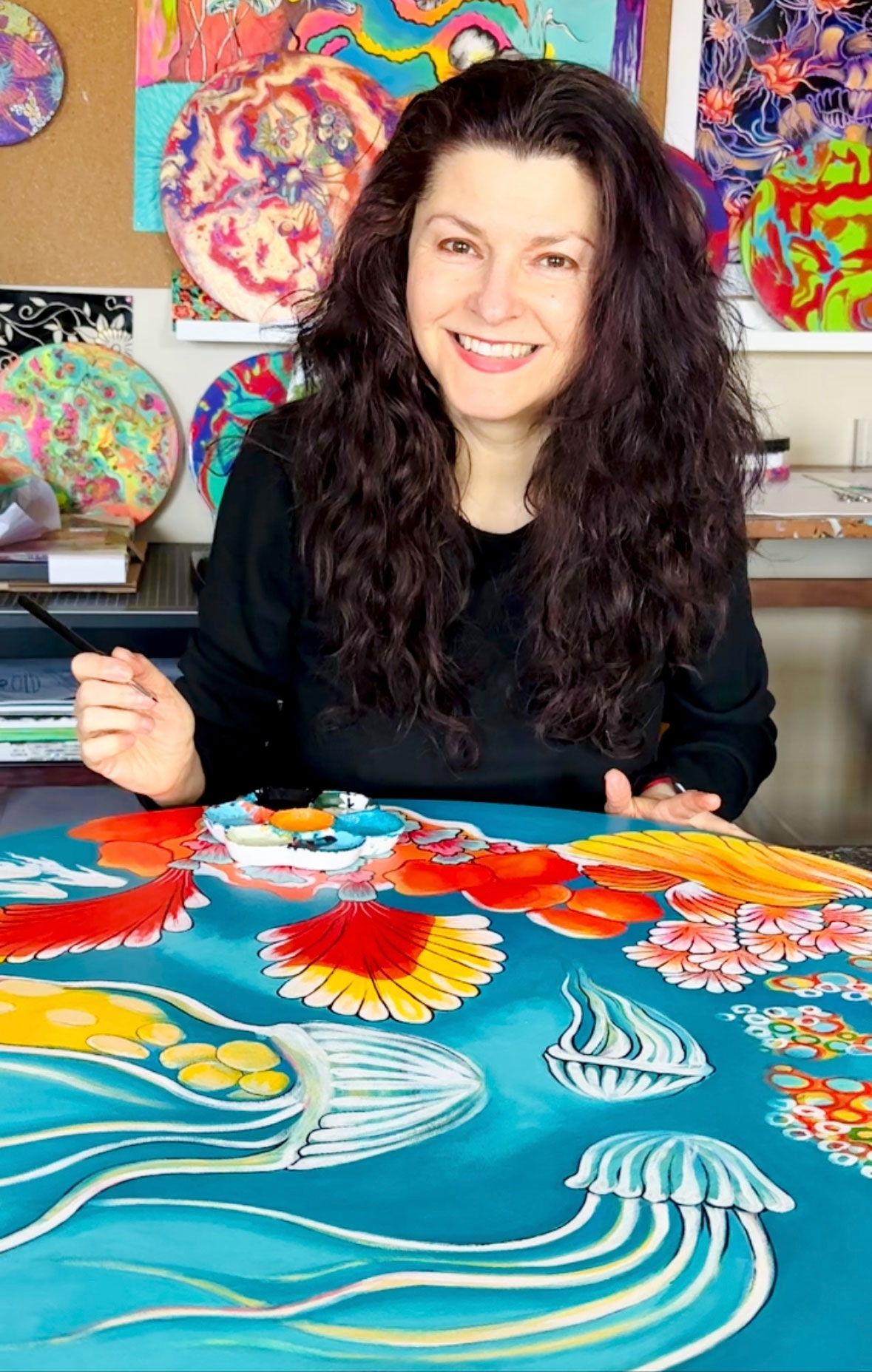
Ann Arbor’s universe of artists got a major upgrade when the Ann Arbor Art Center took advantage of an open storefront which allowed them to expand their offices and studio space. This provides a large space for temporary exhibitions that have brought some of the most thought-provoking and intriguing contemporary fine art in the country to Ann Arbor.
Hava Gurevich is the latest example of what makes the A2AC an indispensable part of Ann Arbor’s art scene with her Organic Fiction show, which opened on October 17, and will run through January 4. You can access it either through the glass and stainless-steel facade of the original A2AC or through the blue rimmed windows and doors of the former shop-turned-gallery where her show is currently.
Fresh off a well-attended opening reception on October 19, Gurevich agreed to the following interview. This interview was conducted over email, and her answers have been edited for length and clarity:
Your show at the A2AC is called “Organic Fiction” by which the A2AC describes your work as exploring “relationships through colorful abstractions inspired by botany, marine life, and microscopic worlds.” Can you walk us through what that means?
“Organic Fiction” is a phrase I came up with about fifteen years ago, and it really captures the essence of my whole visual language. It’s less about a single series or style and more about how I see the world. I love biology, and my paintings are rooted in nature, not in a literal, scientific sense, but in how living systems behave, connect and transform.
I’m fascinated by the patterns that repeat across scales: a coral reef can look like a forest canopy, a cell structure like a galaxy. Those parallels show how everything in life is connected, and that’s what I want my work to capture, that sense of aliveness and interconnection.
The “fiction” part is my imagination at play. I invent worlds that could exist where biology meets imagination. Its nature reinterpreted through emotion and color. I want people to look at my paintings and feel that spark of life underneath it all.
Are there one or two pieces in the show that you would like to go really in depth in explaining how you went from blank canvas, to a completed piece hanging on the wall?
One piece that really represents how I work is The Guardian. It started the way many of my paintings do, with experimentation. I often take photos of my work in progress, especially when I hit that point where I’m torn between pushing further or stopping before I overwork something. Those progress shots often become raw material for new paintings.
Sometimes I’ll crop or recolor them digitally, add or remove elements, and then print the altered image on canvas to keep painting. It’s a way of giving an older idea new life and a chance to explore what I didn’t before. Occasionally, I’ll even return to progress photos from a decade ago just to see where I’d take them now.
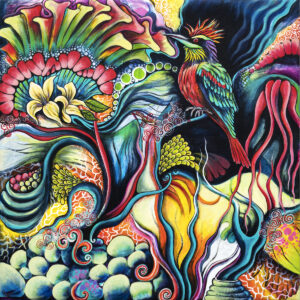
With The Guardian, I kept layering and reworking it, and for the longest time it felt like three separate paintings fighting for space. Each section had something interesting happening, but together they didn’t quite make sense. I actually love that stage when I’m at a loss, it means I’m not repeating myself, it means something new might be about to emerge.
At one point, I came across some old canvas fragments I had cut out from earlier paintings. In a moment of inspiration (or maybe desperation), I collaged a bird and a few smaller elements onto the surface. The moment I did, I instantly knew it belonged there. The bird became a quiet presence, the calm at the center of all that movement. The rest of the piece grew around it: a dense, dreamlike jungle full of twisting tendrils, glowing seedpods, and coral-like forms.
It’s one of those pieces that taught me to trust intuition. Sometimes the best thing you can do is get out of the way and let the painting tell you what it wants to be.
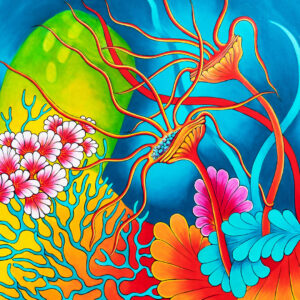
Another piece in the show, The Red Sea, grew out of a completely different kind of experience. A large commission I did a couple of winters ago for a private client (technically, royalty!). The project called for three large round paintings inspired by coral reefs, but with my signature abstracted, flowing style. The color palette we chose, teals, reds, oranges and yellows, felt bold and electric, but it also pushed me out of my comfort zone. I usually rely on black for contrast or outlines, and this time I couldn’t. It was a challenge, but I fell in love with the palette, the way teal glows next to orange, yellow, and fuchsia.
Once the commission was complete and the paintings shipped off, I couldn’t let go of that energy, so The Red Sea became a continuation of that exploration. In this piece, vivid tendrils stretch and swirl through a luminous underwater dreamscape. Electric reds and oranges pulse like living coral, florals morph into sea creatures, neurons bloom like anemones and color becomes language. It’s a celebration of connection, energy and life thriving in every direction and, for me personally, a reminder that taking creative risks almost always leads somewhere exciting.
What has your relationship with A2AC been like, and how did they come to decide that they would pick you as the artist to give an exhibition to?
I actually had a chance to work with A2AC’s director, Jenn Queen, last fall on another project, and we connected. After that, I sent her a proposal for Organic Fiction, and the idea evolved from there. The Art Center has been amazing to work with, supportive, professional, and genuinely invested in artists. It’s such a gift to have an organization like that in Ann Arbor. Being able to use their largest gallery was a dream. It gave me the space to bring together older and newer pieces and having everything up on the wall makes me see them in a new way and find new connections. It’s been exciting to see how the work, some of it made a decade apart, speaks to itself in that space.
How did you go about selecting the pieces that are hanging on the walls of the A2AC’s largest gallery?
That’s always the hardest part! I wanted the show to feel like a cross-section of my work, a mix of older and newer pieces that together tell a story about growth and evolution. Some of the works go back decades, and a few were finished just two weeks before the opening. I tried to represent all three of my recurring themes, botanical, aquatic and more abstract or psychedelic, to show how my visual language has evolved while staying connected to the same core ideas. And then there’s the “circle wall,” which I’m especially excited about.
Over the last few years, I’ve been painting on round canvases, and I envisioned them displayed as a cluster, almost like an organism growing across the wall. Circles show up everywhere in my art, cells, bubbles, energy fields, so it felt natural to give them their own little ecosystem in the gallery. Also, right around the corner in the Aquarium Gallery is Tiny Muse, a playful window display inspired by a little Betta fish named Sasha. He taught me that even the smallest creatures hold unique stories, and we shared a special bond. His beauty and spirit led me to start painting Betta fish portraits.
Can you explain your general approach to the creative process?
My process is rooted in observation and a need to understand. The same systems that fascinate me in nature, evolution, regeneration and interconnection, also shape how I make art. I often revisit old paintings, repurpose canvases and build new work out of what came before.
I love the idea that nothing is wasted, it simply transforms. When I paint, I try not to overthink it. I let the work evolve organically, sometimes layering digital sketches under paint, collaging fragments from older pieces, or switching to my left hand to loosen control. Photography is also part of my process. I capture details in the world around me like reflections, textures and patterns, and those images often spark new paintings.
Sometimes it works in reverse, the paintings change how I see and photograph nature. And then there are the things I simply love doing, tracing fine lines with the tiniest brushes, placing bright complementary colors side by side until they vibrate, and layering paint until the surface feels alive. I think of each painting as its own ecosystem, every mark affecting the next.
What inspires you?
I’m most inspired by patterns and moments in nature that feel both familiar and mysterious. It’s never a big, dramatic moment, more often it’s something small, like light reflecting on water or a strange color combination in a grocery store flower display that makes me stop and stare. Those little moments stick with me. I take photos or sketch patterns that catch my eye and let them percolate. Months later, they’ll resurface in the studio in ways I never planned. I look for repeating shapes like spheres, tendrils, clusters and networks, and abstract them into my own visual language of lines and gestures.
I’m fascinated by the idea that these patterns repeat everywhere, from microscopic structures to galaxies. Nature is an endless source of ideas for me, not just for how it looks but for how it behaves, how everything connects, adapts, and evolves. It reminds me that creativity is part of the same system, it’s life experimenting with itself.
How can people stay up to date with you and what you are up to once the exhibition wraps up on January 4?
The easiest way is through my website, havagurevichart.com, which links to everything, my online shop, newsletter and current projects. I’m also very active on Instagram, where I share studio updates, process videos and works in progress. And then there’s my podcast, I Love Your Stories. It’s where I get to have deep, funny and honest conversations with other artists and creatives about the things we all wrestle with, such as inspiration, burnout, transformation and joy.
Are there any other things that you would like this interview to cover, that Current didn’t specifically ask about?
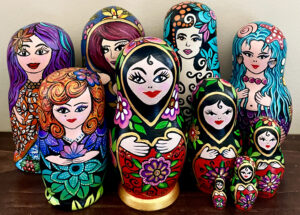
Yes! I’ve also been working on a side project that started during the pandemic, my hand-painted nesting dolls. I was craving color and wanted to bring some of my painted motifs into three dimensions. I bought a few blank wooden Matryoshka sets and started experimenting. At first, I kept them close to the folk tradition, flowers on black backgrounds, aprons, scarves, but they quickly evolved into something else. They became their own little worlds, 3D canvases filled with flowers, mushrooms, underwater creatures and flowing hair that feels like seaweed or coral.
I love that I can hold them in my hands, and that they still carry the same themes as my paintings, transformation, nature and storytelling. They let me blend everything I love, pattern, color and character, into something small, personal and alive. During the pandemic, they became this joyful, grounding practice, a way to play, paint, and tell stories in a new form. Lately, I’ve started offering them as custom commissions.
RELATED: ArtsRx: How Michigan’s New “Prescription for Art” Could Transform Ann Arbor’s Well-Being
The Ann Arbor Arts Center is a three story brick structure with long colorful stripes of fabric mounted in front of the front façade at 117 West Liberty Street. The gallery is open from 10am to 7pm. Monday through Saturday, and from 11am to 5pm on Sundays.
Most of Gurevich’s paintings are for sale. Prices range from $200 to $4,000. Viewing the paintings is totally free.

Drew Saunders is a freelance business and environmental journalist who grew up just outside of Ann Arbor. He covers local business developments, embraces his foodie side with reviews restaurants, obsesses over Michigan's environmental state, loves movies, and feels spoiled by the music he gets to review for Ann Arbor!

