
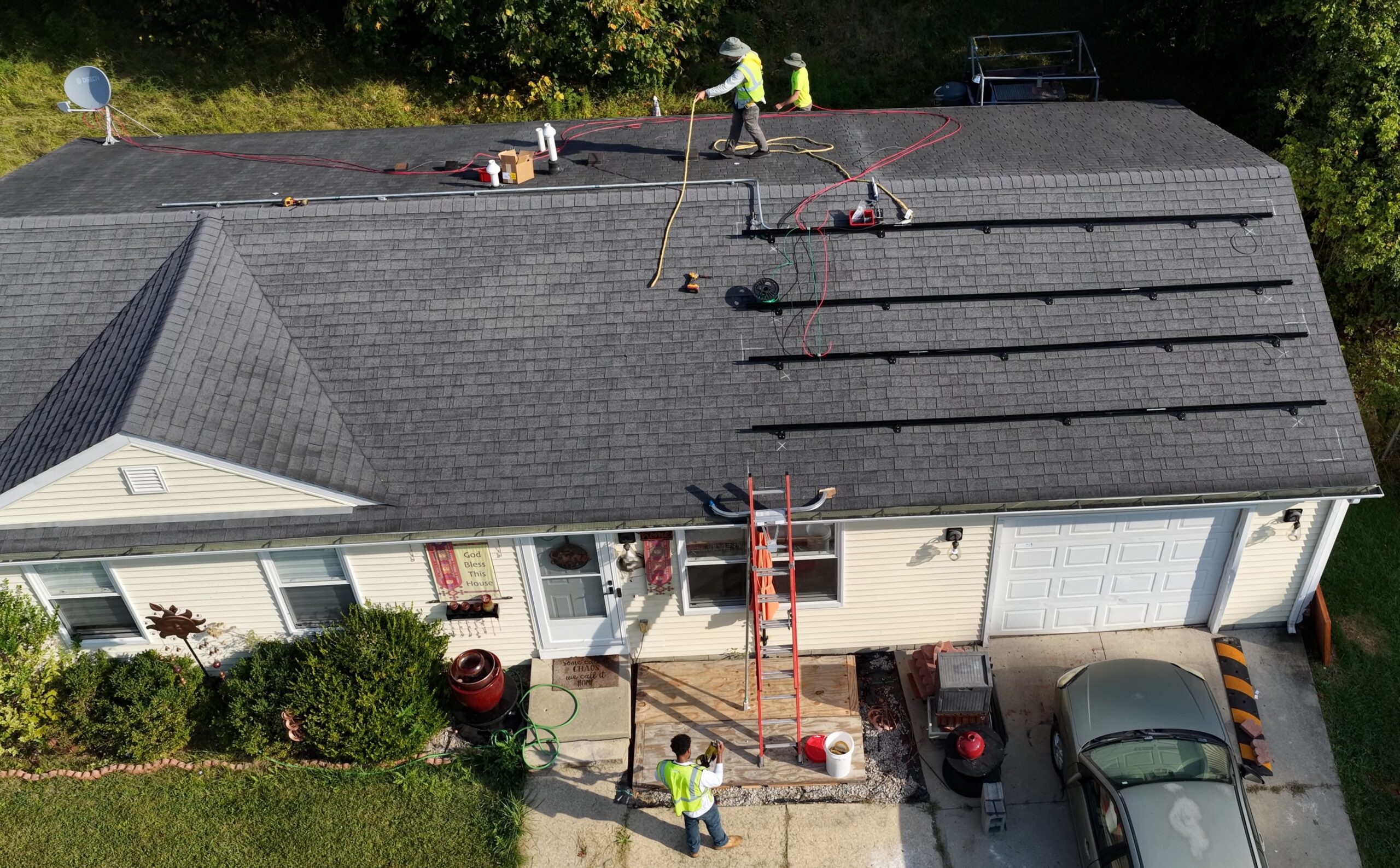
For many homeowners, rooftop solar panels have long been appealing but financially out of reach. The upfront cost of purchasing and installing a system — along with the complexity of managing permits, equipment, and maintenance — has prevented many residents from making the switch to renewable energy.
The City of Ann Arbor’s Sustainable Energy Utility (A2SEU) is taking a different approach. Instead of requiring residents to purchase their own systems, the city-owned utility installs and maintains solar panels and battery storage systems, allowing participating households to pay a monthly rate for the energy they receive.
The program began with a pilot in the Bryant neighborhood and is expanding to additional income-eligible households across Ann Arbor. The city is currently seeking approximately 20 more households for this phase of the program.
“The A2SEU doesn’t charge any upfront costs; customers simply pay a monthly rate for the use of the energy from the solar and battery system,” said Shoshannah Lenski, executive director of the Ann Arbor Sustainable Energy Utility.
Lenski has led A2SEU for just over a year after nearly two decades of working in energy and sustainability.
A simpler path to solar
For residents interested in participating, the process is designed to minimize the complexity often associated with installing solar.
Currently, outside of the Bryant pilot and income-eligible households, interested residents and businesses can begin by submitting a no-commitment “expression of interest” form. Those who sign up will receive updates and be notified when they are eligible to formally apply.
Once invited to apply, residents provide information about their property and energy use. A2SEU then prepares a proposal explaining what type of system could be installed and how much energy it is expected to generate.
After acceptance, the city manages much of the remaining process, including permitting, installation and commissioning.
“The customer has very little they need to do during this time; the A2SEU does most of the work to keep it simple for the customer,” Lenski said.
The physical installation itself typically takes only one to two days on site, although the entire process takes several months because of paperwork, permitting, and final system preparation.
Batteries provide backup power during outages
While solar panels generate renewable electricity, A2SEU includes battery storage because of the additional benefits batteries provide.
“Batteries provide three benefits beyond solar alone,” Lenski said.
First, batteries allow solar energy to be stored and used when residents need it most. Second, they provide backup power during grid outages. Third, they can support the larger electric grid.
The value of battery storage became especially clear during the Labor Day weekend power outage.
“We had a few residents who had batteries functioning during the Labor Day weekend power outage, who were thrilled that their households remained with power from the battery,” Lenski said.
The batteries allowed those households to keep refrigerators running, lights on, and devices charged.
Lenski also noted that backup power can provide an important safety benefit for residents who depend on electricity for medical equipment, refrigerated medication, or other critical needs.
Expanding access to renewable energy
One of the goals of A2SEU is to make renewable energy available to more residents, including those who may not have the financial ability to purchase solar systems themselves.
RELATED: Ann Arborites Watch Solar Panel Installation
The model may also be particularly useful in a city where many residents rent their homes.
“Not only does this make it accessible to folks who don’t have the cash to purchase their own system, but it also makes it an attractive model for rental properties, which make up half of Ann Arbor households,” Lenski said.
Under the A2SEU model, landlords can add solar without making the upfront investment, while tenants can benefit from the resulting affordable energy.
“In our Bryant neighborhood pilot, a third of participants are rental households,” Lenski said.
Learning from the Bryant neighborhood pilot
The Bryant neighborhood pilot has helped the city test equipment, understand customer needs, and improve the process before expanding more broadly.
“We have learned a lot from the Bryant pilot that will shape how the program expands city-wide,” Lenski said.
The pilot has helped A2SEU determine what questions residents have, what information they need, and how standardized system designs can make installations more efficient.
“We’re excited to use these learnings in the expansion in 2027,” Lenski said.
Building a new kind of utility
Lenski describes A2SEU as a new model for how communities can think about energy.
“The A2SEU model is completely innovative,” she said.
Rather than replacing the traditional electric grid, the Sustainable Energy Utility operates alongside it, giving residents another option for renewable energy.
“As a supplemental ‘utility of the future’ it is running in parallel alongside the traditional grid,” Lenski said. “That means it gives people a choice.”
She added that A2SEU is designed to be completely renewable and locally focused.
Looking toward Ann Arbor’s energy future
Creating a new utility has also come with challenges.
“The A2SEU is a startup within the City!” Lenski said. “We’re an extremely lean team trying to build something very ambitious, and very quickly, given the urgency of our climate and affordability crises.”
She said support from the broader city organization has been essential as the team develops the new program.
Looking ahead, Lenski hopes A2SEU becomes a trusted resource for residents and a model other communities can follow.
“In five or ten years the A2SEU will be serving anyone/everyone in the City who wants it, have expanded service beyond solar+storage into other energy services and solutions, and will be a trusted and valued utility partner,” Lenski said.
“It will also be helping meet climate goals and creating a healthier future,” she added. “And it will have inspired and created a model that other communities can replicate, so it will no longer be one-of-a-kind, but rather first-of-a-kind.”
Residents interested in learning more about the program can visit a2seu.com and sign up for the expression of interest list. There is no commitment required at that stage.

Donna Marie Iadipaolo is a writer, journalist, and State of Michigan certified teacher, since 1990. She has written for national publications like The Village Voice, Ear Magazine of New Music, Insurance & Technology, and TheStreet.
She is now writing locally for many publications, including Current Magazine, Ann Arbor Family, and the Ann Arbor Independent. Her undergraduate degree is from the University of Michigan, Ann Arbor, where she graduated with an honors bachelor’s degree and three teacher certificate majors: mathematics, social sciences, English. She also earned three graduate degrees in Master of Science, Master of Arts, and Education Specialist Degree.

