
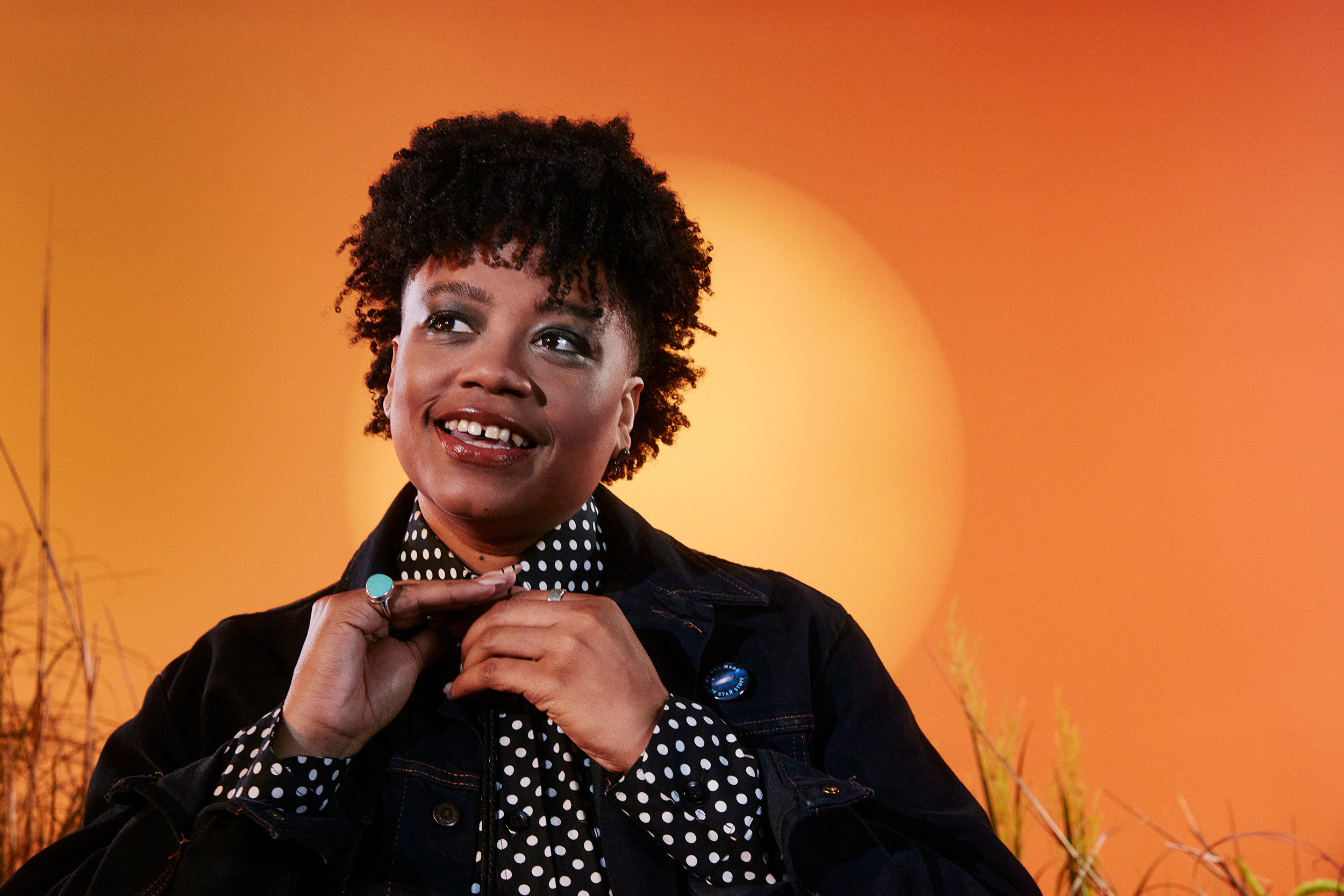
Since bursting onto the national stage with the Grammy-nominated anthem “Black Myself,” Amythyst Kiah has become one of the most distinctive voices in contemporary roots music. Blending folk, blues, rock, Americana and alternative influences, she has built a career that refuses easy categorization while inviting listeners into deeply personal conversations about identity, resilience and self-discovery.
When Kiah returns to The Ark on Monday, Nov. 16, she will be joined by fellow roots innovator Buffalo Nichols. Together, the two artists represent a new generation of musicians honoring tradition while continually expanding it.
For Kiah, that spirit of growth is at the heart of her latest album, “Still + Bright.”
Returning to her authentic self
Kiah says the record reflects a period of profound personal change inspired by Eastern philosophy, particularly Taoism and the idea of non-duality.
RELATED: Great Lake Swimmers Comes to Ann Arbor on Nov. 12
“I had started re-embracing the concept of non-duality, which is a belief that there is an inherent interconnectedness between all living beings and the cosmos,” she says. “After years of being in survival mode, I was getting back into touch with myself, and actively blurring the lines between my public persona and my more authentic self.”
The album title comes from passages in Lao Tzu’s Tao “Te Ching,” ideas that encouraged her to seek stillness rather than constantly chasing outside expectations.
“I spent so much time trying to make myself more palatable and glamorous,” she says. “I’m finally feeling the most comfortable in my own skin for the first time in years.”
Although Still + Bright has not matched the commercial success of Wary + Strange, she says it represents something even more meaningful: a closer alignment between her inner and outer worlds.
Refusing to fit inside one box
Kiah’s music often defies traditional genre labels, something she believes says as much about the music industry as it does about artists themselves.
“I’ve learned that a huge chunk of modern American music originates from blues and gospel music,” she says. “Instrument choice, image and race really determine the genre in the eyes of record executives and their marketing teams.”
Rather than chasing commercial expectations, Kiah has embraced creative freedom.
“If you aren’t interested in chasing wealth and are more interested in expression and human connection, there is usually a way to make it work and the audience will find you.”
The legacy of “Black Myself”
Many listeners first encountered Kiah through “Black Myself,” a song that challenged assumptions about race, identity and genre while earning widespread acclaim.
Looking back, she says the song permanently changed her songwriting.
“A lot of beautiful moments came from that song and I was deeply moved by people’s response to it,” she says. “It was a lesson in writing a song that abandoned universal language and ended up driving the universal message in the song even further. I’ve never forgotten that.”
A home at The Ark
The Ark has long welcomed artists who both preserve and reinvent traditional music, making it a natural stop for Kiah.
“I’ve always had a strong curiosity about the historical and cultural implications of music traditions and how they connect to contemporary music,” she says. “Tradition shouldn’t be synonymous with rigidity. It should change and ebb and flow, just like people do.”
That openness to change extends to every part of her creative process.
Writing toward healing
Earlier in her career, Kiah says she simply wrote about whatever she was experiencing emotionally. Today, her songwriting has become much more intentional.
“Resilience, healing and self-discovery are the only subjects that I’m interested in writing about,” she says. “When I found myself spending a lot of time talking about my traumas repeatedly, it actually started taking a toll on my mental health.”
As a result, she now chooses subjects that allow both herself and her audiences to move forward rather than remain trapped in painful memories.
Inspiration beyond the mainstream
Kiah’s influences extend well beyond roots music, embracing alternative rock, anime, horror and goth culture.
“The thru-line is my affinity for the obscure,” she says. “I’ve always had a drive to seek out art that was shunned or ignored, because usually those things have something meaningful to tell us about human nature and the universal truths that bind us all together.”
That curiosity continues to shape both her songwriting and her evolving musical identity.
Songs that keep evolving
Touring has also transformed the music of “Still + Bright.” Much of this tour has featured Kiah performing solo, creating a more intimate connection with audiences.
“I’ve been touring this album mostly solo, and the intimacy in which I’ve been able to sing these songs has allowed me to talk about how the songs came to be,” she says. “Fans have really been enjoying that.”
While her full-band performances lean toward blues rock, she has also experimented with a trio featuring bass and drums, offering audiences another interpretation of the songs.
Sharing part of the tour with Buffalo Nichols has been especially rewarding.
“I’ve been a fan of his work for a while,” she said. “We have some similar backgrounds and experiences, growing up as Black alternative kids and becoming acquainted with blues and country music while developing our own solo sounds. It’s been great to connect and resonate with each other in that way.”
An evening to inspire
When Kiah walks onto The Ark stage, she hopes listeners leave with something deeper than simply enjoying a concert.
“The most memorable shows are the ones that have me walking away feeling inspired or healed in some way,” she says. “That’s all I can really hope for.”
Amythyst Kiah performs Monday, Nov. 16, at 8 p.m. at The Ark, 316 S. Main St., Ann Arbor, with special guest Buffalo Nichols. Tickets are $29. Audiences can expect an evening of thoughtful storytelling, fearless musicianship, and songs that continue to push the boundaries of American roots music while inviting listeners toward healing, authenticity and connection.

Donna Marie Iadipaolo is a writer, journalist, and State of Michigan certified teacher, since 1990. She has written for national publications like The Village Voice, Ear Magazine of New Music, Insurance & Technology, and TheStreet.
She is now writing locally for many publications, including Current Magazine, Ann Arbor Family, and the Ann Arbor Independent. Her undergraduate degree is from the University of Michigan, Ann Arbor, where she graduated with an honors bachelor’s degree and three teacher certificate majors: mathematics, social sciences, English. She also earned three graduate degrees in Master of Science, Master of Arts, and Education Specialist Degree.

