
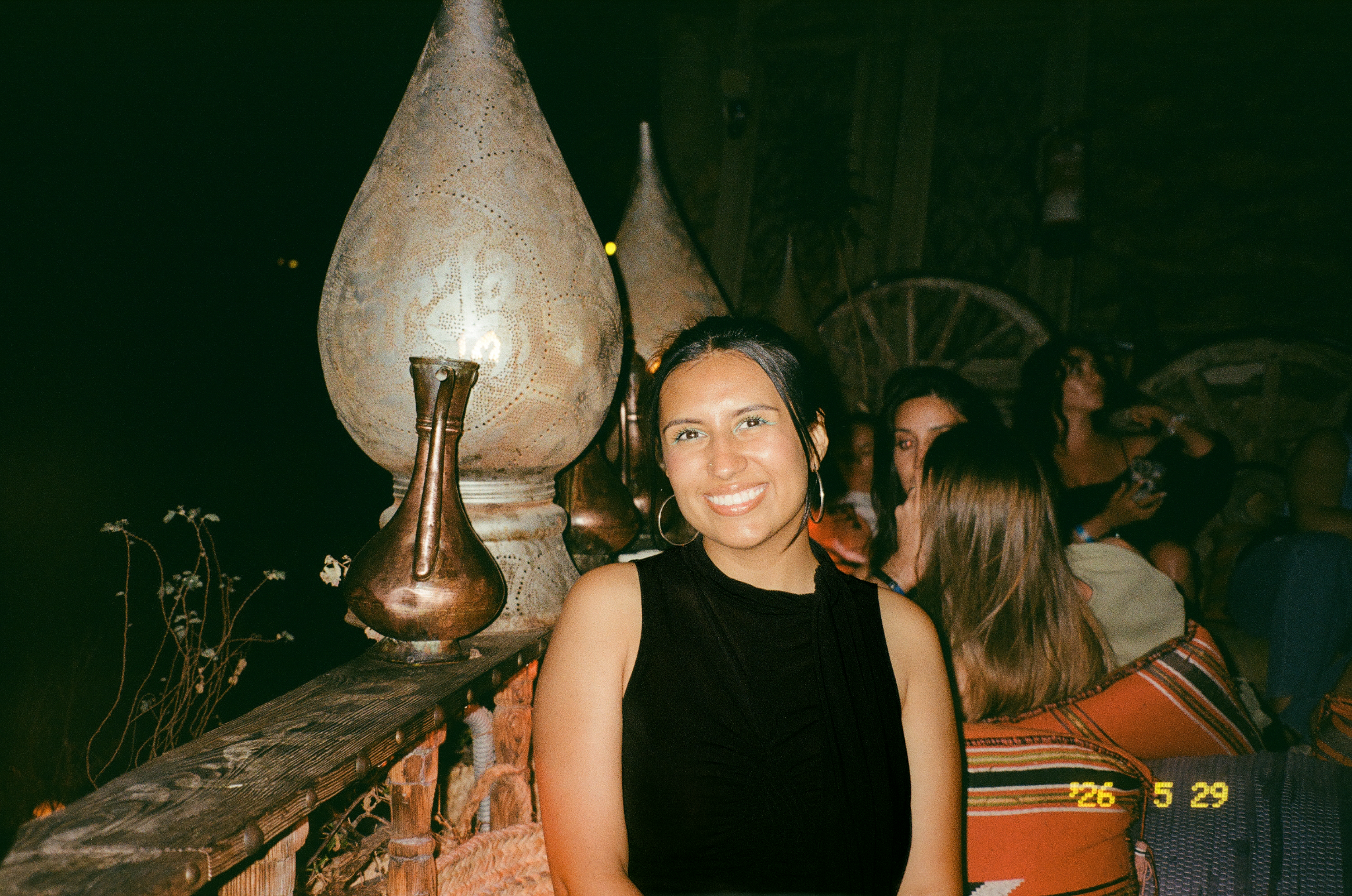
Scholarship recipient Valerie Wilke and Veterans For Peace Chapter 93 share a belief that lasting peace begins with listening, learning and building relationships.
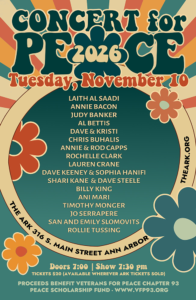
Every fall, musicians and supporters gather in Ann Arbor for the Veterans For Peace Chapter 93 Concert for Peace, an evening that celebrates the power of music while raising scholarship funds for students committed to creating a more peaceful world.
This year’s scholarship recipient, Valerie Wilke, embodies that mission through a life shaped by resilience, curiosity, international study and a belief that peace is built one relationship at a time. Behind the scholarship is a also group of dedicated military veterans who, after witnessing the horrors and costs of war firsthand, have dedicated themselves to supporting the next generation of peacebuilders.
A journey that came full circle
For Wilke, receiving the Veterans For Peace Peace Scholarship felt fitting in an unexpected way.
“It’s a nice coincidence, actually. The proposal I submitted for my scholarship application was an interview series I conducted with my professors while studying abroad in Egypt at The American University in Cairo, which informed my senior research paper for my Peace and Conflict Studies minor,” Wilke said. “Now I find myself on the other end of an interview—it’s a lovely full-circle moment. Receiving the scholarship was especially reaffirming, as I’d extended my time in Egypt to pursue this research.”
But one of the first people she notified upon winning the scholarship was her former roommate in Cairo, who had witnessed her research firsthand, from late nights working on revisions to helping her translate Arabic in local coffee shops.
“The first person I called was my roommate back in Cairo, who’d been cheering me on every day while we lived together! It felt so special to share the news with her,” Wilke said.
RELATED: From Inspiration to Action: Dancingstar Festival and Documentary Aim to Change the Conversation on Recovery
Wilke’s path to this moment was anything but conventional. Before returning to college, she spent years working as a pharmacy technician, including several years in a hospital emergency department during the COVID-19 pandemic. Through Michigan’s Futures for Frontliners scholarship, she earned an associate degree at Oakland Community College before going back to Wayne State University through its Phoenix Reentry Program.
She explained those experiences gave her a new appreciation for education and helped her discover where she truly belonged.
“I’m a returning student at Wayne State University (WSU), though my journey back actually began with Michigan’s Futures for Frontliners scholarship. I had spent years working as a pharmacy technician, several during COVID in a hospital emergency department,” Wilke said. “The scholarship gave me an opportunity to return to school and earn my associate degree at Oakland Community College, which felt like a small miracle at the time. I’d failed out of WSU on my first fresh-out-of-high-school attempt, so finishing a bachelor’s degree hadn’t always seemed possible.”
After returning, she earned a 4.0 GPA during her first semester back and is now completing a Bachelor of Fine Arts in Industrial Design with a minor in Peace and Conflict Studies. For Wilke, the combination of design and peace studies opened new possibilities for understanding how creativity can improve people’s lives.
Redefining what peace means
Living and studying in Egypt transformed Wilke’s understanding of peace. Rather than viewing it as a distant political goal or simply the absence of war, she began seeing peace as something rooted in everyday relationships, honesty and even self-care.
“One thing I learned during my time in Egypt was to let go of some of the Western, outcome-oriented thinking I’d grown accustomed to,” Wilke said. “We’re often encouraged to approach things with a mission, a measurable result, or an ideal version of what success should look like. I think I used to approach peace that way, too. A professor of mine once answered this question simply with ‘peace of mind,’ and I agree.”
That insight continues to influence how she approaches both her academic work and daily life.
“I’ve come to understand that peace doesn’t have to be this grand, utopian concept. It doesn’t necessarily mean the absence of conflict, either. Hard conversations can deepen relationships, and people who care about you will be willing to have them. There’s a certain peace of mind in knowing you can be honest about what you’re going through and still be met with care,” Wilke said.
Wilke hopes to continue her education in graduate school, where she can further explore design, art and storytelling. While she doesn’t expect every project to change the world, she believes thoughtful design carries real responsibility.
Peace begins close to home
Although Wilke’s studies took her overseas, many of her ideas about peace were shaped much closer to home. Growing up in Rochester Hills as a Peruvian-American woman, she became aware early of the importance of community and belonging.
Wilke recalled how her best friend’s uncle, a Rochester resident of over 30 years, was walking through his neighborhood shortly after the 2024 election when a group of young men drove past, threw drinks at him, and told him to go back to his country. The incident reflected a pattern of remarks she and her friends had grown accustomed to brushing off as jokes while growing up.
“It’s honestly taken years of conversations to realize how much we’d internalized that treatment, how easily we’d learned to laugh along at our own expense and accept being made to feel othered,” Wilke said. “That’s what I think about when we talk about peace in everyday life. Consider whether someone can take a walk in the neighborhood they’ve called home for 30 years without being harassed for who they are. It’s worth acknowledging how much the words and actions of people in positions of power can shape the way we treat our own neighbors.”
Receiving recognition from military veterans made the award especially meaningful.
“It’s incredibly meaningful to receive this scholarship from veterans, because their perspectives come from experiences that I haven’t had,” Wilke said. “They are people who have witnessed the consequences of war—choosing to dedicate their time to imagining and advocating for alternatives. There’s a great deal to learn from people who are willing to reflect critically on their own histories and share what they’ve learned with others. I’m grateful for their encouragement, and I look forward to meeting the people involved in the organization and hearing more about their experiences”
Her advice for other young people interested in creating a more peaceful world is both practical and hopeful.
“I’d say start with your friends, and find your center. Figure out what matters to you, even if the people around you don’t always understand it. Your friends can save you if you let them. Travel if you can. Talk to strangers, ask questions, be a sponge! Some of the best things in my life have come from going somewhere unfamiliar and being willing to listen.”
She also believes music and art provide unique opportunities for connection across cultures and backgrounds, making the annual Concert for Peace an especially fitting way to support future scholars.
Veterans supporting the next generation
The scholarship that recognized Wilke exists because members of Veterans For Peace Chapter 93 wanted to invest in students working toward peaceful solutions to conflict. Michael Muha, a U.S. Army veteran who served in Vietnam, retired software consultant, and member of Veterans For Peace since 2003, has watched the program grow from a simple idea into an enduring tradition.
Muha explained that the scholarship began in 2006 after members recognized that many college students needed financial assistance. While they initially considered supporting military veterans pursuing higher education, changing educational benefits led them to expand the scholarship to any Michigan resident studying peace or conflict resolution.
“In 2006 we realized that, between UM and EMU and WCC, there are many veterans who may need financial help with college expenses,” Muha said. “We wanted to award scholarships, but, since we are Veterans for Peace, we wanted to encourage studies directed toward peace. We came to realize that veterans in the present era receive much better financial support from the government, so we opened up the scholarship to any Michigan residents enrolled in an accredited program which relates to peace or conflict resolution.”
A year later, members searched for a creative way to raise scholarship funds. Their answer became what is now known as the Concert for Peace.
“In 2007, we discussed ways to raise money for our scholarships and came up with the idea of a concert with performers playing John Lennon peace songs. One of our members was friends with a local musician/promoter who volunteered to help find musicians who would donate their time for a concert on or around Lennon’s birthday,” Muha said. “We started small at the Corner Brewery in Ypsilanti, then outgrew it and found that The Ark would support us. After several years of only John Lennon songs, we decided to open it up to any peace/anti-war music and changed the name from the John Lennon Birthday Benefit Concert to the Concert for Peace.”
Over the years, the scholarship program has grown steadily.
“We’ve awarded over 45 scholarships, ranging from $250 to $5000, including help with a PhD theses research project,” Muha said. “We try to have a recent scholarship recipient talk about their approach to peace at the opening of each Concert for Peace.”
For Muha, the organization’s work remains especially important today because of the uncertainty facing the world. Veterans For Peace encourages people to consider peaceful alternatives and to think critically about the consequences of war. The organization’s Statement of Purpose calls on veterans to increase public awareness of the causes and costs of war, resist racism and repression, seek justice for veterans and victims of war, oppose militarization and ultimately promote a sustainable and peaceful world.
Looking toward a more peaceful future
Although they come from different generations and life experiences, Valerie Wilke and Michael Muha share a common conviction: peace is not simply an abstract ideal but something created through education, dialogue, creativity and community. As music fills this year’s Concert for Peace, the scholarship represents more than financial assistance. It serves as an investment in people willing to imagine—and help build—a more compassionate future, one conversation, one classroom and one community at a time.
Donna Marie Iadipaolo is a writer, journalist, and State of Michigan certified teacher, since 1990. She has written for national publications like The Village Voice, Ear Magazine of New Music, Insurance & Technology, and TheStreet.
She is now writing locally for many publications, including Current Magazine, Ann Arbor Family, and the Ann Arbor Independent. Her undergraduate degree is from the University of Michigan, Ann Arbor, where she graduated with an honors bachelor’s degree and three teacher certificate majors: mathematics, social sciences, English. She also earned three graduate degrees in Master of Science, Master of Arts, and Education Specialist Degree.

