
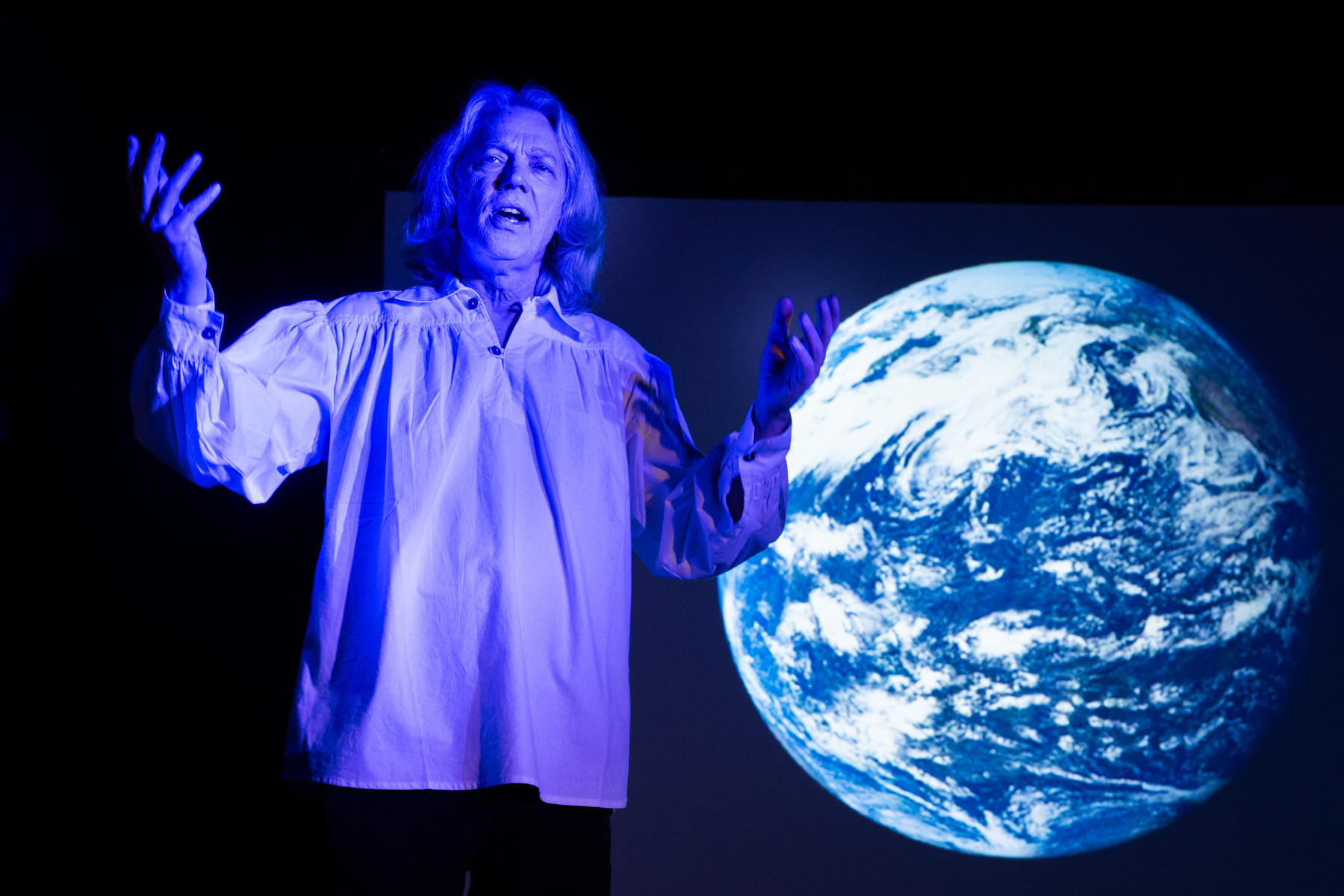
When Apollo looks down upon Earth and sees a world fractured by “fascism and oligarchy,” he does not turn away. Instead, in Frederick Glaysher’s epic poetic theater work “The Parliament of Poets,” the Greek god calls poets from across nations to the moon—not to escape humanity’s struggles, but to discover how imagination, wisdom and storytelling might help create peace.
Glaysher will bring his performance of “The Parliament of Poets” to Cahoots Event Space, 206 E. Huron St. in Ann Arbor, for two more performances: Thursday, Nov. 5, from 7–8:40 p.m., and Saturday, Nov. 7, from 7–8:40 p.m. Tickets are available at BuyTickets.At/ApollosTroupe.
The 100-minute theatrical version is drawn from Glaysher’s much larger epic poem, which explores poetry, philosophy, world religions, history and humanity’s shared journey. For Glaysher, the performance is an opportunity to reconnect audiences with the larger stories and traditions that have shaped civilizations.
“I’d hope that people who attend “The Parliament of Poets” leave with a wider appreciation of the vast expanse of time and space that is our human past and present experience,” Glaysher said. “We all live naturally on mostly the local level, but we Homo sapiens long ago chose to spread out all around the world, seeking to know what’s over the horizon.”
He believes that storytelling can reach people in ways that arguments and theories often cannot.
“Through a story, we can feel and experience it in our hearts and souls, not just our heads,” Glaysher said. “Recovering a little more the great depth within us would help.”
A modern epic for a divided world
For more than a decade, Glaysher has worked to develop “The Parliament of Poets” as a contemporary form of epic poetry performance. The complete poem contains more than 9,150 lines, but the stage version offers audiences a concentrated experience of its themes and vision.
“I often feel I’ve created almost a separate work of art in the 100-minute theatre version that I perform, a taste as I think of it of its themes and vision,” Glaysher said.
The production draws from an ancient tradition in which poets did not simply write literature—they performed it before audiences. Glaysher sees “The Parliament of Poets” as part of an effort to revive that connection between poetry, voice, and communal experience.
“For most of the acting world, epic poetry doesn’t even exist as performance,” Glaysher said. “Theatre begins for them with the chorus and the theatre of Dionysus. Yet Homer and other ancient epic poets performed for centuries in the courts of the little Greek city states.”
Glaysher said he hopes to bring that sense of epic storytelling back into contemporary theater.
“That’s what I want to revive in Ann Arbor,” he said.
Poetry as a bridge across divisions
A central idea behind “The Parliament of Poets” is that humanity’s divisions often obscure a deeper reality: people share far more than separates them.
Glaysher connects this belief to scientific discoveries about human genetics as well as to ancient spiritual and philosophical traditions.
“In the early 2000s, when the human genome was beginning to be decoded at an amazing rate, geneticists Craig Venter and Kenneth Kidd stated human beings are 99.9% genetically identical, and race is not biologically determined, but socially, culturally,” Glaysher said.
“We’re all Homo sapiens,” he continued. “That’s a scientific fact that cannot be denied.”
For Glaysher, poetry can remind people of that shared humanity.
“Our divisions and animosities that are tearing us apart are delusions,” he said. “We all have the identical psycho-somatic nature as Homo sapiens.”
He believes literature from around the world repeatedly returns to questions that unite people rather than separate them.
“All the great literary traditions around the world probe and explore the deepest regions of the human psyche,” Glaysher said. “They’re not just political, economic disquisitions. They’re grappling with the deep space that all Homo sapiens have within, are born with, trying to understand ourselves, the meaning of it all, of life as sensitive people experience it.”
From classrooms to a new experimental theater vision
Although “The Parliament of Poets” reaches across centuries and continents, its roots are deeply connected to the Ann Arbor-Ypsilanti area. Glaysher’s artistic journey was shaped by decades of study, performance, and community connections, including a pivotal experience at Eastern Michigan University with performing poetry professor Annette Martin.
Nearly 50 years later, Glaysher still remembers the impact of Martin’s classroom and how it changed the direction of his creative life.
“Looking back, she had a pivotal influence on my life,” Glaysher said. “I had been thinking of myself as a lyric poet for several years, struggling to write, but her class on performing poetry set me in a different direction, eventually epic poetry and the desire to revive the performance style of the ancient Greek rhapsodes.”
The ancient rhapsodes were performers who brought epic poetry to audiences through voice, movement, and dramatic storytelling. That tradition inspired Glaysher’s vision of creating a modern form of epic performance.
“They would chant narrative poetry, especially Homer, in a moderately dramatic manner, oral recitation and song, the voice itself music, traveling around to those great old amphitheaters,” Glaysher said.
“The idea just kept coming at me, write an epic poem and then work on creating a modern style of performance,” he continued. “I learned from Annette Martin that it was possible, though I’ve always had to figure it out mostly myself.”
Glaysher’s interest in theater was also shaped by one of his earliest experiences attending a major theatrical production in Ann Arbor. As a young person, he saw Sophocles’ Oedipus Rex at the Power Center, performed by the Young Vic.
“Truly an overwhelming experience I’ve never forgotten,” Glaysher said.
The production’s simplicity influenced his own approach to staging “The Parliament of Poets.” Rather than relying on elaborate scenery, he is drawn to performances where imagination becomes part of the experience.
“It was on a bare stage with only a wood stepped platform, and has always resonated for me with the English theatre director Peter Brook’s conception of the ‘empty stage,’” Glaysher said. “Not an elaborate, cluttered stage, but one relying on evoking the imagination of the audience into another realm through the sheer drama of the performance and the words.”
Searching for a home for experimental theater
For years, Glaysher has dreamed of establishing an independent experimental theater in Ann Arbor—a place where epic poetry, classical theater and world traditions could come together.
His vision comes partly from his belief that contemporary theater can expand beyond traditional categories.
“I would also produce with others help highly selective classic theatre and world theatre pieces that give perspective on human experience, as well as other epic traditions,” Glaysher said.
Glaysher sees Ann Arbor as a natural location for this kind of creative space because of the city’s history, intellectual energy and artistic community.
“The Ypsilanti-Ann Arbor area is where much of my intellectual development began so I think it’s rather natural to come back here,” he said.
Over the years, Glaysher has performed his work in many locations, traveling across the United States and internationally. But he has continued to return to the Ann Arbor area, hoping to eventually establish a permanent artistic home.
“Truth is, I’ve wandered all over the country for a decade, from Michigan to Texas, up-state New York, Toronto, Edinburgh, Scotland, San Francisco, New York City, for over 70 performances,” Glaysher said. “I basically always have to start from scratch each time.”
He said that experience has strengthened his desire for a dedicated space where his work and other artists can develop.
“So for years I’ve very much come to the point of looking for a home where I might fully develop it,” Glaysher said.
Ann Arbor’s literary and cultural traditions continue to draw him back.
“Since the mid seventies, I’ve always been coming back regularly, constantly to Ann Arbor, for the bookstores, theatre, poetry, and here I am again, drawn to this marvelously international city, with its rich roots,” Glaysher said.
Creating art beyond traditional boundaries
Glaysher’s work crosses poetry, theater, history, philosophy, and world religions. He believes today’s audiences may be increasingly open to art that does not fit neatly into one category.
“I’ve been a life-long independent in every way,” Glaysher said. “The traditional, conventional ideologies, interpretations and conceptions have become fossilized and out of touch with the fullness of human experience.”
For Glaysher, epic poetry offers a way to explore complexity rather than reduce humanity into opposing sides.
“I believe epic poetry can play a role in that, help, in imagination, people to fine-tune a bit, here and there, choose to,” he said.
His goal is not simply to preserve an ancient art form, but to use it as a living way to examine the challenges of the present.
A lifelong belief in humanity, peace, and the power of art
The themes behind “The Parliament of Poets” are not only philosophical for Frederick Glaysher—they are also personal. His belief in finding common ground was shaped early in life through his family experiences, particularly the example of his mother, who encouraged peace during moments of disagreement.
Glaysher remembers family conflicts over religion, and the way his mother tried to bring people back together rather than allow differences to divide them.
“I’m able to laugh at myself, that, yes, I’m like my mother, a bit, scolding those in the family bitterly arguing over religion, ‘Enough! We’re here to celebrate the holiday together as a family!’” Glaysher said.
He believes that message remains relevant in today’s world.
“But these days, religious, political, secular, academic, whatever, I think the world needs to hear it again,” he said.
That desire to encourage understanding is central to his artistic mission. For Glaysher, artists have a responsibility to help people see beyond conflict and reconnect with their humanity.
“I’d say artists of all mediums represent and explore the human need to reflect on and understand, to create beauty, to elevate the brutal animal into a human being,” Glaysher said.
“Developing sensitivity to the beautiful elevates and enriches the individual and society,” he continued. “An artist who achieves that in any medium has truly accomplished something worthwhile.”
The voices of world literature
Throughout his career, Glaysher has drawn inspiration from literary traditions around the world. He sees poetry as a way different cultures have explored the same fundamental questions about existence, meaning and human experience.
“The metaphors differ, but they are all exploring and seeking to understand the same reality,” Glaysher said.
In discussing the influence of women in literature and culture, Glaysher emphasized what he sees as the connection between creativity, compassion and civilization.
“Women are just so astonishing!” Glaysher said. “The female in every world literature evokes the human, the humane, nurturing, the spiritual, the elegant and stands in opposition to the brutal and cruel barbarous animal nature that men all too often succumb to.”
For Glaysher, these themes are part of a larger examination of what it means to be human.
His work looks beyond individual nations and time periods to explore what people share across cultures.
Bringing epic poetry back to the stage
Glaysher believes that epic poetry has an important role to play in contemporary life because it allows audiences to encounter humanity’s biggest questions through story and performance.
He argues that modern society often becomes divided because people focus too narrowly on competing ideas rather than embracing the complexity of human experience.
“The traditional, conventional ideologies, interpretations, and conceptions have become fossilized and out of touch with the fullness of human experience,” Glaysher said.
He sees epic poetry to reconnect audiences with a broader perspective.
“The great German poet Goethe famously said the healthy literary periods are all objective, while the decadent periods are subjective,” Glaysher said. “Modern literature has long been given to extreme subjectivity, in poetry, theatre, all the arts.”
Glaysher said that his response was to create a work that reaches beyond personal expression.
“We need to move on,” he said. “I long ago concluded the way to do so was to write an epic poem.”
A performance meant to inspire connection
After decades of writing, studying, and performing, Glaysher hopes audiences leave “The Parliament of Poets” with a renewed appreciation for the depth of human history and possibility.
The performance is not simply a theatrical event—it is an invitation to think about humanity’s past, present and future.
Glaysher hopes audiences recognize that despite current challenges, humanity has repeatedly found ways to adapt and grow.
“Modern life has brought us all back together,” Glaysher said. “We’re experiencing much friction and difficulty in adjusting, but we’re capable of it, and have done it many times in the past.”
He believes wisdom traditions, poets, and storytellers can help guide that process.
“Let’s remember and follow a bit more the perennial examples of the many wise and great religious and wisdom traditions and teachers, and the visionary poets, evoking love, compassion, kindness, and all the humane virtues that distinguish the human animal from the beasts,” Glaysher said.
For Glaysher, “The Parliament of Poets” represents a return to an ancient idea: that stories told aloud can bring people together.
Through poetry and performance, he hopes audiences will rediscover the connections that exist beneath the divisions of modern life.
Event Information
Frederick Glaysher presents The Parliament of Poets
Thursday, Nov. 5, 7–8:40 p.m.
Saturday, Nov. 7, 7–8:40 p.m.
Cahoots Event Space
206 E. Huron St.
Ann Arbor, Michigan
Tickets: BuyTickets.At/ApollosTroupe

Donna Marie Iadipaolo is a writer, journalist, and State of Michigan certified teacher, since 1990. She has written for national publications like The Village Voice, Ear Magazine of New Music, Insurance & Technology, and TheStreet.
She is now writing locally for many publications, including Current Magazine, Ann Arbor Family, and the Ann Arbor Independent. Her undergraduate degree is from the University of Michigan, Ann Arbor, where she graduated with an honors bachelor’s degree and three teacher certificate majors: mathematics, social sciences, English. She also earned three graduate degrees in Master of Science, Master of Arts, and Education Specialist Degree.

