
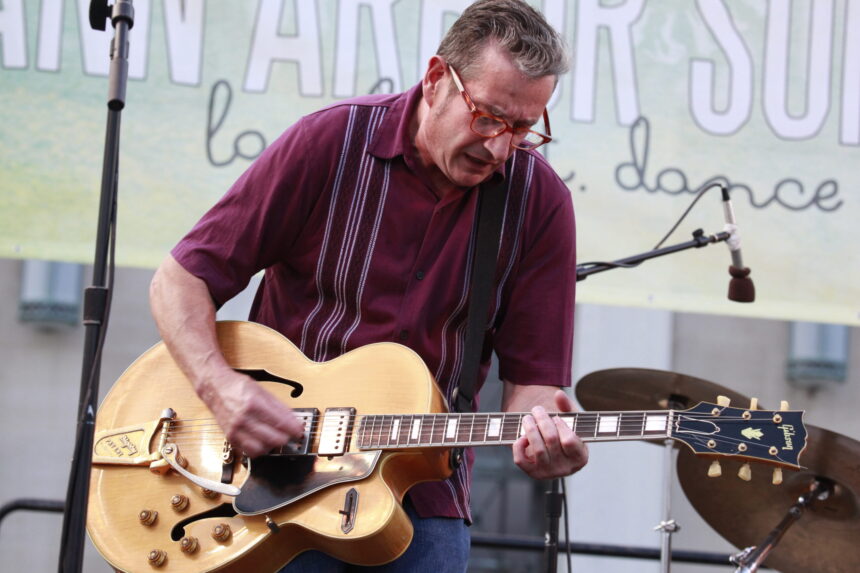
For 14 years, guitarist and bandleader George Bedard has invited audiences to travel through the rich landscape of American music. Rather than offering a traditional history lesson, his annual History of American Music series has become something more personal—a musical journey that explores the artists, songs and eras that continue to inspire him.
This year, Bedard returns to The Ark on Aug. 15 with a tribute to pioneering rockabilly legend Carl Perkins. Along with Perkins’ classics such as “Blue Suede Shoes,” “Honey Don’t,” and “Dixie Fried,” the concert also celebrates the remarkable musical landscape of 1963, featuring songs associated with artists including Bob Dylan, Johnny Cash, Otis Redding, George Jones and The Beatles.
For Bedard, the series began with a simple desire to share the music he loves.
“I had always wanted to showcase the many eras and styles of music I’m interested in,” he said. “The series has evolved not into an academic ‘history’ but a journey through the music, taking a different path each year.”
Over the years, the concerts have highlighted influential artists from across American music. Among the performances that stand out most to Bedard are a tribute to rock-and-roll pioneer Chuck Berry featuring Berry’s longtime pianist Darryl Davis, as well as last year’s celebration of blues guitarist Elmore James.
Honoring a personal musical hero
Unlike anniversaries or milestone birthdays that often dictate tribute concerts, Bedard’s decision to focus on Perkins comes from admiration rather than timing.
“I have no idea if Carl is the ‘right’ artist to spotlight in 2026,” Bedard admitted. “I do know that I love his music and he’s been a huge influence on me.”
Although Perkins helped shape early rock and roll, Bedard believes many listeners today may not fully recognize his impact.
“Modern audiences may be unaware of his influence, but that doesn’t mean it’s not there,” he said.
That influence extends far beyond Perkins’ own recordings. Songs such as “Blue Suede Shoes” became staples for generations of performers and helped define the emerging rockabilly sound, blending country, blues and early rock and roll.
Even after decades of performing it, “Blue Suede Shoes” continues to spark vivid memories for Bedard.
“I remember hearing my dad’s college students singing the intro, ‘One for the money/ two for the show,’ when I was maybe four,” he recalled. “Also, I dig the guitar solo.”
Revisiting the musical explosion of 1963
While Perkins provides the evening’s central focus, the concert also explores one of the most dynamic years in popular music.
For Bedard, what makes 1963 so fascinating is not one artist but the incredible variety of sounds that coexisted.
“I think about the incredible diversity of music at that time, all of which would have been accessible to any kid with a radio who was allowed to stay up late,” he said.
That diversity reflects a remarkable moment in American music when folk, country, rhythm and blues, soul and the early British Invasion all found audiences simultaneously. By weaving together songs from artists as varied as Dylan, Cash, Redding, Jones and The Beatles, Bedard hopes to capture the excitement of a musical era filled with innovation.
Keeping classic music alive
Throughout his career, Bedard has earned a reputation for presenting classic American music with authenticity while avoiding simple nostalgia.
Rather than consciously trying to balance historical accuracy with contemporary performance, he approaches each song instinctively.
“I don’t think about balance when performing,” he said. “I just try my best to lose myself and channel the music.”
His philosophy has served him well over a career that has included performances with legendary musicians such as Muddy Waters, Bonnie Raitt, Koko Taylor, and Johnnie Johnson.
Among those experiences, one memory remains especially meaningful.
“Muddy Waters was very gracious, willing to treat a green young kid as a fellow artist,” Bedard said.
A career rooted in musical versatility
Bedard’s own music reflects influences ranging from blues and country to jazz, rockabilly, and early rock and roll. Rather than blending genres indiscriminately, he believes each style deserves respect.
“I try to be true to the style of music I’m playing without being too rigid about it,” he explained. “As a bandleader, I hire musicians who can play and respect different genres of music.”
That philosophy extends to the musicians joining him onstage for this year’s performance: drummer Rich Dishman, bassist Pat Prouty, and guitarist Randy Tessier.
“They are all longtime friends,” Bedard said. “I trust them all to learn the material and give their best.”
The trust built through years of performing together allows the musicians to focus on bringing new life to songs that have endured for generations.
Looking beyond nostalgia
Bedard has also been a cornerstone of Ann Arbor’s music community for decades, including closing the Ann Arbor Summer Festival for more than 25 years. While the local scene has certainly changed during that time, he hesitates to describe those changes as a simple evolution.
“I’m not sure ‘evolve’ is the right word,” he said. “It’s certainly changed.”
Ultimately, Bedard hopes audiences leave with more than an enjoyable evening of familiar songs.
“My hope is always that people will be inspired to check out the original artists,” he said.
That curiosity has always been the heart of the History of American Music series. By celebrating artists like Carl Perkins while placing them within the broader musical landscape of 1963, Bedard invites listeners not only to revisit beloved classics but also to discover the deeper roots of American music—one song at a time.

Donna Marie Iadipaolo is a writer, journalist, and State of Michigan certified teacher, since 1990. She has written for national publications like The Village Voice, Ear Magazine of New Music, Insurance & Technology, and TheStreet.
She is now writing locally for many publications, including Current Magazine, Ann Arbor Family, and the Ann Arbor Independent. Her undergraduate degree is from the University of Michigan, Ann Arbor, where she graduated with an honors bachelor’s degree and three teacher certificate majors: mathematics, social sciences, English. She also earned three graduate degrees in Master of Science, Master of Arts, and Education Specialist Degree.

