
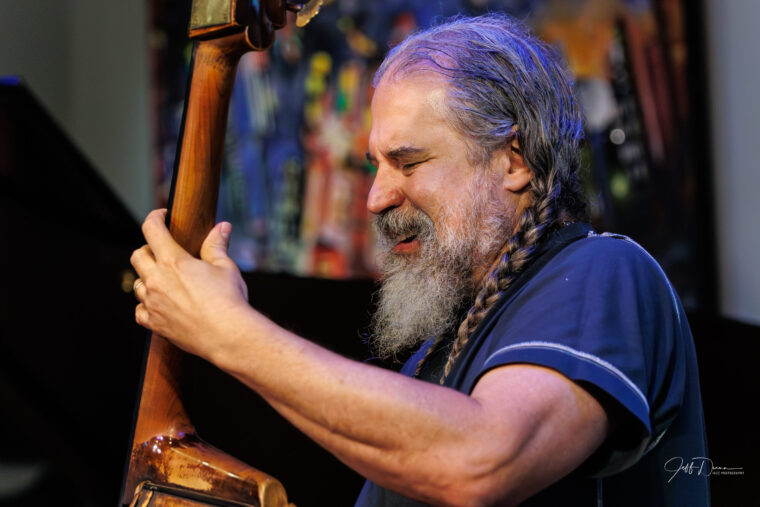
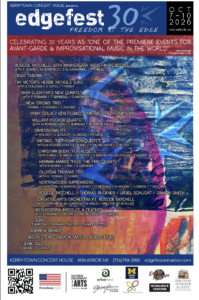
For three decades, Edgefest has invited audiences to step beyond the familiar and discover music that challenges, surprises and inspires. The annual festival of creative music and avant-garde jazz returns this fall for its 30th anniversary, continuing a legacy built on experimentation, artistic courage and a belief that some of the most meaningful musical experiences happen when listeners are willing to explore the unknown.
At the heart of Edgefest’s story is the evolution of Kerrytown Concert House (KCH), the intimate Ann Arbor venue founded in 1984 by Deanna Relyea. Originally trained as a classical pianist, Relyea never expected her journey would lead her through decades of jazz, chamber music, visual art and nonprofit leadership—but that spirit of discovery became central to the identity of both KCH and Edgefest.
“As founder of KCH, I have been enriched by the variety of artists and genres that have passed through the House. My background was in classical music, and over the years I feel I have gained several graduate degrees in other areas—jazz, chamber music, art, even business—as I was learning to run a nonprofit organization. The House has always been about evolution, learning, and being open to new artistic experiences,” Relyea said.
A festival born from a musical movement
Edgefest was created in 1997, emerging from a growing interest in avant-garde jazz and new music movements that were flourishing in places such as New York City, the West Coast, Montreal, and beyond.
The festival’s beginnings were sparked by Dave Lynch, a community member, writer, and reviewer for the All Music Guide who was passionate about creative music and the artists developing new approaches to sound. Lynch began bringing traveling groups to Kerrytown Concert House, and audiences gradually discovered a new musical world.
“Edgefest came about because of Dave Lynch. He was passionate about the avant-garde jazz and new music movement that was emerging and thriving in places like New York City and the West Coast, and he was also drawn to the Montreal musicians who had a movement and style all their own. In the spring of 1997, Dave came and said he had two groups that wanted to play the same weekend—great New York creative bands. We thought, ‘OK, we will add maybe two more groups and call it a festival. If you call it a festival, people will come!’” Relyea said.
What began as an ambitious experiment quickly became a nationally recognized destination for adventurous music. Lynch served as Edgefest’s artistic director for ten years, bringing musicians from across the United States, Europe, Canada, and Asia to Ann Arbor.
At a time when international touring was more accessible, Edgefest audiences were able to experience some of the world’s most innovative musicians. The festival also highlighted Detroit artists influenced by creative music pioneers such as Roscoe Mitchell, who will appear at this year’s festival.
Keeping the edge for three decades
Maintaining a festival devoted to experimental music for 30 years requires both dedication and a willingness to embrace change. For Relyea, Edgefest’s longevity comes from the artists themselves—their commitment to creating music outside traditional commercial boundaries.
“One of the factors that keeps Edgefest resilient is that the artists who perform this music are ever evolving themselves—uncompromising and resilient. There has evolved a community of artists and presenters in this music that is always accepting and exploring. Because the artists who put their lives onto the avant-garde trail do not become the big monied stars of the day, one knows that this music is who they are and that it is a lifestyle commitment,” Relyea said.
That dedication has helped create a unique relationship between performers and audiences. Edgefest is not simply a series of concerts; it becomes a gathering place where musicians and listeners form connections around shared curiosity.
“People who attend Edgefest know that every night is full of surprises and moving moments. The audience reflects a wide range of ages, from high school students to seniors, and includes people from many different cultural backgrounds. There are always new audience members, many from other parts of the country and even from abroad. Audience members and the artists together become a community for that week, and lasting bonds are created,” Relyea said.
A future built on exploration
As Edgefest celebrates its 30th anniversary, the festival continues its original mission: presenting artists who are finding their voices and expanding what music can be.
For Relyea, the journey from classical piano to avant-garde jazz reflects the very philosophy that has guided Edgefest from the beginning. The festival remains a reminder that artistic discovery is a lifelong process—and that audiences can continue to find beauty in unexpected places.
This year’s Edgefest 30: Freedom at the Edge will feature internationally recognized artists, emerging voices, educational events and opportunities for the community to experience creative music in an intimate setting. After three decades, Edgefest remains one of Ann Arbor’s most distinctive cultural traditions—still exploring, still evolving, and still living on the edge.
Edgefest will take place Wednesday, October 7, through Saturday, October 10, 2026, with its main performances held at Kerrytown Concert House in Ann Arbor. In addition, Thursday’s events will include a free conversation with acclaimed musician Roscoe Mitchell and a Creative Arts Orchestra performance at Community High School Auditorium.
To see the full schedule or purchase tickets, visit: Edgefest 30: Freedom at the Edge
Donna Marie Iadipaolo is a writer, journalist, and State of Michigan certified teacher, since 1990. She has written for national publications like The Village Voice, Ear Magazine of New Music, Insurance & Technology, and TheStreet.
She is now writing locally for many publications, including Current Magazine, Ann Arbor Family, and the Ann Arbor Independent. Her undergraduate degree is from the University of Michigan, Ann Arbor, where she graduated with an honors bachelor’s degree and three teacher certificate majors: mathematics, social sciences, English. She also earned three graduate degrees in Master of Science, Master of Arts, and Education Specialist Degree.

