
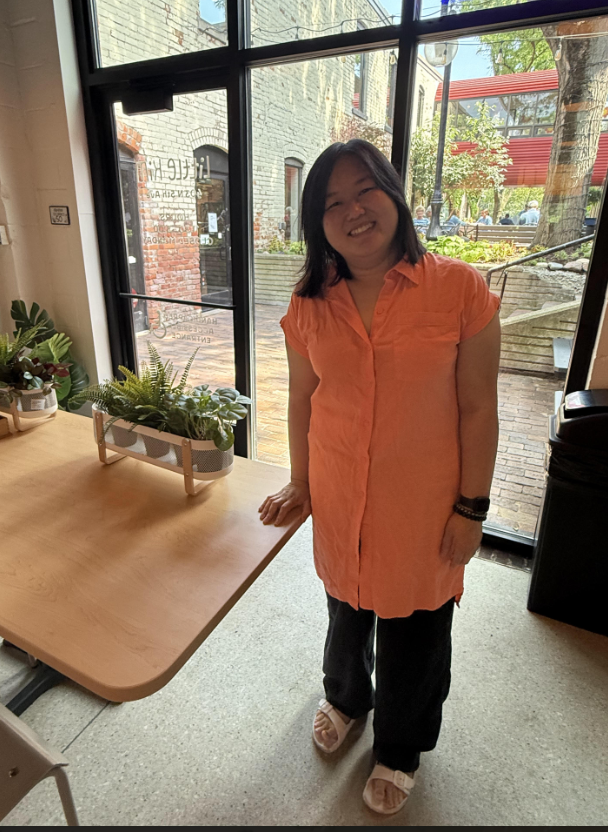
Ji Hye Kim, chef and owner of Miss Kim and the newly opened Little Kim, has carved out a distinctive place in Ann Arbor’s culinary landscape.
Her journey began in 2008, when she trained within the Zingerman’s Community of Businesses and the Rome Sustainable Food Project. In partnership with Zingerman’s, she launched a pan-Asian food cart called San Street, which she operated for four years before opening her first brick-and-mortar restaurant, Miss Kim, in 2016.
Her new venture, Little Kim, brings a new dimension to her cooking—one rooted in vibrant, vegetarian flavors and super-casual health dining. Little Kim is located at 207 North 5th Avenue, nestled in the Kerrytown courtiers next to Miss Kim.
Inspiration behind Little Kim
For Kim, the concept for Little Kim came from a mix of practicality, passion and personal taste shifts.
“I wanted to buy more vegetables from the farmers I love and feed more people,” she said. “Little Kim is a vegetarian fast casual spot with a lower price point than Miss Kim. I want more people to come and enjoy the food and enjoy it often.”
She added that although she isn’t a vegetarian, plant-based eating has increasingly shaped her meals.
“Whenever I go to Korea, I visit a Buddhist temple and really enjoy the vegan food served there; I just think that vegetarian food can be so delicious, and I wanted to share that.”
The name itself carries a personal touch:
“For the name Little Kim, this restaurant just felt like a chill, younger, vegetarian sister to Miss Kim,” she said.
Atmosphere, concept and menu
Donna Iadipaolo.
Kim designed Little Kim with the warmth and welcome of her own home in mind.
“The concept is a chef-driven, fast-casual restaurant that draws from diverse Asian vegetarian traditions while also highlighting Michigan farmers and producers,” she said.
Little Kim’s menu is entirely vegetarian. Its space reflects simplicity, sustainability and Korean heritage with a modern touch: natural wood tables, lush greenery and cozy seating anchored by an open kitchen—giving diners a direct connection to the cooking process.
Little Kim also features a mini mart that offers house-made sauces, vegan kimchi, pickles and products from other Asian and Asian American makers.
RELATED: Chef Corner: Ji Hye Kim
Signature dishes
If you’re imagining a pared-down vegetarian menu, think again. Little Kim’s offerings are bold, varied and full of texture and flavor.
Donna Iadipaolo.
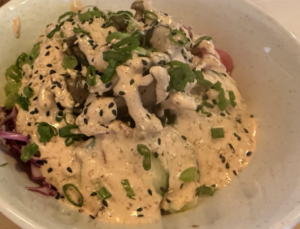
“Make Your Own Bowls are a focal point of the menu,” Kim explains. Options include bases like jasmine rice, greens and even French fries; proteins such as panko-fried tofu, paneer, and smoked tempeh; vegetables including kimchi, pickled radishes and charred broccolini; and sauces like gochujang mayo, siamang garlic vinaigrette and spicy mayo.
Other highlights include loaded fries with vegan kimchi, a crunchy spicy sesame salad with tahini dressing, a panko-fried paneer sandwich, tempeh jajjang bap made with locally sourced tempeh and a rotating Daily Kimbap. Grab-and-go offerings include gochujang marinara sauce, pickles and vegan kimchi.
Donna Iadipaolo.
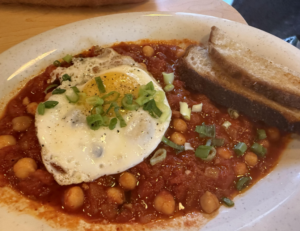
Kim she recommended the “Eggs in Purgatory Dish.” It was served in a savory tomato sauce accompanied by ample chickpeas, a fried egg on top and toast on the side. Extremely savory and a major triumph!
Many cultures claim the “Eggs in Purgatory” dish, including Italian (“Uova in Purgatorio”), Middle Eastern (“Shakshuka”), Mexican, African, Creole and others with a looser variation of eggs and a red sauce. Kim’s variety, according to the menu, contains Gochujang as well.
Donna Iadipaolo.
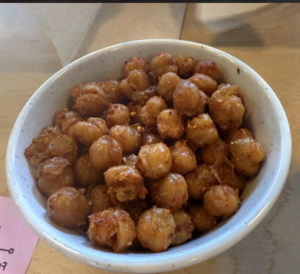
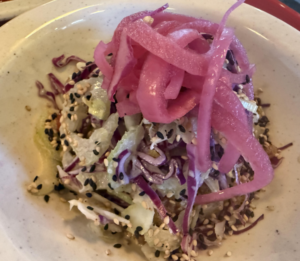
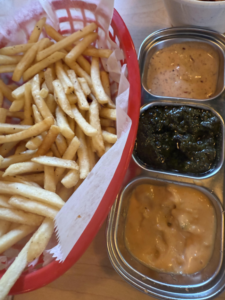
We also sampled the fried chickpeas that were spiced with Korean chili spice mix, which were fun to snack on first. We also shared the mushroom avocado bowl, which was a delightful mix of Stoney Creek Mushrooms, Avocado, Red cabbage, Pickled Onions, Chipotle Mayo and Purple Jasmin Rice. An imaginative and healthy blend of flavors. The fennel salad was also a delight with the tahini dressing and mix of celery and other vibrant veggies. French fries were served with Korean-style dips instead of ketchup.
The chef also came out and chatted with us and even showed us how to create the Korean heart signal. She graciously went around and hung out with customers as well—a generous soul.
100% vegetarian (and often vegan)
Donna Iadipaolo.
Kim confirms that the restaurant is entirely vegetarian, with plenty of vegan options. This makes Little Kim unique among Ann Arbor’s Asian eateries and gives diners more plant-based choices at an approachable price point.
Creative process and culinary influences
Kim’s menu design blends her cultural background, professional training and constant curiosity.
“The inspiration comes from everywhere. Obviously, the menu draws from diverse Asian vegetarian traditions (including influences from Korea, Japan, China, and India). But then, I like to just walk around the farmer’s market and see what’s in season and blend that into the menu.”
Her Korean heritage is central, but she also weaves in elements from her travels and local partnerships.
Donna Iadipaolo.
“The menu at Little Kim is definitely a little bit of me and where I come from—Korea, and more broadly, Asia. But it is also where else I have been—such as a little bit of Italy in gochujang marinara sauce—and where I am—seasonal vegetables and local artisanal ingredients like the Brinery’s tempeh or the Tracklement’s smoked tofu.”
Navigating a male-dominated industry
Kim acknowledges that professional kitchens can be tough environments for women, but her own experiences have been largely positive.
“The challenges faced by a female cook or chef in kitchens are very real. Fortunately, I have only worked in kitchens where I did not have to deal with that very much. I was lucky enough to be in a better working environment with folks who were generous with their knowledge.”
Part of that, she believes, comes from the fact that she entered the field later in life with a clear end goal.
“From the moment I stepped into the kitchen, I communicated those goals, and that I was there to just learn. In that sense, I probably was not a threat to other cooks and chefs. I was a visiting student, an outsider, a passerby.”
Awards and recognition
Kim’s thoughtful, community-minded cooking has earned her national recognition. She was named one of Food & Wine’s Best New Chefs of 2021 and is a five-time James Beard Award semifinalist, most recently in 2025 for “Best Chef: Great Lakes.”
Buzz from the community
The response to Little Kim has been enthusiastic.
“I see a lot of people walking by and notice the coming soon signs and get excited, and we get a lot of questions on the opening dates; so, I think people are curious and excited.”
And now that it is open, customers love it:
“I had lunch at Little Kim yesterday,” Anne Marie said.
“Everything was delicious. So happy to have another vegetarian choice.”
Little Kim is also family-friendly, with many healthy choices for everyone. Even its name “little” conveys warmth, playfulness and friendliness like a nickname or “little sibling.” Chef Kim even said some of the playful snacks are Korean-American influenced dishes that remind her of her own youth.
Dining experience goals
Kim wants Little Kim to be as approachable and welcoming as possible.
“I’d love Little Kim to be people’s go-to spot, to come back often with friends and family, even with ones who may be skeptical or may have low expectations of eating vegetarian food. And just have a great meal, you know?”
She envisions a relaxed yet attentive service model:
“From the moment you walk in, you’re warmly greeted, our staff friendly and happy to help. You’d order, sit down and we will bring everything out for you and take care of you, even though it’s a counter service restaurant. The kind of service that puts a smile on your face.”
Sustainability and local sourcing
Sustainability is a core part of the menu design.
“Little Kim’s menu will change seasonally to reflect Asian ingredients as well as those from the Midwest that are at their peak at different times of the year.”
By working with local farmers and artisanal producers, Kim connects her cooking to the regional food ecosystem while still maintaining her global flavors.
Adding to Ann Arbor’s food scene
Kim sees Little Kim as a complement to the city’s vibrant dining culture, not competition.
“Ann Arbor is full of great, small, independent businesses and has wonderful vegetarian and vegan restaurants. I am just happy to be a part of it. I always think, the more the merrier – I don’t operate with the idea that there is room for only one of each kind of restaurant. More Asian food, more independent restaurants, more vegetarian food, more diversity – that’s what makes Ann Arbor unique and delicious. It’s all good.”
Always learning
Even with years of experience, Kim sees herself as a student of cooking.
“I started cooking later than most chefs and it has been a path of learning. I continue to research, learn, develop and evolve. I’m sure it would be the same at Little Kim.”
That ongoing growth is at the heart of her work—and likely a big reason why diners will keep coming back.
Kim also hosts special dinners highlighting other chefs and people in the food industry. She discusses influences such as culture, family and life experiences in the creation of her and others’ culinary art. We recently enjoyed Peter Som’s Cookbook Dinner hosted by Chef Kim. They collaborated on Chinese and Korean-influenced dishes, with her takes on his grandmother’s recipes.
Find more events hosted by Miss Kim at misskimannarbor.com/events.
Little Kim. 403 N. Fifth Ave, Ann Arbor. 734-239-7979. littlekimannarbor.com.

Donna Marie Iadipaolo is a writer, journalist, and State of Michigan certified teacher, since 1990. She has written for national publications like The Village Voice, Ear Magazine of New Music, Insurance & Technology, and TheStreet.
She is now writing locally for many publications, including Current Magazine, Ann Arbor Family, and the Ann Arbor Independent. Her undergraduate degree is from the University of Michigan, Ann Arbor, where she graduated with an honors bachelor’s degree and three teacher certificate majors: mathematics, social sciences, English. She also earned three graduate degrees in Master of Science, Master of Arts, and Education Specialist Degree.

