
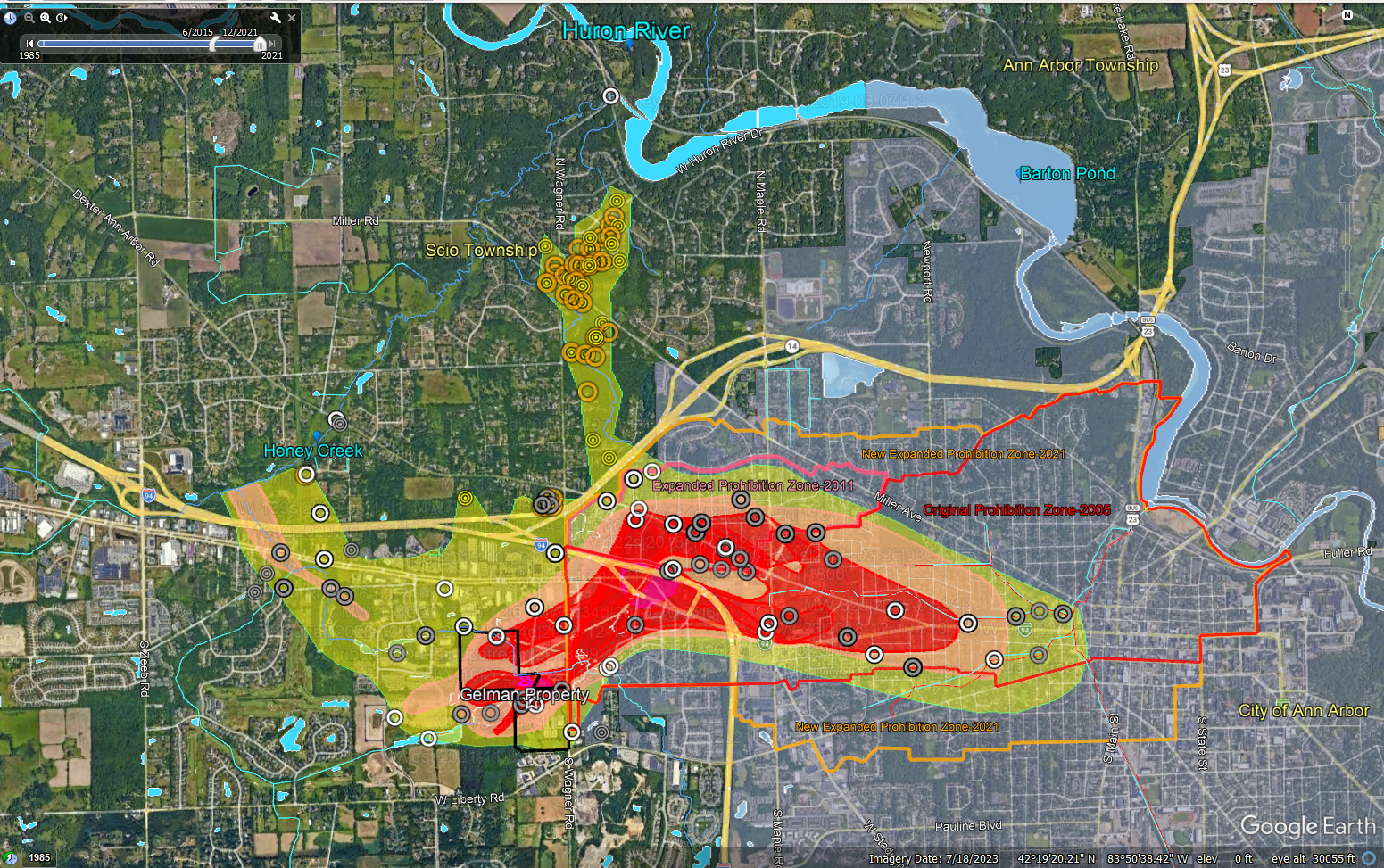
For more than three decades, the spread of 1,4-dioxane contamination—commonly known as the “Gelman Plume”—has remained one of the most persistent environmental concerns in the Ann Arbor area. What began as an industrial pollution issue with Gelman Sciences has evolved into a long-running public health and environmental debate—one shaped as much by scientific uncertainty as by community persistence.
Now, with the site’s new designation under the federal Superfund program, many residents are asking what this shift will mean for cleanup, transparency, and long-term safety.
Roger Rayle, chair of the Coalition for Action on Remediation of Dioxane (CARD) and Scio Residents for Safe Water (SRSW), has been deeply involved in tracking and advocating around the plume for over 30 years. His reaction to the recent Superfund designation was succinct: “All good news.”
A “fundamental shift” in cleanup
The plume originates from groundwater contamination linked to the former Gelman Sciences site, where 1,4-dioxane—a likely human carcinogen—entered the aquifer and began migrating beneath western Washtenaw County. Over time, the contamination spread far beyond its original source, raising concerns about its reach toward residential neighborhoods and municipal water systems.
Until now, oversight has largely been handled at the state level through the Michigan Department of Environment, Great Lakes, and Energy. While that process produced years of monitoring and containment efforts, critics have long argued that it fell short of fully addressing the scope and urgency of the problem.
Rayle believes the new federal involvement marks a major turning point.
“A fundamental shift in how the cleanup will be managed,” he said, pointing to the increased authority and resources that come with Superfund designation under the United States Environmental Protection Agency.
In March 2026, the EPA formally added the site to the National Priorities List (NPL), making it eligible for long-term federal cleanup funding and enforcement. This designation typically signals a more rigorous phase of investigation—one that includes expanded monitoring, deeper analysis of contamination pathways, and legally enforceable cleanup requirements for responsible parties.
Addressing longstanding concerns
For years, community advocates have questioned whether the full extent of the plume has been accurately mapped. The invisible nature of groundwater contamination has made it difficult for residents to fully grasp the risk, while shifting models and incomplete data have fueled skepticism.
When asked whether the Superfund process will bring greater transparency and more comprehensive testing, Rayle responded simply: “Yes.”
He also highlighted persistent misunderstandings among the public, noting that “‘Containment equals Cleanup’, ‘Plume extents and movements are known’ and other misconceptions will be addressed by the Superfund process.” These misconceptions, he suggests, have contributed to a false sense of security about the contamination’s reach and risks.
The plume’s proximity to municipal drinking water remains a central concern. While Rayle did not offer a definitive distance, he emphasized the importance of improved data and modeling:
“Having more complete data and modeling can help predict this…” Rayle said.
The role of community advocacy
If the Gelman plume story has a constant, it is the role of citizen advocacy. Local groups have spent decades pressing for answers, organizing meetings, and ensuring that the issue remains visible even when public attention wanes.
Scio Residents for Safe Water, formed in 1995, worked to establish CARD in 2006 and now provides technical support to CARD to inform residents and push for accountability. According to Rayle, that role is far from over.
RELATED: Toxicologist Sounds Alarm on 1,4-Dioxane in Ann Arbor
“SRSW has been a key stakeholder to date,” he said, adding that both organizations “will likely be key participants in the site’s Community Involvement Plans (CIP).”
These plans are a core component of the Superfund process, designed to ensure that residents have a formal voice in cleanup decisions and ongoing access to information. In theory, they represent a shift toward greater public inclusion—something advocates have long demanded.
Measuring progress—and managing expectations
Even with federal involvement, the timeline for meaningful change remains uncertain. Superfund cleanups are often measured in years or decades, not months, and early phases tend to focus more on study than visible remediation.
As the process begins, residents are eager for benchmarks that signal real progress. Rayle suggested that clearer expectations are forthcoming: “These will be discussed at upcoming CARD meetings.”
Despite decades of frustration, he expressed confidence in the trajectory. “Perseverance and facts prevailed over frustrating instances. NPL listing was a significant step.”
He also dismissed concerns that the designation might ultimately fall short, stating, “No. As long as water-based entities (humans) are making the decisions.”
Looking ahead
The road to full remediation will not be immediate. Still, for longtime observers like Rayle, the Superfund designation represents something that has often felt out of reach: momentum.
“Gelman’s dioxane had about a 20-year head start on us finding solutions, but EPA with community support knows how to address such problems,” he said.
For residents who have lived with uncertainty about their water, his message is both practical and urgent: “Stay tuned and get involved. ‘You’re about 2/3 water… act accordingly.’”
As federal oversight begins and community engagement ramps up, the designation may mark the most significant turning point yet in Ann Arbor’s long-running environmental challenge.
Yet policy shifts and regulatory frameworks tell only part of the story. For many residents, the impact of the plume is not abstract—it is personal, lived, and ongoing.
Another lived experience with the plume
For Cherie Charbeneau, the Gelman plume is not just an environmental issue—it is a lived reality shaped by years of exposure and unanswered questions.
“I rented a house for about 35 years at 214 Wildwood. After the city changed the sewer system in my neighborhood, my basement started flooding on a regular basis. I did not know that the 1,4-Dioxane Plume had reached the land under my house. Within two months of the first flood, my health began to greatly suffer,” Charbeneau said.
Her experience underscores a dimension of the crisis that is often less visible in official reports: the human health impact, particularly in cases where exposure pathways are not immediately obvious.
What superfund could mean for residents
Like many in the community, Charbeneau sees the Superfund designation as a potential inflection point—though not without reservations.
“I think this matter will finally receive the attention that it requires to make some much needed adjustments and hopefully save the water supply. I would like to see monitoring of people that have been exposed,” Charbeneau said.
Her emphasis on human monitoring reflects a broader concern that the health effects of exposure remain underexamined, particularly for residents who may have encountered the contaminant in ways not traditionally measured.
Public awareness and competing attention
Despite the significance of the designation, Charbeneau described a relatively muted public response so far.
“I have not seen a lot of information, a little on NextDoor. I think at this particular time in history, the news of the current administration is so overwhelming that many people are focused on other topics,”
The comment points to a challenge facing environmental issues nationwide: even major developments can struggle to break through in a crowded and often polarized information landscape.
Uncertainty about cleanup progress
While Superfund status brings new authority, it does not guarantee rapid change—a reality Charbeneau views with caution.
“I am not really sure how likely this will move forward with the current cutbacks of this current presidential administration. The EPA has had severe cuts, so I will not hold my breath on seeing change soon,” Charbeneau said.
Her skepticism reflects broader concerns about whether federal resources and political will will match the scale of the problem.
A turning point—long in the making
At the same time, she sees the designation as overdue.
“It does. I am astounded that in a city with so many knowledgeable scientists, it has taken this long. I had heard that the mayor was more concerned with the possibility of people not wanting to move here because of it, and didn’t want the Superfund designation. I believe this will help,” Charbeneau said.
The remark highlights longstanding tensions between environmental transparency and economic concerns—particularly in a city known for its academic and research institutions.
Concerns about drinking water
For Charbeneau, the issue ultimately comes down to risk—especially to the region’s water supply.
“The last time I looked at the map and read information about the testing of wells on Blueberry Lane, it was quite close to the Huron River. I think people should be VERY CONCERNED!”
She adds, in stark terms, that the biggest risk is “Contaminating the drinking water for the city of Ann Arbor.”
Health impacts and medical challenges
Her most detailed reflections center on the difficulty of understanding and treating potential exposure.
“When I got sick after the first flood in my basement, attempting to get medical care was very challenging. No one was studying what the effects were on humans.”
“The rash I got happened after a trip to Lake MI, so I had no idea what caused it. But when two months of not sleeping through the night, due to waking up scratching my whole body until it was bloody, I was very frustrated. I was sick and none of the medical profession even knew this was an issue.”
These experiences point to a gap between environmental monitoring and medical knowledge—particularly for contaminants like 1,4-dioxane, where long-term human health data remains limited.
Confidence in safeguards
When asked about current protections, Charbeneau was direct.
“Not confident at all. We live in the Great Lakes State and have 20% of the earth’s fresh water. I don’t think people push our political leaders hard enough on protecting this amazing resource that too many take for granted.”
Understanding exposure risks
Her experience also challenges assumptions about how exposure occurs.
“This is not true. I thought exposure would mean drinking the water. In my case, after the flood, and me cleaning my basement up myself, I had no idea that breathing in the air of the water that had been in my basement, but had dried, could impact my health in such a devastating manner.”
She described how later information helped her connect those experiences to the plume.
“That was the first time I realized that what occurred with my health could have been due to the plume reaching the ground water under my house, and that just touching the water, or drinking it were not the only issues.”
Accountability and the road ahead
Looking forward, Charbeneau expressed both hope and realism.
“I would hope that the clean-up would move faster and steps taken to protect our community. But at this point in time, with our political situation being what it is, I will not be surprised if very little happens at all.”
At the same time, she pointed to a broader lesson.
“From a community standpoint, I would hope going forward, the importance of laws that put the onus on corporations to clean up toxic messes they create, will be a priority.”

Donna Marie Iadipaolo is a writer, journalist, and State of Michigan certified teacher, since 1990. She has written for national publications like The Village Voice, Ear Magazine of New Music, Insurance & Technology, and TheStreet.
She is now writing locally for many publications, including Current Magazine, Ann Arbor Family, and the Ann Arbor Independent. Her undergraduate degree is from the University of Michigan, Ann Arbor, where she graduated with an honors bachelor’s degree and three teacher certificate majors: mathematics, social sciences, English. She also earned three graduate degrees in Master of Science, Master of Arts, and Education Specialist Degree.

