

Each April, Ann Arbor quietly becomes a gateway to modern Italian culture—not through travel, but through film. The Italian Film Festival USA returns to the University of Michigan campus on April 11 and 12, offering audiences a curated selection of contemporary Italian cinema rarely seen in American theaters.
It is a national touring festival dedicated exclusively to Italian film, bringing carefully selected works to communities across the country—including Ann Arbor.
A festival years in the making
Pierluigi Erbaggio is the Director of the Metro Detroit Committee of the Italian Film Festival USA since 2017.
For nearly two decades, Erbaggio has helped shape the festival’s presence in Southeast Michigan, with the support of a dedicated committee of like-minded volunteers and the organization’s director, Barbara Klein. Their efforts allowed the Festival to grow from a small campus initiative into a regional cultural fixture.
“The Italian Film Festival USA is present on many University campuses around the United States. In Metro Detroit, it started with screenings at Wayne State University and at the University of Michigan. Today, in addition to these locations, we show films at Michigan State University, Schoolcraft College, Chippewa Valley High School and the prestigious Detroit Film Theatre,” Erbaggio said.
What began as a university-based effort has expanded into a multi-venue experience, connecting audiences across the region while maintaining a strong foothold in Ann Arbor.
A loyal and growing audience
The festival’s success is rooted in community—both longtime supporters and newcomers discovering it for the first time.
“We try to reach the Italian community in Southeast Michigan as much as we can,” Erbaggio said. “Our community looks forward to the Festival every year. We have a large group of people who come back for our events year after year, but we also have new spectators who join us for some of our films because they learn about our festival through friends or social media.”
That blend of tradition and discovery mirrors the films themselves: grounded in Italian culture, yet constantly evolving.
A unique cinematic offering
What makes this festival especially distinctive is its scope and accessibility. It is the only festival in Michigan devoted entirely to Italian cinema, and it offers audiences a rare chance to see new films that often never receive U.S. distribution.
RELATED: Twenty-Five years of LGBTQ+ Cinema Meets AI Commentary at the 2026 Ann Arbor Film Festival
“The Italian Film Festival USA is the only festival in Michigan bringing an extensive program of Italian cinema year after year,” Erbaggio said. “This year, we will have 17 screenings, showing 12 feature films and 7 short films. We offer contemporary Italian films, with free admission, in original language with English subtitles.”
Erbaggio emphasizes that the festival fills an important gap in the film landscape.
“While in recent years more Italian films have found a US distribution, we offer many contemporary Italian films that would not have a US audience if it weren’t for our festival, which screens films in thirteen cities across the United States,” Erbaggio said.
How the films are chosen
Behind the scenes, the selection process is both rigorous and expansive, drawing from a wide pool of submissions and distributor offerings.
“Starting at the beginning of the fall, we start a process of selection by watching over 100 feature films and about 120 short films,” Erbaggio said. “These works are either sent to us by distributors upon our request or submitted by young directors. We usually select about a dozen of titles and then each city committee includes a number of films from the selection depending on the number of screenings they want to organize.”
Ann Arbor’s portion of the festival is intentionally intimate, focusing on a few standout screenings.
“In Ann Arbor, we usually have three shows,” Erbaggio said. All of the films will be shown at Rackham Amphitheatre. “This year, in Ann Arbor, we will have:
- Short Film Program (Saturday, April 11 at 5 pm), an exclusive collection of 7 short films by talented Italian directors;
- Familia by Francesco Costabile (Saturday, April 11 at 7:30 pm), a drama that focuses on domestic violence, which was the Italian candidate for the 2026 Best Foreign Film Oscar;
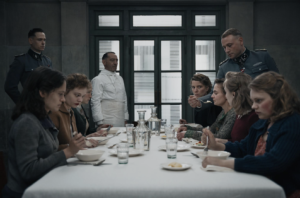
- The Tasters by renowned director Silvio Soldini (Sunday, April 12 at 5 pm), a film set in Germany and in German, based on the true story of the women who tasted Hitler’s meals during the closing years of WWII.”
Highlights and premieres
Beyond Ann Arbor, the broader Metro Detroit lineup includes several highly anticipated premieres and works from acclaimed directors.
“I’m always excited to share our lineup with our audience,” Erbaggio said. “As I’m directly involved in the curatorial process, I love to hear about our selected films from the audience. I invite the Ann Arbor spectators to come watch as many films as they can, in Ann Arbor and in other locations.”
The Italian Film Festival USA has brought many guests from Italy in recent years. This year, film director Valerio Ciriaci and producer Antonella Di Nocera will attend the screening of their film Elvira Notari. Beyond the Silence, a documentary focusing on the first woman director in the history of Italian cinema. They will introduce the film and interact with the audience at the Detroit Film Theatre on April 19, at 5 pm.
Additionally, an exclusive interview with director Silvio Soldini will be screened before his film The Tasters, which is one of the films shown in Ann Arbor.
Among the highlights are films making their North American debut.
“I’m particularly proud of showing The Ascent by Massimiliano Gallo and Zvanì by Giuseppe Piccioni, two films that will have their North American premieres during our festival,” Erbaggio said. “We have debut films like Sweetheart, by Margherita Spampinato and films by experienced directors such as Napoli-New York by Oscar-winner Gabriele Salvatores, the comedy Life Is Life by Riccardo Milani, Five Seconds, the latest film directed by Paolo Virzì.”
Beyond neorealism
Italian cinema is often associated with the classics—Federico Fellini, postwar neorealism—but this festival aims to broaden that perception. Federico Fellini has the record for the most Foreign Film awards by a director from the Academy, which is now titled International films. Italy is the country with the most International Best Films awarded by the Academy.
“We believe that Italian cinema is more than Neorealism and Fellini. Our festival, every year, brings contemporary Italian films by talented filmmakers as well as the most recent works of renowned directors and brilliant actors. Our program reflects the vitality of the Italian film industry,” Erbaggio said.
That vitality, Erbaggio suggests, is essential to understanding modern Italy itself.
“As Ambassador Peronaci mentioned in a message he sent for our audience, our films ‘showcase not only the passion of our people and the beauty of our land, but also the vitality of our culture and the depth of our art and history.’”
A cultural invitation
For Ann Arbor audiences, the Italian Film Festival USA offers more than just a weekend at the movies. It’s an invitation—to hear the Italian language, to experience contemporary storytelling, and to engage with a culture that continues to evolve on screen.
With free admission and a thoughtfully curated lineup, it remains one of the area’s most accessible and enriching cultural events—one that rewards both devoted film lovers and curious newcomers alike.
For more information: italianfilmfests.org.
In addition to Pierluigi Erbaggio, the Metro Detroit Committee includes Robert Cascardo, Carmen De Lorenzo, Silvia Giorgini-Althoen, Enzo Paglia and Elena Past.
It can be reached at [email protected]

Donna Marie Iadipaolo is a writer, journalist, and State of Michigan certified teacher, since 1990. She has written for national publications like The Village Voice, Ear Magazine of New Music, Insurance & Technology, and TheStreet.
She is now writing locally for many publications, including Current Magazine, Ann Arbor Family, and the Ann Arbor Independent. Her undergraduate degree is from the University of Michigan, Ann Arbor, where she graduated with an honors bachelor’s degree and three teacher certificate majors: mathematics, social sciences, English. She also earned three graduate degrees in Master of Science, Master of Arts, and Education Specialist Degree.

