For Dan Gunning, Ann Arbor is more than just a place to live. It is a community shaped by decades of musical traditions, neighborhood character and evolving civic debate. Gunning, a retired public radio producer and editor, first arrived in Ann Arbor in the early 1970s and recently returned after decades away, bringing with him both nostalgia and renewed civic engagement.
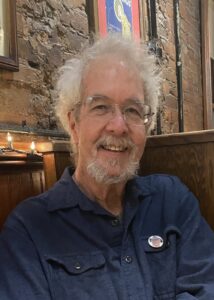
“Not originally from here, I moved to Ann Arbor in my late teens. I lived in Ann Arbor from the early 1970s until 1986, when I moved to San Francisco with my wife. In 2017, we moved back to the west side of Ann Arbor,” Gunning said.
He said returning to Ann Arbor felt like reconnecting with a formative part of his life.
“I love Ann Arbor and am glad to be back. I did not attend the University of Michigan, but my wife did,” Gunning said.
Today, Gunning has become one of several residents speaking out about a proposed development at 315 West Huron, a project that has sparked debate about zoning standards, affordable housing, cultural preservation and the city’s future identity.
315 West Huron currently houses The Arbor Atrium, which currently has a prominent “For Lease” sign displayed. On the corner of Huron and First Street, the LIVE nightclub (102 South First Street) and The Last Word are the immediate neighbors of the Atrium and part of the same proposed development footprint.
LIVE and the importance of musical community spaces
At the center of Gunning’s, and others’, concerns is the possible loss of LIVE, a local venue that hosts free Friday happy hour music performances—part of a tradition stretching back decades in Ann Arbor. This event is also frequently referred to as “Geezer Happy Hour.”
“Yes, for me the Friday Happy Hour is the primary concern, although I have several other issues with the proposed development,” Gunning said. “I have been attending various Friday Happy Hours in Ann Arbor since Mike Smith and The Country Volunteers performed every Friday at Mr. Flood’s Party in the mid-1970s. This is an Ann Arbor music tradition that I value greatly and has been an important part of my reintegration into the community. I’ve made many new friends at LIVE and reconnected with many old friends.”
He also emphasizes the venue’s role in sustaining the local music economy.
“The Friday Happy Hour at LIVE is also an important showcase for local musicians, where people can check out local music for free, and it is one of the more lucrative bookings for the bands. Even though it is free admission, people contribute generously to the passed pitcher and the club contributes a cut from the bar sales,” Gunning said. “Although the free music happy hour has been located at several venues over the past 50 years, most music venues no longer exist, and the Ann Arbor music scene does not have anywhere near as many viable performance spaces as it once did.”
The variance that sparked opposition
The initial conflict over the project emerged when developers sought a zoning variance to exceed existing height limits. Gunning attended early public meetings and quickly realized that the proposal would require a substantial exception to existing city guidelines.
RELATED: Ann Arbor for Public Power to Host Ballot Signature Gathering for Municipalization with Upcoming Kickoff
“I noticed that their plans required a ‘variance’ from the Zoning Board to exceed the allowable height limits for that location. I found out that the height limit for that location is about 6 stories, and they were proposing 12 stories,” Gunning said. “Apparently, a variance is usually an adjustment of an existing limitation, not a doubling of the guidelines, so I decided that the zoning request was the best line of defense, since that was a legal obstacle.”
The proposed increase drew scrutiny not only from residents but also from members of the Zoning Board of Appeals. Gunning noted that the size of the request ultimately proved to be its downfall.
“The maximum building height allowed is 60 feet, and they requested an additional 59′ 11″. At the meeting in July to present the proposal to the public, the developers said that they could not go forward without the new height allowance, but apparently, they are going to attempt to reduce the height slightly and ask the city to rezone the district or the site.”
In October 2025, the Zoning Board voted against the variance request, though not unanimously.
Legal limits, not public pressure
While development battles often hinge on organized neighborhood activism, Gunning said this case played out differently. He describes the variance denial as largely driven by zoning law rather than mass public engagement.
“The decision at the Zoning Board of Appeals was just basic legal limitations. There was negligible public turnout. Only two community members spoke on the subject, myself against and a businessman who stood to gain financially from the development spoke in favor.”
He added that community feedback submitted digitally was acknowledged but not fully aired during the meeting. “There was a tally of several digital letters submitted to the ZBA, but they were not read aloud at the meeting, just summarized as ‘for’ or ‘against’. Cultural preservation was not discussed, and I’m not sure it is something the zoning board has jurisdiction over in this case.”
A revised proposal raises familiar concerns
Though the variance was denied, the proposal has not disappeared. Developers have returned with a modified plan that reportedly reduces the building height while pursuing zoning changes.
“According to an article in MLive dated December 3, 2025, the developers are now proposing a ten-story building and are seeking zoning changes. It is not substantially different from the previous plan.”
For Gunning and others following the project, the scale and potential neighborhood impact remain largely unchanged.
Development versus affordable housing
Gunning rejects the idea that opposing the project equates to opposing housing development altogether. Instead, he argues that the project does not adequately address affordability challenges.
“I am not opposed to new housing or development, but I believe that the people of Ann Arbor have worked over the past several decades to design a system of standards to maintain a quality of life for residents that makes Ann Arbor a desirable place to live. These are community standards and are part of Ann Arbor’s general appeal. I am in favor of more affordable housing, and this project does not address that need.”
Gunning also questions the affordability benchmarks commonly used in development proposals. Specifically, the median income that is considered and how many restaurant workers, local musicians and artists make under that number.
Navigating civic process and public engagement
Gunning’s involvement in the issue grew out of his own effort to understand the city’s planning structure — something he says can be difficult for residents to follow.
“I took it upon myself to understand the zoning limitations for this project based on what I heard at the Greyline meeting I attended in person last summer and was able to determine how the process would proceed: first the Zoning Board would rule on their request, then it would go to the Planning Commission, and then the City Council would have the final say and approve the project. This information is not easily attained, and the city website does not make it easy to see what is on the agenda for the casual observer.”
He believes more residents might engage if the process were easier to navigate. “As far as community involvement going forward is concerned, I think it is very difficult for people to find out how the process works and how to have a voice in it. City government is opaque, and it requires a commitment just to find out when projects are being discussed.”
Broader questions about city development
Beyond this specific proposal, Gunning sees larger issues shaping Ann Arbor’s growth. He argues that public priorities may not always align with development decisions.
“I think the will of the people is being ignored and manipulated by the Taylor machine. Chris Taylor has a very effective machine that portrays itself as progressive but is serving a wealthy clientele and ignoring the needs of the general population. People are in favor of more affordable housing and development, but I don’t think most people are happy with the tall buildings that are out of character with the general design of the city.”
He contrasts recent private development with projects completed by the University of Michigan, which he says often incorporate long-term planning and architectural continuity.
“The difference is that the University knows that they will be here for generations to come, and the developers don’t even live here. The problem as I see it is the city under the Taylor machine is selling itself cheap. They could demand more from developers and maintain the high standards that made Ann Arbor what it is, but they are selling us out to expedite development under their watch, and cash in,” Gunning said.
Additional neighborhood and cultural concerns
Gunning also points to potential ripple effects if redevelopment proceeds, including traffic complications, pressure on social services and the displacement of existing businesses.
“In addition to LIVE, I am also concerned with the demise of The Last Word bar where I often attend a weekly musical performance by the Pherotones, a jazz band that plays every Thursday. That is also a unique venue that I am not confident could be recreated somewhere else. There is a speakeasy feel and excellent lighting, but most importantly these businesses are in existing buildings with an economic equation that is working.”
He adds that redevelopment could affect both small business owners and employees.
“Part of their economic equation is to buy out the owners of LIVE and The Last Word, which I assume involves paying substantially over the market value for that building and putting two successful businesses out. They are also going to buy out the owner of the building at 106 South First Street who is the landlord for the HanJan Pocha Korean restaurant next door to LIVE. The HanJan has only been there for a couple of years and is just getting established. As a tenant he has no control over the situation.”
Looking ahead
The 315 West Huron proposal remains under review as developers pursue zoning changes and the city continues discussions about downtown growth. For Gunning, the issue is not simply about one building but about maintaining the social and cultural fabric that residents say makes Ann Arbor distinctive.
He believes preserving organically developed cultural spaces should remain a priority, even as the city expands. Whether that balance can be achieved remains an open question—one likely to shape future debates over Ann Arbor’s development and identity for years to come.
What you can do
The city’s imminent Comprehensive Land Use Plan is expected to play a significant role in shaping the future of large-scale developments, including proposals for sizable new buildings. The plan, which outlines long-term growth and zoning priorities, is expected to be finalized on February 18. Residents interested in how the document may influence development projects can attend the Planning Commission meeting, where the plan is scheduled for consideration.
Community members seeking to follow specific development proposals, including plans associated with 315 W. Huron, may also want to monitor the Ann Arbor Planning Commission. The commission typically reviews rezoning requests and zoning exceptions that could be necessary for projects of that scale to move forward. Meeting agendas are posted publicly, allowing residents to track when proposals are scheduled for discussion.
https://content.govdelivery.com/accounts/MIANNA/bulletins/4081f57?reqfrom=share

Donna Marie Iadipaolo is a writer, journalist, and State of Michigan certified teacher, since 1990. She has written for national publications like The Village Voice, Ear Magazine of New Music, Insurance & Technology, and TheStreet.
She is now writing locally for many publications, including Current Magazine, Ann Arbor Family, and the Ann Arbor Independent. Her undergraduate degree is from the University of Michigan, Ann Arbor, where she graduated with an honors bachelor’s degree and three teacher certificate majors: mathematics, social sciences, English. She also earned three graduate degrees in Master of Science, Master of Arts, and Education Specialist Degree.