
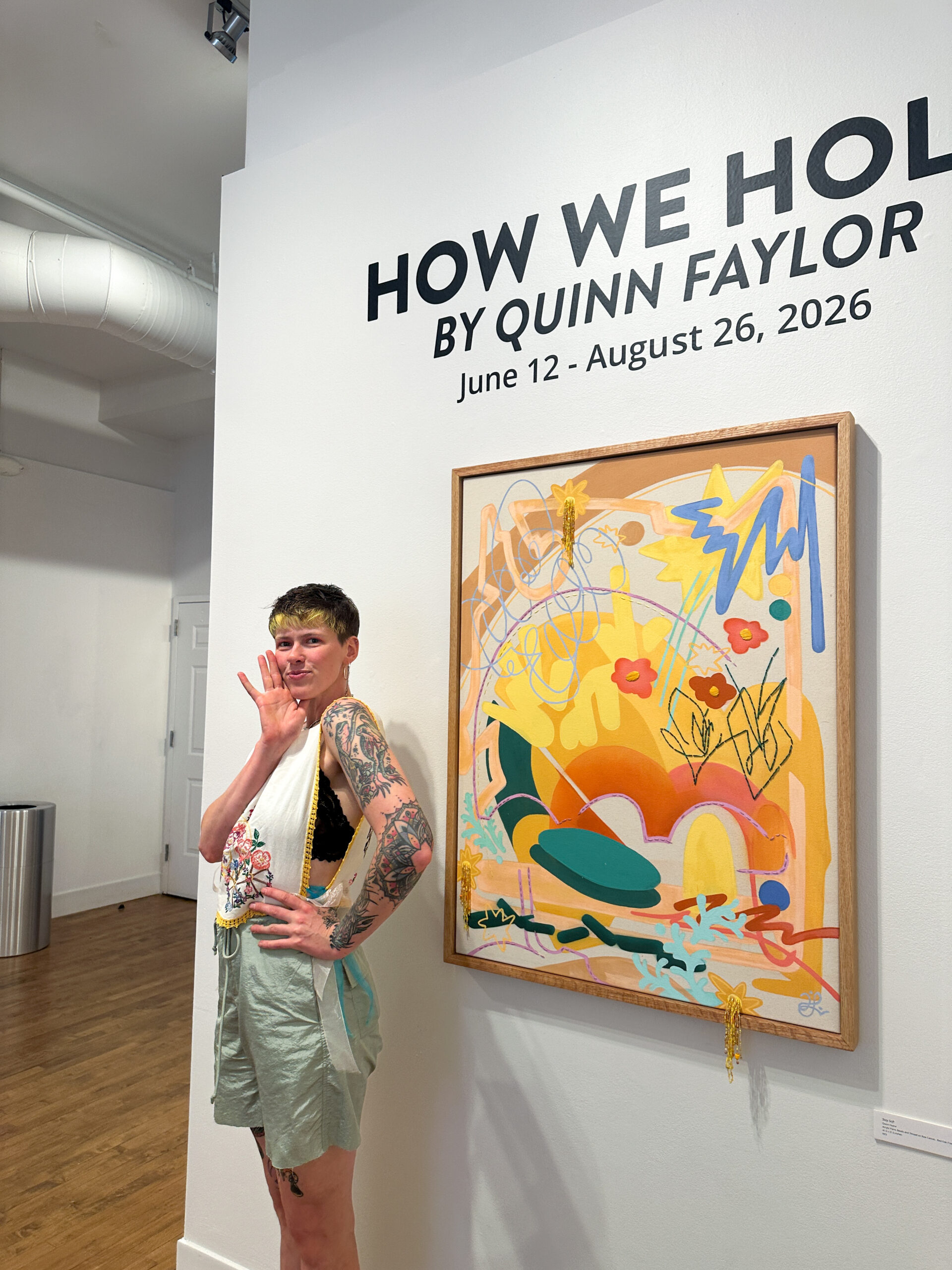
Quinn Faylor is exploring relationships between things and people, and how their presence and interactions effect each other through their new multimedia show at the Ann Arbor Arts Center. “How We Hold” was officially unveiled on June 12 and will be in the temporary exhibition gallery until August 26.
Faylor discussed the show with Current Magazine in this interview over email. It has been edited for length and clarity.
Current Magazine: Let’s start with you. Can we get the basics of who you are and how your artistic journey led here?
Faylor: I’m a queer, non-binary interdisciplinary artist based in Detroit. I’m self-taught across the different mediums I work in, including painting, printmaking, installation, sculpture, and murals.
My work finds ground in joy and abundance. Abstraction emerged through following intuition rather than trying to represent something specific. Making art made me feel more alive and more at home in myself than almost anything else. In many ways, creative practice was one of the first places where I began to cultivate a home in my body. My practice brought me closer to my yes and no. At its core, my work is about following the embodied feeling of curiosity, play, and trust. I love myself, and the world around me through varied materials and forms.
CURRENT MAGAZINE: Can you explain the title “How We Hold” and how it describes the show’s exploration of relationships?
Faylor: I’m deeply inspired by relationships—between people, environments, bodies, and the systems that support them. The title “How We Hold” comes from thinking about the ways we care for one another and create structures of support.
As a queer person, I’ve often thought about how much of queer existence involves unraveling expectations that were never ours to begin with and intentionally building a home within ourselves. This world of walls isn’t designed to hold us fully, so we create new ways of relating, connecting and belonging. We create homes in our bodies and our relationships.
I think of relationships as something beyond the two individuals involved. There’s each person, but there’s also the relationship itself—a living third thing that is equal parts curiosity, fantasy and care. This body of work explores those connections through abstraction. I’m interested in world-building and the act of creating realities that are more expansive, complex and joyful
RELATED: Ann Arbor Prepares for Half a Million People for Upcoming Art Fair
Current Magazine: According to the Current Magazine calendar, you have quite a lot of mediums in this show—painting, printmaking, installations. Could you talk a little more about that?
Faylor: Most of my previous exhibitions have focused primarily on one medium, but when I proposed this show, I wanted to bring together the different extensions of my practice into a single space. I love moving between mediums because they constantly inform one another. A shape that begins in a painting might later become a print, while a small detail from a composition might expand into a sculpture or mobile. I’m fascinated by how ideas transform when they’re translated into different materials and dimensions.
Having all of these mediums together feels less like a definitive statement and more like a snapshot of a particular season. It’s an opportunity to explore a single visual language from multiple angles and see what new possibilities emerge.
Current Magazine: A2AC described the show as “an observation of relationships—between bodies, objects, environments, and the systems that hold them together.” Could you expand on that?
Faylor: My compositions are built from interlocking systems of color, shape and movement. I enjoy creating relationships between foreground and background, tucking forms behind one another and allowing visual elements to influence each other in unexpected ways.
In some ways, these compositions become metaphors for larger relational systems. Nothing exists in isolation; every shape affects the shapes around it. While the work is abstract, it’s often rooted in a feeling, memory or experience I’m processing.
Spending hours in the studio with a composition means that whatever I’m moving through inevitably becomes embedded in the work. Even if the final result is a colorful abstract shape, it contains traces of attention, reflection and personal evolution. The work becomes a record of those relationships—both internal and external.
Current Magazine: Is this show your statement on relationships between people, place and things, or do you want viewers to ask their own questions and come to their own conclusions?
Faylor: I don’t think the work is trying to communicate one specific message. One of the things I love about abstraction is that it allows viewers to bring their own experiences into the work.
Color and shape often land in the body before they land in language. I’m interested in what the work might evoke—what feelings arise, what memories surface, what questions emerge. I’m curious about what certain shapes or colors call forth in different people. If the work encourages someone to feel more curious about themselves, their relationships, or the possibilities of who they could become, then I consider that a success.
Current Magazine: Once people have seen your show and are exiting through the A2AC’s doors, what would you like them to walk away with?
Faylor: I hope people leave feeling a little more connected to their sense of wonder and possibility. I hope the work reminds them that there are many ways to relate—to themselves, to others and to the world around them.
More than anything, I hope they leave curious. Curious about what moved them, what resonated, and what new possibilities might exist within their own lives.
Current Magazine: What are your future plans for this year?
Faylor: This summer I’ll be working on a major public art project for Mary Free Bed Rehabilitation Hospital in Grand Rapids. I’ll be creating two murals for the site, including the largest mural I’ve made to date at nearly 6,000 square feet. I’m excited about the opportunity to bring color, movement and a sense of play into a healthcare environment and to continue expanding my public art practice through projects of that scale.
I am also teaching a mobile making workshop at the Ann Arbor Art Center in August. I am excited to guide folks through intuitive composition building and balancing forms.
Current Magazine: Is there anything else you’d like to add?
Faylor: Just gratitude. I’m thankful to the Ann Arbor Art Center for supporting this exhibition and for creating space for artists to experiment, take risks, and share their work with the community. Thanks for taking the time to learn more about the show.
The A2AC is located at 117 W Liberty St, Ann Arbor. They are open from 10am-7pm Mondays through Thursdays, Fridays until 8pm, and Saturdays from noon until 8pm.

Drew Saunders is a freelance business and environmental journalist who grew up just outside of Ann Arbor. He covers local business developments, embraces his foodie side with reviews restaurants, obsesses over Michigan's environmental state, loves movies, and feels spoiled by the music he gets to review for Ann Arbor!

