
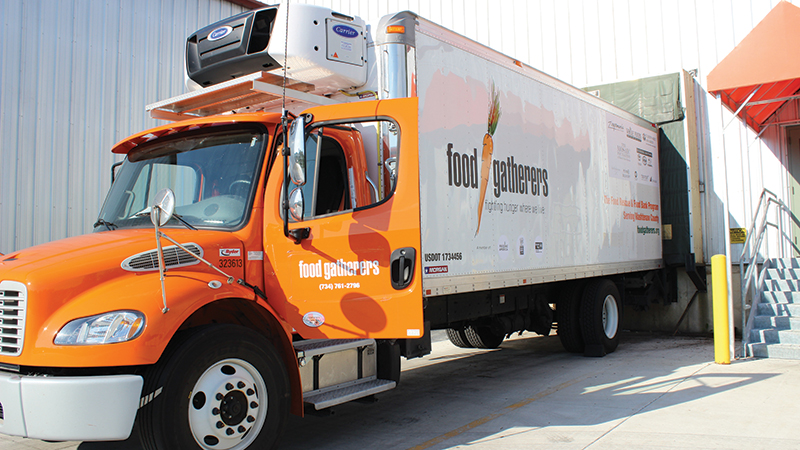
The school meal programs that help feed children from families in need throughout the school year, are often not continued in the summer. That is why Food Gatherers is providing grab and go meals for from June 16 until August 14.
“By offering Grab and Go Meals, we hope to help more children and families get the nutrition they need to have a fun, healthy summer,” LeRonica Roberts, Food Gatherers community food programs manager, said in a press release. “We encourage families to visit the site that works best for them, each week they need to during the summer.”
According to the press release, “Free meals will be available to children 18 years of age and under, or to persons up to 26 years of age who are enrolled in an educational program recognized by a state or local public educational agency.”
RELATED: Meet Food Gatherers Executive Director: Eileen Spring
“The Grab and Go option is available at rural locations, however any family can pick up meals for kids at any location. Schools also operate summer meals during the summer. Check with your district for more information,” Dani Wyman, food gatherer’s communications and public relations manager, said.
This is happening for a number of reasons. There is the decades long squeeze of the middle class, and the increasing cost of food caused by long term market factors. But a big part of this is also the war that President Trump launched in Iran without Constitutionally mandated Congressional authority. About 20 percent of the world’s fossil fuels, and a substantial amount of the worlds fertilizer, needs to go from the Persian Gulf through the Strait of Hormuz, which has been blocked by the Iranian dictatorship. The price shock of fertilizer is only beginning; but in the meantime the tractors, combine harvesters, trains and trucks that move the world’s food supply around has been suffering from high prices, which are being passed on to consumers.
“At the global level, even moderate disruptions lead to declines in household income and food consumption. Although percentage changes appear small, they translate into tens of millions of people experiencing increased hunger and poverty. Agricultural incomes also decline, with cereal producers facing particularly large losses,” says a report from the Council on Foreign Relations, a think tank. “In the short term, supporting farmers during the current planting season is the priority. That includes providing access to fertilizers, expanding credit to offset rising costs, and ensuring that trade routes remain open. Governments should also take measures to prevent the diversion of food crops into fuel production and to avoid energy and fertilizer export restrictions that could worsen global shortages… In the long term, the crisis highlights the need for structural transformation. Investment in sustainable fertilizer production, including green ammonia, can reduce reliance on fossil fuels. Strengthening domestic agricultural systems and improving supply chain resilience will be critical to managing future risks.”
Food Gatherers estimates that 14.2% of Washtenaw’s children are food insecure this year. That is an increase of the 12.3% is was in the 2024-2025 school year, and it is more than double the 6.8% of kids who didn’t have a stable source of food in the 2023-2024 year.
“We operate 5 SFSP sites. We are limited to locations that are eligible for the Grab and Go Summer Food Service Program. The program, authorized by Congress, requires that at least 50% of children at the nearest school qualify for free or reduced-price meals, and be located in an area that is qualified as rural. The Michigan Department of Education helps determine site eligibility,” says Wyman. She doesn’t know how many meals or donations will be needed last year, but revealed “last summer we distributed 112,315 meals through Summer Food June to August, which was 58% more meals than the year before.”
There are other programs to help to. Food Gatherers is going to be helping Kroger distribute its Kroger Bags for Kids. These are kits full of kid-friendly snack options from Kroger, to pantry locations.
There are also ways to help the program. They are always accepting donations of both food and money from the public. And if neither are an option for you, you can also sign up to volunteer.

Drew Saunders is a freelance business and environmental journalist who grew up just outside of Ann Arbor. He covers local business developments, embraces his foodie side with reviews restaurants, obsesses over Michigan's environmental state, loves movies, and feels spoiled by the music he gets to review for Ann Arbor!

