
Through the its Sustainable Energy Utility, Ann Arbor is working towards pioneering the approach to creating a practical and scalable way to transition America’s homes away from the traditional, fossil fuel grid that has powered the country for the last century.
 The City promised to hit the ground running with the program if voters approved it, and now that they have, they estimate that they are on track to getting around 100 homes of the 262 in the Bryant Park neighborhood equipped with a combination of rooftop solar panels and battery storage capacity by “roughly October-ish” according to one official. Next year, their goal is install solar on the roofs of 1,000 homes and businesses across the whole city.
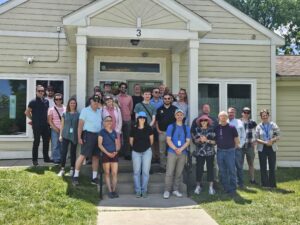
Officials say that program had only established “four and a half” SEU installations when Ann Abrorites interested in the program gathered at the Bryant Community Center on June 2. They were here to take see the installation of rooftop solar happen themselves.
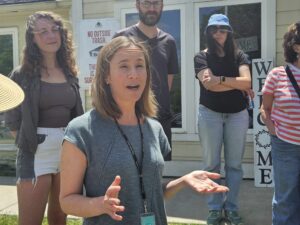
Shoshannah Lenski, the Executive Director of the SEU, told attendees that the SEU “is a totally new model for utilities. It doesn’t exist anywhere else in the country.” The point of the SEU “is to supplement the energy that folks are getting from the grid, and provide it through a municipal utility. We are only building renewable energy – the SEU’s never going to a gas plant or deliver any kind of non-renewable energy. And we are doing distributed energy, which means that we’re not getting in the business of owning poles and wires. We consider that the grid of the past. It’s vulnerable. I’m not saying those poles and wires are going away … but that’s not the part of the business that we want to be in. We want to be in the business of owning energy generation at the point where it’s consumed, which means you don’t need poles and wires, and you can really serve your own load locally.”
The public was able to ask questions, get a better idea of how much paperwork is involved, and more information was made available about how renters can take advantage of the SEU with a financial mechanism called a “split incentive.”
Serving renters
“One of the things that’s super exciting to me is that we can serve renters. There’s really never been a good way to bring solar energy to renters in the past; because if you think about it, it’s an expensive investment that the landlord has to make, and usually the utility bills are paid by the renters, so it’d be the renter who benefits from having lower DTE bills, or having the resiliency of having a backup battery,” says Lenski. Hence the idea of the split incentive. “Under this model, the City pays for the installation, and then the customer -which could be the property owner or landlord, or it could be the renter – pays for the energy for the solar. That means that there’s no split incentive; there’s really no reason for a landlord or property owner to say that they don’t want this on their property.”
So, in theory, it’s a win-win-win-win. The landlord doesn’t have to make a huge expense, the tenant would get green power at a lower usage rate, the city gets that much closer to a 100% sustainable electricity setup, and the utility company gets that much closer to its goal of carbon neutrality by 2050. Lenski claims that they have one such landlord-renter who has already taken them up on this arrangement, and they have a handful of landlords with multiple properties interested in getting this done to all of their properties.
RELATED: Ann Arbor Community Can Now Volunteer to Participate in Sustainable Energy Utility Program
“I think it’s very exciting. It’s nice to see some renewable infrastructure getting put together and installed. It feels like a complicated time for renewable times right now, and it’s encouraging,” Allen Gibson, an attendee who says he rents an apartment on the west side of town, said. “I think it’s definitely more complicated with a multi-unit building…. As it stands, landlords don’t really have a huge incentive to install [renewables] on their own, so I’m happy there’s at least one solution where they’re incentives, and renters may not have the resources to do it themselves.”
The potential for locally produced and consumed EV power is huge. A 2021 report from the City’s A2ZERO program found that 71% of Ann Arbor’s roofs are viable for solar power. They estimate that that means they could get 400 MW of power from them – enough to provide about one third of the power that Ann Arbor needs.
How it works
The way it works is that you can volunteer part of your property to get green power put on it to accelerate the transition from fossil fuels to renewable power. What gets installed is somewhat standardized into specific installation modules. But to a degree what you get installed depends on what you want – you can get solar panels, battery storage for when the sun isn’t out, and even other options should the laws of physics allow. And because you’re getting power from your new renewable energy options instead of DTE Energy, you pay the lower SEU power rate, saving you money and the size of your carbon footprint. If there isn’t enough sunlight for the solar panels to work, and you either didn’t get batteries or your batteries are dead, then you revert automatically to the DTE Energy grid at their higher power supply.
Either way, you’d have power. And another selling point that the SEU is selling is reliability. Your rooftop solar would still work should you lose power in an ice storm or because of winds knocking out power lines miles away from you; meaning that you can keep working, the lights can keep on and your fridge will keep refrigerating during any outage.
Bryant Park
Bryant Park is a neighborhood located between Elsworth and I-94, just east of Stone School Road. The neighborhood was selected because the houses are almost all single story, and newish – built in the 1960s – making them easy to install solar on. It makes it cheaper to install solar on, and allows the City to establish a one-size-fits all approach to the neighborhood’s roof – saving time and money. Other neighborhoods may require a different setup, but people in other neighborhoods interested in the SEU will still be subject to the same basic SEU setup.
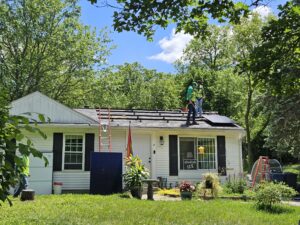
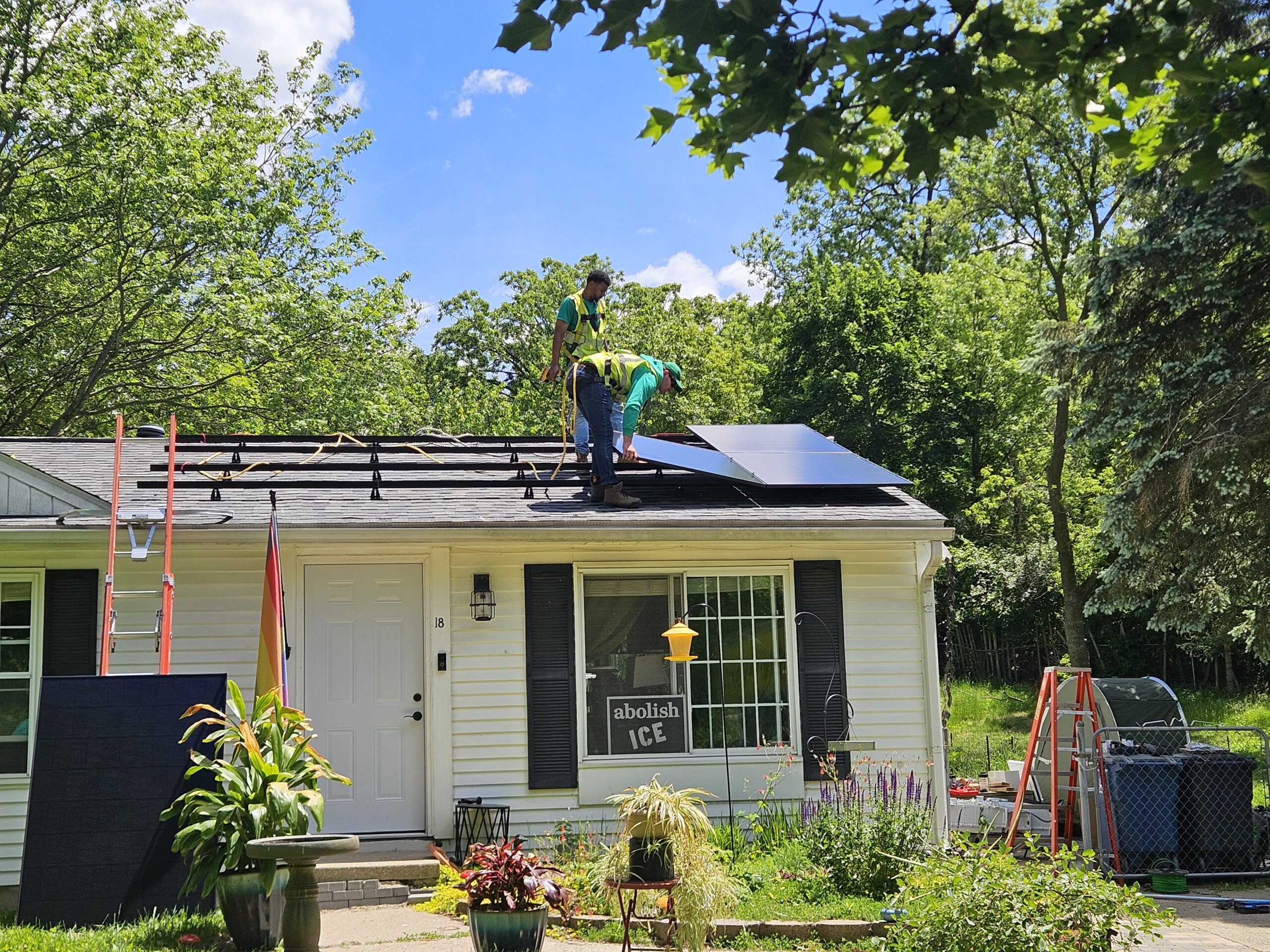
Shunta Legette was one of about two dozen people who took the Office of Sustainability and Innovations up on the chance to watch a crew install solar to the roof of a Bryant Park home, Tuesday – which in her case was just a few blocks away from her. When people gathered in front of the house two men were tied to with safety ropes as they shuffled around the metal support beams on top of the roof. They had already drilled the frame into the roof. One of five panels was already installed. It took less than an hour for two other men on the lawn of the home to fetch a poster sized solar panel, polish it off one last time, and then methodically raise it up one panel at a time.
Legette said that seeing the panels being installed on one of her neighbor’s houses made her feel “excited. It’s awesome, because I had more questions of how many panels would fit on a roof, which they showed me; and just how fast they’re getting it done. I thought it would take more of a day to get it done.” She says she’s more interested in the program now, and that her motivations for looking at the program were “environmental for sure. And definitely financial. If it can save me money anywhere, why not get it done?”
Installation
The City has hired three companies to install the panels – Ann Arbor-based Homeland Solar, Michigan Solar Solutions, and Oak Electric. Michigan Solar Solutions purchases the solar modules from REC for the City, according to Lenski. Battery backup is provided by the San Jose-based Franklin WH.
Jeremy Zinn of Oak Electric said that the biggest thing stopping more adaptation of solar is misconceptions about what they are capable of. Modern solar panels can provide reliable power even in a state as seasonable as Michigan. He says they’re built stronger than a lot of people think too.
“It’s a big deal. Once it gets rolling, I think we could easily put one to two crews every single week doing this, so it’s a big thing,” Zinn says. “It’s a windfall right now. When you look at what happened last year, losing the [federal] tax credit, it’s a lull right now. The utility rate’s the way they are, solar still makes sense for everybody.”
If you’re a skilled journeyman, Zinn said that solar panel installers can earn “north of $40 an hour” doing this kind of work.
Zach Martin, a representative from Franklin, said that the SEU’s approach to solar “is extremely different because utilities have in the past, been pretty off-put by renewables and adding this to the grid. This is one of the few instances when a utility is environmentally putting their best foot forward and partnering with renewable manufacturers and installers. In the past, what you’ve typically seen is a lot of push back from the utility, and what’s different about this system is normally a virtual power plant is set up on a utility to incentivize homeowners to themselves buy the system, and then send the power back to them when it is needed. What’s different about this is the utility is buying the system up front, and then having the homeowners take ownership of the solar setups and battery installations.”
There are some limitations to the SEU process. The SEU is a city owned and operated operation that acts essentially as an add on to the power provided by DTE Energy, the local for-profit power utility. They can deny the application for safety reasons, if it would compromise the capacity of the local transformer, or if the amount of solar panels and storage capacity that you want for your property could end up sending too much green power to the grid.
DTE Energy received a list of questions from DTE Energy but did not respond by deadline. This article will be updated with their responses when they provide answers.
Ann Arbor voters have repeatedly decided, through ballot options, to go for a green power grid by 2030. The SEU is a key part of the city government’s plan to actually, realistically do that.
The next ballot initiative will be on whether or not Ann Arbor wants to continue its relationship with DTE Energy or establish its own fully fledged city-owned power utility through a process called municipalization. Voters may or may not decide to do that this November. In the meantime, interested Ann Arborites can keep up to date with SEU developments at the SEU website, sign up for the SEU newsletter, and anyone who wants to go forward with being in the SEU pipeline can sign up for the SEU online.
Emily Mills, an Ann Arbor resident at the demonstration said, “It makes me beyond hyped.” Like Legette, she is interested in the SEU for environmental and financial reasons; though she added that “the climate catastrophe” is, in her opinion, “the single most important issue that we are facing. I think that it should be the first thing that we begin and end our day with. And it’s very exciting to see the City take on this initiative… I hope that this is outrageously successful, and I hope that that inspires outside communities to follow suit, and also to allow us to continue to grow and explore other options that are available to us.”

Drew Saunders is a freelance business and environmental journalist who grew up just outside of Ann Arbor. He covers local business developments, embraces his foodie side with reviews restaurants, obsesses over Michigan's environmental state, loves movies, and feels spoiled by the music he gets to review for Ann Arbor!

