
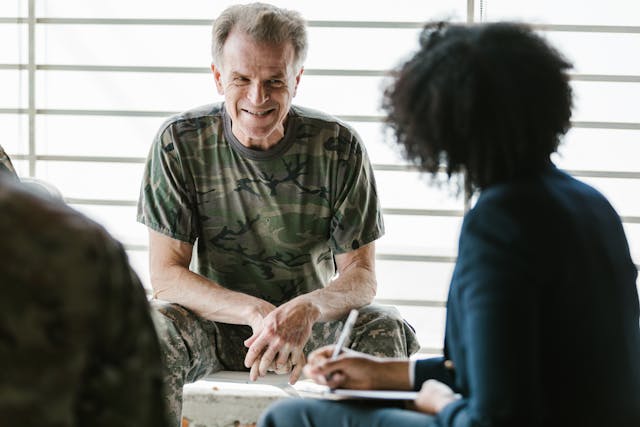
Veteran’s day is in November. It’s no surprise to most of us, that our veterans don’t always get the care they deserve, both during and after their service.
Cannabis can actually be a helpful tool to helping veterans who are struggling with PTSD after their service. But, there are big barriers to accessing it through the Veterans Affairs (VA).
Some of cannabis’ general positive impacts, like reduced anxiety, help in sleeping, and reduced nightmares, all have obvious applications to veterans with PTSD. CBD in particular can be helpful in reducing anxiety, can ease the frequency of nightmares, and can help improve the quality of sleep.
Many veterans self-report that they find cannabis helpful in treating some of their symptoms. A study a few years ago, reported on by the Veterans of Foreign Wars, acknowledges that cannabis use, at least in the short term, showed positive support for vets who were using it to treat PTSD.
But despite Michigan’s legalization of cannabis in recreational form as well as medicinal form, the VA still refuses to prescribe it for any of their veterans. This is because federally, cannabis is still classified as a controlled substance, so the federal rules override the state laws, even though it’s legal in Michigan.
Of the veterans using the VA, 23% of them were diagnosed with PTSD at some point.
RELATED: Cannabis and College: Back to School Tips for Boosting Concentration
The state of Michigan is trying to help fill in the gaps between the VA’s inability to currently support veterans seeking cannabis, and the state’s support of vets being able to use this treatment. Recently over $7 million was awarded by the state to the U-M to study CBD and medical cannabis therapy on veterans’ chronic pain.
A local veteran, Mr. Bridger, who asked to be identified only by last name, thinks that there are a few barriers toward veterans being able to use cannabis to treat PTSD.
First, he thinks that PTSD in veterans, and using cannabis to treat it, needs to continue to be studied, to confirm that it can be helpful.
Second, he thinks there needs to be a better way to measure impairment from cannabis. He sees it like alcohol: “There are rules and regulations about when you need to stop drinking to show up to work to fly airplanes,” he says, “and there are regulations that dictate exactly how impaired you can be from blood alcohol content. An equivalent way to measure impairment does not yet exist for THC, and if it did exist, it could help us govern its use when it comes to service members using it.”
If there was a way to clearly measure cannabis impairment, then it could be much easier to legalize cannabis usage in the VA, since the guidelines for when service members and veterans could use and not use it would be much clearer.
If you support veterans being able to use cannabis to treat their PTSD with fewer barriers, consider writing letters or calling your federal representatives to urge them to change the federal law, enabling the VA to support it. Or, contact your local representatives and encourage them to continue supporting local policies that help vets out, even when federal law inhibits the VA’s full approval. Or, continue to support studies done on cannabis to show how it may support people with PTSD.
To find local representatives, visit washtenaw.org/1247/State-Representatives-Senators. To find a federal representative, visit house.gov/representatives/find-your-representative.


