

Initially, Emmy-nominated actor Robert Picardo didn’t want the role of the Doctor, the Emergency Medical Hologram – perhaps his most famous character in a career spanning nearly 45 years – on 1995-2001’s “Star Trek: Voyager.”
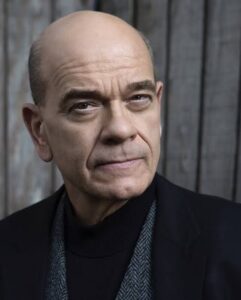
“I read the brief description, which was exactly this: ‘Colorless, humorless, a computer program of a doctor.’ Now that didn’t sound like a bucket of fun for me for a potential seven years. I actually passed on auditioning for that character that I eventually got. I asked to read for Neelix…so I actually talked myself out of a role I eventually got, read for another role,” recalled Picardo, a Yale University alumnus who will appear at the Motor City Comic Con in Novi May 16-18.
The role of Neelix went to Ethan Phillips instead. The producers asked Picardo to read for the EMH, which surprised him.
“Because once you’ve had your test for a network TV for whatever role, if they reject you, you’re like a used paper towel; they don’t look back, they only look forward,” said Picardo. “There was something about my voice, they said. I famously told my agent, ‘I don’t get the character, but I’ll try,’ so I read for it and made them laugh. I heard they wanted to laugh because they’d seen 900 actors for the part. I made them laugh by adlibbing, which is a no-no in a network test. I thought the lines weren’t that funny and I didn’t have that many, only 8-9.”
He continued, “At the end of my audition, the last scripted line, the character – who’s a hologram activated only for emergency use and is supposed to be deactivated when no longer needed – is left active in sickbay with nothing to do. He complains to the computer, ‘I believe someone has failed to terminate my program.’ That’s the last line of the scene. After that line, I took a long deadpan look at the 14 people I’m auditioning for and said very sternly, ‘I’m a doctor, not a nightlight.’ I got a huge laugh and they hired me that day. Stealing from DeForest Kelley is my best advice for any actor auditioning for a ‘Star Trek’ series. Steal from the greatest.”
Picardo played the EMH on all seven seasons of “Voyager,” as well as in several video games, “Star Trek: Deep Space Nine,” “Star Trek: Prodigy,” and “Star Trek: First Contact.” He will reprise his role as the EMH on the upcoming “Star Trek: Starfleet Academy” TV series.
Picardo shared his insights on what made the EMH such a popular character. He pointed out the outsider characters traditionally are very popular in ‘Star Trek,’ starting with Spock (Leonard Nimoy) the half-human/half-Vulcan who aspired to be human, but also rejected the emotionality, illogical side of humanity. He held humanity at arm’s length but observed and commented on it. Then there was Data (Brent Spiner) on “Star Trek: The Next Generation,” an android who could adapt and learn but had no capacity for emotional development. On “DS9,” the shapeshifter Odo (Rene Auberjonois) served as the outsider character.
“It turns out (the creators) had plans for my character grow and become more human-like; I wasn’t aware of them,” he said. “I wasn’t aware of it when I auditioned, but I became immediately aware of it once we started shooting. In the second episode, he’d be the full-time chief medical officer even though he was designed as a part-time supplement. He was designed to be the star relief pitcher on a baseball team, who was now assigned to start – and finish – every game forever. He’s not happy about that because some of the pedestrian science and medical needs he’ll be called upon to deal with are beneath him and his level of expertise and knowledge.”
Picardo continued, “(In one scene), Kes (Jennifer Lien) asked me for soil samples and I bitterly complained about how I have the combined medical knowledge of 4,000 textbooks and personal experiences of 27 Starfleet CMOs, blah, blah, blah, ‘so, yes, let me get your dirt.’ Clearly, he had a bad attitude. That was the key for me what the character’s issue was: He wasn’t being accorded the respect he felt he deserved. Under those circumstances, he could be huffy and arrogant…. then when he was taken down a notch and learned a lesson, he slowly started to develop emotional subroutines to develop a bedside manner and interact with patients.”
As the series continued, the EMH became more human-like brick by brick. He barely smiled the first two seasons.
“It was a wonderful journey to go from a humorless, unsmiling, affectless, unpleasant nonhuman character to a quite human-like individual who developed slowly over seven years. I think he had just a wonderful arc. The audience could be made to laugh and also be touched by the very dramatic stories that involved his growing sense of entitlement about what he should be getting as a full-fledged member of the crew,” he explained. “I also didn’t have to obey the rules of being a Starfleet officer. I could be self-involved. It was fun to see me very expressive, rolling my eyeballs, looking disdainful when I got an order I didn’t like; other Starfleet officers didn’t behave that way and I had the freedom to behave that way. I saw a certain delight in the rules my character could break.”
RELATED: Astronomicon 8 in Ypsilanti Boasts Star-Studded Lineup
He spoke about what makes “Voyager” stand out in the “Trek” canon. It was the first “Trek” series with a female captain, Kathryn Janeway (Kate Mulgrew). The titular starship ended up in the Delta Quadrant, 75 years from home in the Alpha Quadrant, so the series was about the crew trying to find their way back while also exploring strange new worlds along the way.
“Kate’s a spectacular actress, a great captain and a wonderful leader of our cast. Across the board, we had a really wonderful group of actors who all had very distinct characterizations,” explained Picardo. “Also, ‘Voyager’ was most like (‘TOS’) because we were shipwrecked 70 million light years from home in unexplored space. So the whole ‘Mr. Rogers’ Neighborhood’ aspect of (‘TNG’) – they know all the aliens in our quadrant of space – was gone. It was about discovering new challenges, new aliens, not knowing we’d ever get home…”
Many people rediscovered “Voyager” during the COVID 19 pandemic.
“The pandemic, as terrifying and awful as it was, did a lot for older science-fiction shows,” said Picardo. “People sat down when they had to isolate and watched (‘Voyager’) again. I’m proud of the fact that it’s evergreen.”
Picardo is also known for playing Dr. Dick Richard on “China Beach,” Coach Cutlip on “The Wonder Years” and Richard Woolsey on “Stargate SG-1.”
“I played Coach Cutlip as Richard Nixon with lower intelligence. I played him as Nixon with an IQ of 65. He was a dimwitted Nixon but had all of the paranoia and lack of humor that Nixon had,” said Picardo, laughing.
Picardo has also worked with director Joe Dante on 1981’s “The Howling,” 1985’s “Explorers,” 1987’s “Innerspace,” 1989’s “The ‘Burbs,” 1990’s “Gremlins 2: The New Batch,” 1993’s “Matinee,” 1998’s “Small Soldiers” and 2003’s “Looney Tunes: Back in Action.”
“Joe’s a great friend,” said Picardo. “He gives me entirely different roles all the time – sometimes big, sometimes small. He once said in an interview if he can’t figure out how to cast a part, ‘I just give it to Bob Picardo.’”
“The Howling” was Picardo’s film debut. He played serial killer Eddie Quist, who’s also a werewolf.
“I have a 7-minute scene where I torturously turn into a werewolf on camera. This was pre-CGI, so it was all done with practical makeup. It was extraordinary to be in transformation scene that made film history for its reality. Many people still consider it old school. Ours was the bladder makeup technique underneath a latex copy of my own features. The bladders would slowly inflate with air and create this pulsating effect. It was also used by the great Rick Baker in ‘An American Werewolf in London.’ It was a groundbreaking movie,” he explained.
Many of his early roles involved being in monster makeup, including 1985’s “Legend,” starring Tom Cruise and Tim Curry. Picardo played Meg Mucklebones.
“Tim and I were made up to look like the devil and a witch, respectively,” he said. “When people learned I joined (‘Trek’) franchise 31 years ago, the natural assumption was I was playing an alien character. I’m happy to say that wasn’t the case. I wasn’t wearing any makeup at all on (‘Voyager’). My years of heavy prosthetics are long behind me.”
Motor City Comic Con
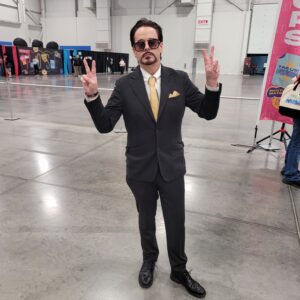
Picardo’s looking forward to attending MC3 for the first time since 2007. Other notable attendees include Jeremy Renner (the “Avengers” movies), Famke Janssen (the “X-Men” movies), Martin Sheen (“The West Wing”), Anson Mount (“Star Trek: Strange New Worlds”), Jacob Bertrand (“Cobra Kai”), Malin Akerman (“Watchmen”), among others.
Grosse Pointe native Charlie Carden, cofounder/host of the Secret Friends Unite! podcast is attending with his wife April. A lifelong “Trekkie,” he’s looking forward to meeting the “Trek” actors and hosting “Trek” trivia on Sunday, May 18.
“This is one of the most impressive line-ups of celebrities and comic book creators I’ve ever seen in Michigan,” said Charlie, of Grand Rapids.
For Picardo, the best part of cons is the “unqualified love” he gets from fans.
“It’s always a pleasure to meet (‘Trek’) fans in particular, but I’d say all science-fiction fans are the most enthusiastic, loyal fans in the world,” he said. “I know (MC3’s) a wonderful convention. The fans are very enthusiastic. What’s going to make it special for me this time is a long-time friend of mine and colleague on the Board (of Directors) of the Planetary Society, Bill Nye the Science Guy will be there on Sunday. Although he and I have done many events for our beloved Planetary Society and performed together at other venues, we’ve never done a convention together, so that’ll be fun.”
For questions or more information about MC3, visit https://motorcitycomiccon.com/.


