The average social media user spends a full day a week on social media. Since the pandemic, awareness of our collective screen time has weighed on culture.
Investing in physical media is a popular tool to combat passive technology use; DVDs shielding from rising streaming costs and cameras not attached to smartphones can contribute to a more present mindset.
A major facet of physical media is intentional consumption: the deliberate use of entertainment instead of passively absorbing it. Vinyl sales have benefited greatly from being phone-free entertainment: sifting through boxes of records with a wish-list is a fun way to intentionally craft a music library.
This collective reversion to physical media isn’t coming out of nowhere; many attributes attract modern listeners.
Pandemic
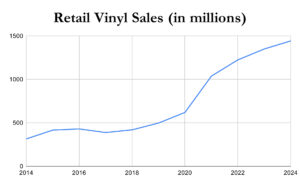
Lockdowns during the pandemic brought out new and nostalgic hobbies in people. Vinyl sales increased about 9% year-over-year on average for 10 years before 2020, when they rose by 40%.
Matt Bradish, owner of Underground Sounds, a longstanding Ann Arbor record shop, said 2020 was insane.
“Our sales jumped by 50%. In 2020 or 2021, we ran out of dollar records and classical records. People were just buying anything,” Bradish noticed.
Collectability
Post-lockdown saw an explosion of popularity for new and rereleased vinyls.
Fleetwood Mac’s 1977 album “Rumors” is one of the best-selling vinyl albums ever. In August 2021, a Target-exclusive gold vinyl was released, cementing its fame in culture 48 years after its initial release. A TikTok trend created in 2020 propelled “Dream” from the album to a new generation of vinyl collectors.
Tyler, the Creator’s 2022 vinyl release, “Call Me If You Get Lost,” became the most sold rap vinyl since Luminate—the data company powering Billboard’s top 500—began tracking sales in 1991. It dropped a year after the album’s release due to limited manufacturing capacity. That didn’t stop the album from returning to No.1 on Billboard’s top 200.
Accessibility and aesthetic
As with any technology gaining popularity, cheap versions promising the same result have risen. Access to vinyl technology has been key to its boom; record players and vinyls are sold in person and online across major platforms.
RELATED: A Guide to Ypsilanti: Where to Eat, Sip, Shop, and Play
“Some of your big box stores, Target and Urban Outfitters, sells them. They’re record players with built-in speakers on them, which is a completely bad idea,” Bradish explained.
A bad idea because record players translate sound from microscopic vibrations, and speakers vibrate to project sound. This causes dissonant skipping sounds. The acrylic needle also weighs more than the standard diamond needle, breaking the spiral tracking needed to spin vinyl without skipping.
The average consumer doesn’t know the drawbacks to this seemingly convenient and cheap technology. Bradish explained that many of his record returns are due to this, highlighting the demographic of new, inexperienced vinyl listeners.
Digital burnout
Consumers are growing tired of subscription services: rising prices, changing content and the financial fatigue of multiple monthly services to pay. Streaming offers rental while vinyl offers ownership, a one-time purchase that lasts a lifetime with proper care.
Digital burnout is the product of our hyperconnected and compulsive relationship with our portable technology. This relationship leads to 3 major effects: negativity, exhaustion and a lowered efficacy. Vinyl entertains us unattached to our phones and laptops, an act that people are now seeking.
Artist support
Streaming platforms like Spotify and iTunes infamously underpay artists. In 2018, Singer Peter Frampton tweeted that he received $1,700 for 55 million streams.
Meanwhile, Bradish said artists receive more revenue per sale from record sales than from streams. He remarked, “I’m told by one of my distributors, Redeye [Worldwide Distribution]… that each record I sell is worth 15,000 streams. So if you were to sell a thousand records? That’s like 15 million streams. And that’s still not a whole lot of money.”
Artists are leaving streaming services, citing low royalty payouts, but many have returned in some capacity to make their music accessible to fans.
Bradish’s vinyl recommendations
- “Folkminers” (1987) by The Folkminers
- “Whenever You’re Ready” (2003) by Swell
- “Crazy Price” (2005) by Messer Chups
- “Unavailable” (1998) by The Charm Pops
- “Mandatory Equipment” (2021) by Dummy