

Ann Arbor Film Festival Executive Director Leslie Raymond said that the really remarkable thing about the 2026 season is not the number of Artificial Intelligence-created films that have been submitted—the number of these submissions remains unchanged from last year— but rather, the overall quality of the films experimenting with AI. There are a lot of mixed feelings about the rise of AI, but to an experimental filmmaker, any sort of new tool or new medium generally produces a neutral effect that is not necessarily positive or negative, but rather an instinct to run with the technology and see how many ways you can use the new technology to produce something genuinely new.
Raymond clarified that what she means is an increase in quality from the AI films “in terms of the artists’ exploration of it as a medium, as well as their critique and surfacing different complicated issues around it.”
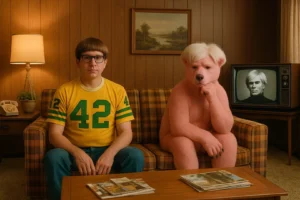
These AI films are a drop in the bucket from the sheer number of films that were submitted. But the filmmakers who are using them are adhering to the core of the AAFF spirit—filmmakers like John Weise, who made the AI generated film “42.” In this film, he combined a current photograph of himself with an elementary school photo, along with David Bowie and Open AI to produce something that he calls “absurd and fabulous”.
“There’s immediacy to what you can generate; which is true if you’re using a film or digital camera. But it’s that combined with just making up the environment. It’s not necessarily easy, but you can do it and dramatically reduce the overhead,’ Weise said. “It’s not for everyone. If you’re into stop motion, you’re not going to want to use AI, at least not in the traditional sense.”
Not everyone is a fan of AI in film of course. Recent Hollywood strikes included an ultimately successful fight to get anti-AI clauses into actors’ contracts. Ann Arbor-based film maker Jen Proctor said that she doesn’t even like using AI and her film is an AI film. Her film is called, “AI Movie.”
“My film is very much a critique of AI. I’m struggling to see too many of the advantages, honestly…. There was a film in 1958 by Bruce Connor called “A Movie,” which is a found-footage film in which he edited together a number of clips from old newsreels and novelty films, to create a new movie. And around 2010 I remade his movie, essentially shot for shot, using YouTube and Live leak videos, and so once AI took off, I decided I needed to remake it again using regenerative AI—using his original film as a template for exploring the contemporary media landscapes that we find ourselves in,” Proctor said. “The result is kind of soulless and disturbing, and not actually all that enjoyable to watch. I’m still in a position where I’m struggling to see the advantages of AI when so much of this work could be created without AI and still communicate the same meanings that we’re after.”
That being said, Proctor said that AI can be useful “in certain contexts.” The nature of the film makes Proctor feel like she’s the “curator” of the film, but it isn’t really hers. She has been in the festival before, but said that being one of the films shown on opening night was both “thrilling and a little bit nerve wracking.”
Out Night makes a quarter of a century
LGBTQ+ films are also a massive AAFF highlight this year as 2026 marks the twenty-fifth anniversary of Out Night, a series of films focusing on queer stories and storytellers.
The twenty-fifth Out Night anniversary will also feature LGBTQ+ films. Abigail Knox curated this year’s program of five “historic AAFF award-winning films from past Out Night programs, creating an expansive portrait of queer voices across generations and reflecting the shifting cultural and political landscapes shaping LGBTQ+ lives,” according to the AAFF website.
There will also be nine competing contemporary short films, according to Raymond, whose screening will start in the main theater of the Michigan at 9:30 p.m. on March 26. This year’s contemporary LGBTQ+ entries were curated by Sean Donovan.
“Highlights include Tushar Gidwani’s 16mm fever dream of diaspora and longing, Mar Sudac’s darkly comic meditation on sexuality in a binary world, and Lara Delmage’s intimate, feral portrait of human and animal impulses. The program also features works reflecting on aging, memory and resilience, offering a compelling view of contemporary LGBTQ+ experience,” a press release from the AAFF explains. “This expanded programming underscores AAFF’s ongoing commitment to queer experimental cinema—honoring its history, elevating contemporary voices, and supporting future generations of filmmakers—while recognizing LGBTQ+ film as a vital lens on the social and political currents shaping our shared future.”
One of this year’s films in competition is “Barbara Forever,” an American bio piece directed by Brydie O’Connor that in the words of the AAFF, documents a “pioneering lesbian experimental filmmaker Barbara Hammer, Barbara Forever traces Hammer’s life, work, and enduring legacy through her prolific canon and never-before-seen documentation of her body and personal life.”
Another queer feature film is “Adam’s Apple,” directed by Amy Jenkins in collaboration with her son Adam, who is transgender. In this piece, mother and son document the journey that Adam took — the AAFF bills the film as a “deeply personal meditation on identity, growth, and love” as Adam transitioned to becoming the man he is today.
AAFF 2026, in context
The festival will kick off at the Michigan Theater starting at 6:30pm on the evening of March 24 and will run until March 29. The festival will continue online for two weeks with two awards programs available to watch from March 30-April 13.
“We had just four shy of 2,800 submissions this year,” AAFF Deputy Director Vicki Joling said. “The math usually ends up being four percent of the submissions end up getting accepted into the film festival.”
Only 97 films made the cut—11 features and 86 shorts from 30 countries, including 18 world premieres, according to Raymond.
It is always a wonderfully crowded and dynamic event—old friends and promising new talent getting to know each other in and around the grand staircase of the Michigan Theater —a truly international and cosmopolitan expression of creativity, diverse voices being given an equal spotlight and a rich tapestry of interests and perspectives. Business connections between filmmakers are made just as often as friendships are.
The food that will be provided for free reflects that too. This year the AAFF will have food from Blue Llama, Café Zola, Jerusalem Garden, Miss Kim, Red Rock Barbeque, Side Biscuit, Slurping Turtle and TeaHaus. Drinks will come from hear.say, Mothfire Brewing Company and Tito’s Handmade Vodka. They will be arranged buffet-style across both levels of the Michigan Theater’s grand staircase.
RELATED: From Punk to the Smithsonian: The Enduring Magic of “Skate Witches”
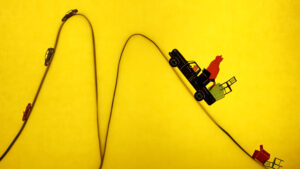
“It’s a great honor,” Heidi Kumao, the University of Michigan professor in the STAMPS school, and is following her 2015 appearance with the 6 minute and 45 second film “35 Days,” said. Among her experimental film making colleagues “we’ve all been rejected by the film festival at this point, so it’s a huge honor to be part of it.”
This time she is bringing a stop footage animation short film based on a real incident, when her cat went missing during the Covid lockdown. “The opening night is just super fun. It’s a party that’s different each year. But generally, they try to make opening night accessible, and they try to give you a taste of the different kinds of films you might see during the week. It’s curated to appeal to the general population, which might not be super familiar with experimental film.”
Nobody can see all of the films in person at once, as film series are shown at the same time between the Michigan and State Theaters, as well as at various U of M buildings. But you can still theoretically watch every film if you want to, as the films will remain viewable online from March 30 until April 13.
Marquee Arts CEO Molly Rowan said via email, “We’re excited to welcome the Ann Arbor Film Festival back to the Michigan Theater. AAFF is a longtime partner and an essential part of what we do. We’re looking forward to another year of mind-bending shorts blocks, conversational debates and celebrating experimental film in the heart of our community.”
Then there is the reality of where the United States is at the moment. The Trump Administration’s use of ICE and other DHS forces on people for their racial appearance—the Supreme Court effectively legalized the use of racial profiling to allow law enforcement to arrest anyone they presume might be an undocumented person last year—and the administration’s hostility on the world stage, has changed the perception of so many about what the US is and whether or not it is safe to travel here.
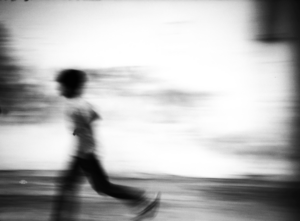
The Chilean film maker Sebastian Vaccarias will not be attending the screening of his 8:51 experimental 16mm film “Seagull Dog Child.” He said, “I understand the AAFF has a great history challenging the status quo of moving image, and that’s something very exciting. The what else, the new, the something that don’t fit, and everything in between. The commodification of things has turned mass cinema into something of the likes of fast food, and so it is refreshing to see that the other side still exists, and has a place,” Vaccarias said.
Of his decision to not come to Ann Arbor, Vaccaris said, “The US are going through a very very dark period, and it saddens me to see what perfectly law abiding and peaceful citizens are going through, as so as minorities and the marginalized. My decision of not going is as much of an act of personal safety as it is an act of solidarity with the oppressed: Hispanic, Latino, African American, LGBTQ, climate activists and more—power to you and keep the fight for your civil and human rights—the end of fascism shall come.”
Some filmmakers cannot make it for financial reasons, and some can’t make it into the US for domestic situations. The AAFF will be able to welcome Saeed Mohammadi when his 28 minute long “The Shape of the Eye and the Arch of the Ear” comes to the screen during the Animated Films In Competition show, at 9:30 p.m. on Friday night. He is stuck in Iran due to the political and economic situation there, but would’ve loved to attend if he could.
“The film combines archival footage from the history of cinema with Iranian miniature painting, creating a layered visual language. It moves between experimental, archival and narrative forms, with elements of magical realism. The story revolves around a fictional magical book that belongs to a world of occult knowledge from a thousand years ago. In the book, a city is described where a giant demonic eye appears in the sky, bringing poverty, oppression, and violence upon its people. The citizens attempt to destroy the eye, but to do so they must pass through a mysterious and deadly labyrinth filled with uncertainty and sacrifice,” Mohammadi said.
He calls the film’s style “experimental narrative animation” and said that this will only be the second time it has ever been screened.
Of the AAFF, Mohammadi said getting a film screened “is certainly very important to me in my artistic path. Ann Arbor is one of the most respected festivals in the field of experimental cinema, the space in which I work. The more I learned about the festival’s history, the more meaningful it became to me, so having my film accepted there is a real honor. It is a festival that has presented early and significant works by filmmakers such as Agnès Varda, Kenneth Anger and Andy Warhol. Being selected by Ann Arbor has genuinely made me feel more hopeful about my artistic future in cinema.”
The AAFF is also doing its guest host program again. This is a program where if you live in the area and are willing to host a filmmaker in your home to cut down on their travel costs, you can get a free pass to the festival. There were five spaces left available as of February 26.
This can be a great deal as this year’s in person festival pass is $185 per person. The combo pass—which lets you take in the online awards as well as everything else included in the cheaper pass—is $200. A full list of prices and discounts for seniors and students, can be found online. This is a big deal for some filmmakers as many are attempting to break into the industry with limited finances. You can sign up for this on their website or by contacting guests@aafilmfest.org.
The Ukrainian film maker Nelly Shylova was denied a visa by the Trump Administration. Now resident in Dublin, Ireland, her film is a short documentary about what it was like to flee the unprovoked full invasion of her country by the regime of the dictator Vladimir Putin and immigrating into Irish society.
“It is funny that this movie is allowed to enter [the] USA but my body is not. That’s kind of ironic, I think,” Shylova said.
Shylova has been part of the struggle for independence and full democracy in Ukraine ever since the Magdan protests in 2014, which brought down a previous Ukrainian president aligned with Putin’s regime. She considers herself lucky to be safe in Ireland now, and noted that she has made several trips back to Kyiv since having to leave. Her boyfriend, Shylova said, was more concerned for her safety when she was trying to come to the United States, than he was when she was making trips back to her home in an actual war zone.
Ukraine has not been forgotten by the AAFF
The AAFF makes an effort to make sure that the real world gets in, both by engaging with the Washtenaw County community and including art that touches on the most important stories of our time, which explains the inclusion of “Is The War This Close?”
This is a VR reality set that will be in the lobby of the Michigan Theater directed by Joseph Andrew Sywenkyj, which brings the reality of what it is like to be a civilian caught in the middle of the war launched by the Russian dictator Vladimir Putin against the democratic government in neighboring Ukraine.
What this will actually mean for the festival, according to an AAFF statement, “Is The War This Close?” will give you the chance to enter “A room-scale 360° virtual reality documentary that places viewers inside a Kyiv home during a large Russian drone and missile attack. Using gaming technology and spatial audio, the work allows free movement within the scene, offering a visceral, firsthand perspective on the war’s impact on civilian life. Sywenkyj is an Ann Arbor–based filmmaker and journalist and currently serves as the Howard R. Marsh Visiting Professor of Journalism at the University of Michigan.”
The main venue of the Michigan Theater will also be hosting a series of Ukrainian films starting at 3:30 p.m. on March 28. A press release from the AAFF describes these short films as “Ukrainian Films foregrounds voices shaped by war, displacement, memory and survival. Spanning poetic film essays, animation, documentary and experimental fiction, these works explore exile as a lived condition, the fragility of home, intergenerational bonds, ecological aftermaths of industry, and the psychological traces of loss. Together, the films form a constellation of perspectives that insist on presence, complexity, and continued creative life in the face of rupture.”
It’s not just about screentime
The AAFF always has more to do than sit in a theater. Proctor will present “I’ve Created a Monster: Generative AI, Found Footage Filmmaking, and the Archive Effect” at Third Minds Books, an independent book store at 118 East Washington Street. This presentation by Proctor starts at 10:30 a.m. on March 26.
“Third Mind Books is simply delighted to be part of the Ann Arbor Film Festival and view our involvement with the festival as an extension of our commitment to building culture and community in the great city of Ann Arbor,” Joe Provenzano, the vice-president of Third Mind Books, said. “Jennifer Proctor’s film excites us because of its relation to the original Beat Generation and San Francisco Renaissance. Bruce Conner, the experimental filmmaker whose 1958 collage classic, “A Movie,” Proctor reproduced, was present at the dawn of the San Francisco Renaissance, which remains a focus for Third Mind Books as booksellers and scholars. We’re looking forward to seeing Proctor’s film and are excited by its connection to a key avant-garde of the 20th century.”
The next off-screen event requires tickets. “Devotional Signals” is what the AAFF describes as a “live cinema performance by Eric Souther” which will start in the Michigan Theater’s main auditorium at 7:30 p.m. on March 27.
If you are more into workshops than presentations then The Joy OF LOOPing is for you. This is an interactive workshop in that will be led by the Pickle Fort Film Collective in the foyer of the Michigan Theater from 11 a.m. to 1:30 p.m. on March 30.
As you can probably imagine, the AAFF gets a lot of fantastic experimental submissions every year, but they also get a lot of random stuff that can only be described as “weird.” That is why one of the most beloved recurring events that they do is: What The Was That? This is a panel discussion that streams the most odd submissions—not in a mocking way, but really in a you’ve-got-to-see-this way. This year it will be moderated by Daniel Herbert from 10:30 a.m. to 11:30 a.m, March 29, at the University of Michigan’s Modern Languages Building.
There will be after parties too on three of the days. Walk across the street from the Michigan after the opening reception and you’ll find the first one at Knight’s Steakhouse going from 9:30 p.m. to 11:30 p.m. on March 24 with jazz provided by the Jonathan Hammonds Trio.
There will also be a night out at Uplift from 10:30 p.m. to 1 a.m. on Thursday. Uplift is Ann Arbor’s centerpiece queer bar on the other side of downtown. They are located at 210 South First Street.
The last night out will be at the Rabbit Hole. This is a cocktail bar at right next to where Uplift. They will welcome AAFF attendees from 10:30 p.m. to 1 a.m.

Drew Saunders is a freelance business and environmental journalist who grew up just outside of Ann Arbor. He covers local business developments, embraces his foodie side with reviews restaurants, obsesses over Michigan's environmental state, loves movies, and feels spoiled by the music he gets to review for Ann Arbor!

