
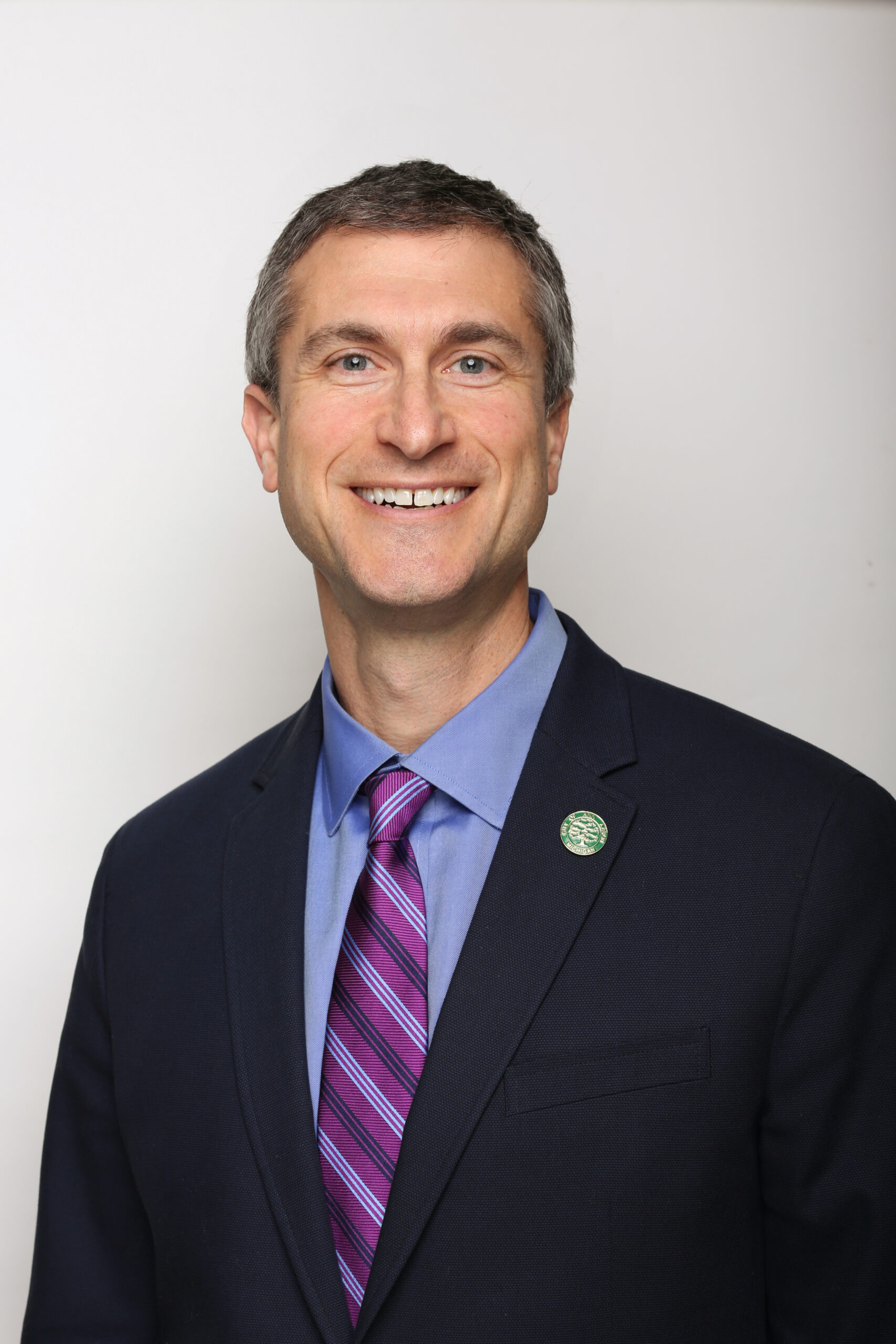
For the 10th consecutive year, Ann Arbor has earned a perfect score on the Human Rights Campaign’s Municipal Equality Index, a national assessment that evaluates how inclusive cities are for LGBTQ+ residents and employees. The distinction places Ann Arbor among a small group of U.S. cities that have demonstrated sustained commitment to equity across laws, services and civic leadership.
Launched in 2012, the Municipal Equality Index examines nondiscrimination protections, employment policies, municipal services, police practices and leadership on LGBTQ+ equality. Ann Arbor has received full marks every year since 2016, building on a much longer history of LGBTQ+ advocacy and policy leadership at the local level.
Inclusion as a core city value
Mayor Christopher Taylor attributes the city’s decade-long streak to intentional, ongoing work rather than symbolic gestures.
“We’ve been focused on the needs of our community members, our employees, our residents, and making sure that we keep up with legal and policy changes,” Taylor said. “Inclusion is indeed a core city value, and we’re looking to make sure that it’s part of everything we do at each of our different unit levels.”
RELATED: Prideful: LGBTQ+ Owned Businesses in Ann Arbor
Rather than treating inclusion as a standalone initiative, Taylor emphasized that it is embedded across city operations and expectations.
Progress — and the need to keep listening
Although Ann Arbor continues to score above the threshold for a perfect rating, Taylor stressed that the city does not view the achievement as an endpoint.
“We’re always looking to do better,” he said. “We know that we as a community and culture have a lot to do to improve treatment for historically marginalized groups, and we’re working hard to accomplish that.”
Listening, he noted, remains central to that work.
Making inclusion felt beyond policy
Taylor said city leaders focus on ensuring that inclusion is experienced in daily interactions, not just written into ordinances.
“We make sure that we, as a municipal organization, reflect and create a culture where people are safe and welcome to be themselves in their everyday interactions with the city,” he said. “We do that by making sure that that’s how our employees feel.”
He described the approach as a “virtuous circle” in which internal culture shapes public service.
Responding to a changing national climate
As LGBTQ+ rights face increased scrutiny and rollback efforts at the federal level, Ann Arbor remains attentive to potential gaps.
“We continue to be on the lookout for areas where we do need to improve,” Taylor said. “We want to make sure, particularly because there are changes at the federal level where gaps are potentially being created, that we have an opportunity to fill them.”
Locally, he said, the city stays focused on protecting residents using the authority it has.
“We stay focused on our community and the people who live here and work here,” Taylor said. “We speak out clearly about these crucial values of inclusion, even when the national conversation differs.”
A legacy that’s a starting point, not a finish line
Ann Arbor banned LGBTQ+ discrimination in housing, employment and public accommodations in 1972 and gained national attention with the election of Kathy Kozachenko in 1974, the first openly gay person elected to public office in the United States.
“That history is a starting point,” Taylor said. “It’s not a finish line.”
He added that the city must continue to evolve to meet current needs and expectations.
Leadership and accountability
Taylor described the mayor’s office as responsible for setting clear expectations citywide.
“Inclusion is a non-negotiable value and practice of city government,” he said. “We use the visibility of the office to affirm LGBTQ+ residents and staff, and we support departments with the resources they need to get the work done.”
Listening to the community
Feedback from LGBTQ+ residents and organizations remains central to Ann Arbor’s approach.
“We listen with humility,” Taylor said. “We engage through public meetings, advisory groups, email surveys and strong, open relationships with local LGBTQ+ leaders and organizations.”
What success really looks like
Beyond perfect scores and national recognition, Taylor said success is measured in everyday lived experience.
“Success means that our LGBTQ+ residents are and feel safe and respected, seen and uplifted in their daily lives,” he said. “It means government earns trust through actions, not merely statements.”
As Ann Arbor marks its 10th consecutive year of perfect scores, city leaders emphasize that the work of inclusion remains ongoing—rooted in history, shaped by listening, and measured by trust.

Donna Marie Iadipaolo is a writer, journalist, and State of Michigan certified teacher, since 1990. She has written for national publications like The Village Voice, Ear Magazine of New Music, Insurance & Technology, and TheStreet.
She is now writing locally for many publications, including Current Magazine, Ann Arbor Family, and the Ann Arbor Independent. Her undergraduate degree is from the University of Michigan, Ann Arbor, where she graduated with an honors bachelor’s degree and three teacher certificate majors: mathematics, social sciences, English. She also earned three graduate degrees in Master of Science, Master of Arts, and Education Specialist Degree.

