
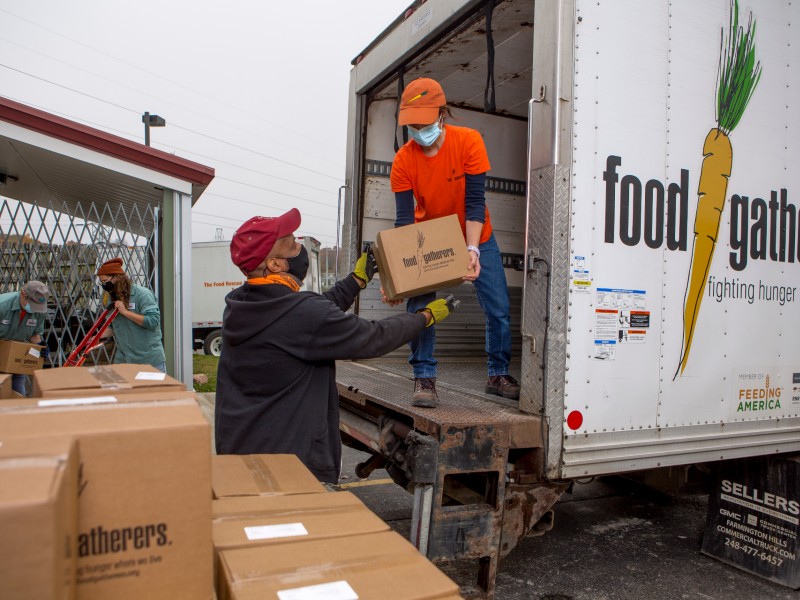
One hundred thousand meals. That is the number of meals that the Rotary Club of Ann Arbor and Food Gatherers estimate that they will need to raise between March 9 to March 20 to meet the need in Washtenaw County, with a special focus on feeding vulnerable families with children.
“Efforts like Rotary Fights Child Hunger are crucial right now,” Food Gatherers President and CEO Eileen Spring said in a press release. “Food Gatherers is purchasing twice the amount of food that we were last year to offset federal cuts and meet the heightened need for food in our community.”
One in seven people are facing regular hunger in Washtenaw County right now, according to Food Gatherers. This has a profound and lasting impact on the children growing up in those circumstances which the Rotary Club and Food Gatherers are dedicated to reverse.
“Just knowing that there is access to the food that you need is available eliminates the insecurity piece, which is incredibly stressful. As soon as a person or family can get connected to our 140 partners that we’re distributing the food to through the community, eliminates a huge amount of stress, and helps them plan for their family,” Charlotte Csicsila, Food Gatherers Chief Development Officer, said. “A single meal makes a difference in a moment, in an hour, from being completely distracted to being able to attend to everything in life that is required.”
Local poverty and recent tariff policies
The City of Ann Arbor might be one of the wealthier communities in Michigan, but it is still a town with a 23.8% poverty rate according to the Census. Washtenaw County as a whole has a 13.8% poverty rate, while Ypsilanti has a 24.8% poverty rate, Ypsilanti Township has a 14.8% poverty rate and Pittsfield Township has a 7.2% poverty rate.
On top of that, food prices have spiked as ever shifting tariff policies have impacted the traditionally export-dependent American agricultural sector. President Trump claimed that International Emergency Economic Power’s Act (IEEPA), a 1970s law on tariffs, gave him the power to unilaterally impose tariffs. Though cheap foreign food imports have become harder to get this year, it has also meant that the 68.7 million metric tons of soybeans, $13,695,939,999 worth of corn, $201,224,200 worth of wheat products, $9,082,782 worth of beef and veal and 3.3 million metric tons of pork that the American agricultural sector exported in 2024 suddenly found itself stuck, and often rotting, in barns and silos across the country as foreign countries retaliated with tariffs equal to the ones that the Trump Administration imposed.
What happens to one part of the agricultural industry effects every other part, including domestic prices for food, a part of the economy so sensitive that the failure to control food prices doomed both Biden and Harris’ 2024 campaigns. The Trump Administration’s use of IEEPA may have been recently declared unconstitutional by a bipartisan, 6-3 decision at the Supreme Court, but the repercussions will still reverberate throughout the American economy with years of higher prices.
The Constitution of the United States provides the power to impose taxes—like a tariff—to Congress, and not to the president. A tariff is a tax from the federal government imposed on companies that import products from overseas, and it is always paid by the domestic company, which nearly always passes the expense on to the consumer. Foreign companies and countries do not pay a single penny of a tariff, and never have. Trump has vowed to use other laws to achieve his tariff ideology. The Yale Budget Lab finds that the overall effect of tariffs on American family expenses has been “a loss of about $800 for the average household and $400 for households at the bottom of the income distribution.”
The net result has been a massive increase in ALICE Households and temporary assistance, rather than systemic assistance. An ALICE Household is a household that is technically chugging along with a home and employment, but are actually in an extremely brittle financial situation. They are technically above the poverty line, and have no or less access to social services, but are in fact struggling to make ends meet and wholly unable to make any sort of savings or make any meaningful plan to get out of this trap. This makes them especially vulnerable to sudden bills like car repair, or having to replace a broken heating system. Having food available for free to get you over a sudden crisis like that can be the difference between being actually able to work your way out of ALICE status or poverty, or being stuck in a cycle of misery.
“About 50 percent of the families and households that we serve use food assistance one to three times a year; so its’ really just in an emergency, to help them get through a particular moment and get back on their feet. The meal that is provided gives them the ability to do that,” Csicsila told Current. There is chronic need for charity and food assistance, as we have said. But according to Csicsila “About 20 percent the households we are serving are using a pantry more than once a month. That’s that chronic level of need associated with underemployment, unemployment, or sometimes working two jobs and still not making enough to be able to afford the cost of living here.”
RELATED: Help 107.1 and Food Gatherers Raise a Million Meals for “Rockin’ for the Hungry”
How to help
Thanks to donations from Todd and Margaret Kephart, any donation of $25 or more will be matched by them, doubling the money donated to Food Gatherers, and their 140 affiliated food banks and soup kitchens. The match has a cap of $15,000.
You can donate online, or by mailing a check payable to Food Gatherers to their headquarters at 1 Carrot Way, Ann Abror, Michigan. Food Gatherers asked in the same press release for people to mark “Rotary” in the memo line to have your donation be marked as part of this program.
Food Gatherers always accepts non-perishable food donations too. They are asking most often for filling and long-lasting things like soup, chili, flour, oils and anything with whole grains. They have also asked for things like baby formula and other necessities to keep things going, and condiments. The latter can be taken for granted, but Csicsila said that the little boost in flavor can have a major psychological effect for someone battling bills, cold, debt, and fatigue.
Food Gatherers asks that no food donations come in glass containers. They regularly update their list of most-needed-items online.
No one in Washtenaw County needs to ever go hungry. You can contact Food Gatherers at info@foodgatherers.org or at 734.761.2796 directly or find help through their list of affiliated programs or their interactive map.

Drew Saunders is a freelance business and environmental journalist who grew up just outside of Ann Arbor. He covers local business developments, embraces his foodie side with reviews restaurants, obsesses over Michigan's environmental state, loves movies, and feels spoiled by the music he gets to review for Ann Arbor!

